What Is a Real Estate Payment Gateway?

A real estate payment gateway is the secure technology layer that authorizes, processes, and routes online payments within real estate transactions, connecting buyers, tenants, agents, and brokers to their respective financial institutions. Unlike a generic e-commerce gateway, this infrastructure handles funds that carry legal weight: earnest money deposits, commission disbursements, referral fees, and rental payments. Getting any of these wrong creates regulatory exposure, not just operational friction. For brokers and property managers, understanding how a real estate payment gateway works is the first step toward building a payment process that is both efficient and defensible.
What is a real estate payment gateway and how does it work?
A real estate payment gateway is defined as infrastructure that securely captures, encrypts, and transmits payment data between a payer, a merchant, and their respective banks before depositing funds into designated accounts. The gateway sits between the person sending money and the account receiving it, acting as a secure intermediary that validates the transaction at every step.
The transaction flow follows five distinct stages:
- Payment data capture. The buyer, tenant, or agent enters card or bank account details into a payment form. The gateway immediately encrypts this data using TLS protocols before it travels anywhere.
- Authorization request. The gateway forwards the encrypted data to the payment processor, which contacts the issuing bank to confirm available funds and account validity.
- Authentication. The issuing bank approves or declines the transaction and sends a response code back through the processor to the gateway.
- Clearing. Approved transactions move into the clearing stage, where the financial details are confirmed between the acquiring bank and the issuing bank.
- Settlement. Funds transfer from the payer’s bank to the destination account, which in real estate may be a trust account, an operating account, or an agent’s account depending on the payment type.
Gateways operating in real estate must comply with PCI DSS standards, which govern how cardholder data is stored, processed, and transmitted. A gateway that acts as a secure intermediary also uses tokenization to replace sensitive card numbers with unique identifiers, so the brokerage never directly handles raw payment credentials.
Pro Tip: If your brokerage uses an API-connected gateway, you can automate the routing of commission splits at the settlement stage, so funds reach each agent’s account without manual calculation after every closing.

Why real estate transactions need specialized gateways
Generic payment processors like Square or basic ACH providers handle money movement, but they do not understand the legal architecture of a real estate transaction. Real estate requires a different layer of logic entirely.
The core reasons specialized gateways are necessary include:
- Trust account segregation. State law in every U.S. jurisdiction requires that earnest money and client funds be held in accounts separate from the brokerage’s operating funds. A generic processor has no mechanism to enforce this separation automatically.
- Statutory timing rules for earnest money. Earnest money deposits are commonly 1 to 3 percent of the purchase price and must be deposited within 24 to 72 hours depending on state law. Minnesota requires deposit within three business days; Oregon requires immediate deposit per the agreement terms. Missing these windows creates broker liability.
- Commission disbursement complexity. A single closing may trigger payouts to a listing agent, a buyer’s agent, a referral partner, and a franchise. Each payout may carry a different split percentage, a cap adjustment, or a royalty deduction. Commission calculation engines integrated with the payment system handle these splits, overrides, and fees per contract terms automatically.
- Anti-money laundering (AML) compliance. Real estate is a documented target for financial crime. Specialized gateways include transaction monitoring and reporting tools that flag suspicious patterns, which generic processors do not provide at the transaction level.
“Compliance responsibilities span from the user interface to backend trust accounting and fraud prevention, making specialized real estate payment infrastructure preferable to building in-house from scratch.” — GTCsys
The practical implication is direct: a brokerage that routes earnest money through Venmo or Zelle is not just taking a shortcut. It is creating federal liability under RESPA and state licensing law.
Hosted vs. integrated gateways: which fits your brokerage?
The two primary gateway architectures available to real estate professionals are hosted gateways and integrated gateways. Each carries distinct trade-offs in compliance burden, user experience, and technical overhead.
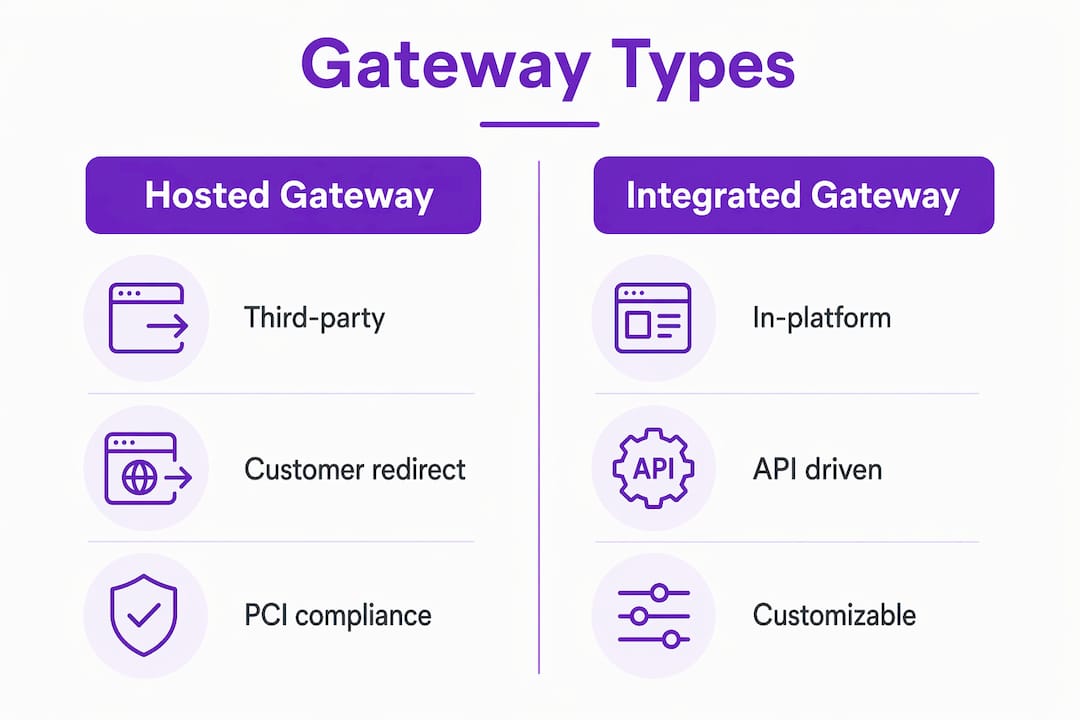
| Feature | Hosted gateway | Integrated gateway |
|---|---|---|
| Payment page location | Third-party site (offsite redirect) | Embedded within your platform |
| PCI DSS scope | Reduced for the brokerage | Higher, requires tighter controls |
| User experience | Redirect interrupts the flow | Fully seamless, no redirect |
| Customization | Limited to provider’s template | Full control via API |
| Best for | Smaller brokerages, lower volume | Larger platforms, high transaction volume |
Hosted gateways redirect customers to a third-party payment page, which means the gateway provider absorbs most of the PCI DSS compliance burden. Providers like PayPal and Stripe offer hosted options that work for basic rent collection or fee payments. The trade-off is that the payer leaves your platform to complete the transaction, which can reduce trust and completion rates.
Integrated gateways keep the entire payment experience within your platform using APIs. Dwolla, for example, offers ACH-focused API infrastructure that real estate platforms use to build custom payment flows for commission disbursements and recurring rent collection. The experience is cleaner, but your technical team must maintain the security controls that the hosted model offloads to the provider.
Pro Tip: For brokerages processing high volumes of commission payouts, an integrated gateway with a commission calculation API reduces reconciliation time significantly compared to manually matching payouts to closing statements.
Key features and benefits of real estate payment gateways
A purpose-built online payment system for real estate does more than move money. It replaces a chain of manual steps with automated, documented, and auditable processes.
The most operationally significant features include:
- Automated collection with real-time confirmation. Rent, application fees, and earnest money deposits trigger instant confirmation emails to both parties. Automated recordkeeping removes check and cash delays and eliminates manual reconciliation at month end.
- Recurring invoicing and multiple payment methods. Property managers can schedule recurring ACH debits for monthly rent. Tenants and buyers can pay via credit card, debit card, or bank transfer depending on what the platform supports.
- Instant and same-day commission disbursements. Modern real estate payment platforms integrate outbound payout rails including same-day ACH, Real Time Payments, and FedNow, accelerating agent commission settlements from days to hours.
- Automated split calculations. When a closing triggers a commission, the system calculates each agent’s share, applies cap adjustments, deducts referral fees, and initiates the correct payout to each party without manual input.
- Audit trails for compliance. Every transaction generates a timestamped record showing the payer, amount, destination account, and authorization status. This documentation is critical during state licensing audits and RESPA reviews.
- Fraud detection and AML monitoring. Specialized platforms flag transactions that match known fraud patterns, such as unusually large wire transfers or rapid sequential payments from a single source.
The aggregate benefit is a reduction in the three most common pain points for brokers: delayed agent payments, compliance gaps in trust accounting, and time spent on manual reconciliation. Real estate payment solutions that automate these functions free up broker time for client-facing work rather than back-office corrections.
Key takeaways
A real estate payment gateway is not optional infrastructure. It is the compliance and operational backbone of any brokerage processing earnest money, commissions, or recurring fees at scale.
| Point | Details |
|---|---|
| Core function | Gateways authorize, encrypt, and route real estate payments to correct destination accounts. |
| Compliance requirement | Trust account segregation and earnest money timing rules require specialized, not generic, payment infrastructure. |
| Gateway types | Hosted gateways reduce compliance burden; integrated gateways deliver better user experience via APIs. |
| Commission automation | Purpose-built platforms calculate splits, deductions, and referral fees automatically at settlement. |
| Speed of settlement | FedNow and Real Time Payments rails enable same-day or instant agent commission disbursements. |
Why brokers who skip specialized infrastructure always pay for it later
I have watched brokerages of every size try to patch together payment workflows using tools that were never designed for real estate. The pattern is always the same: Venmo for agent splits, a personal PayPal account for referral fees, and a spreadsheet to track who owes what after closing. It works until it doesn’t.
The moment a state licensing board audits the trust account, or an agent disputes a split, or a referral partner demands documentation of a payment, the informal system collapses. There is no audit trail. There is no timestamped confirmation. There is no proof that earnest money hit a segregated trust account within the statutory window. The brokerage is exposed, and the broker is personally liable.
What I find most underappreciated in this space is the reputational cost. Agents choose brokerages partly based on how reliably and quickly they get paid. A brokerage that consistently delivers same-day commission payouts through a documented, automated system retains agents more effectively than one that sends manual wires two days after closing. Payment infrastructure is a recruiting tool, not just a compliance checkbox.
The future of real estate payment processing is moving toward instant settlement as the default. FedNow and Real Time Payments are already live and being adopted by forward-thinking platforms. Brokerages that build on specialized infrastructure now will not need to retrofit their workflows when instant payouts become the industry expectation. Those still using informal workarounds will face both a compliance reckoning and a competitive disadvantage at the same time.
— Wes
Stop using workarounds and start processing payments the right way
If your brokerage is still splitting commissions manually or routing agent payments through personal apps, the liability is real and growing. Brokerpay is built specifically for real estate brokerages that need a compliant, documented, and automated commission payment platform.

Brokerpay tracks, documents, and processes agent splits, referral fees, and co-op commissions while keeping your brokerage RESPA-compliant. It eliminates the Venmo and Zelle workarounds that create federal exposure and replaces them with a purpose-built payment system that generates the audit trail your broker license depends on. If you are ready to move your commission payments onto infrastructure that was actually designed for real estate, Brokerpay is the place to start.
FAQ
What is a real estate payment gateway?
A real estate payment gateway is technology infrastructure that securely authorizes, encrypts, and processes online payments within real estate transactions, including earnest money, rent, fees, and agent commissions, before routing funds to designated accounts.
How is a real estate gateway different from a regular payment processor?
A real estate gateway includes trust account segregation logic, statutory timing enforcement for earnest money, and commission split calculation engines that generic processors like Square or basic ACH providers do not offer.
What payment methods do real estate gateways support?
Most real estate payment platforms support credit cards, debit cards, ACH bank transfers, and increasingly, modern payout rails like FedNow and Real Time Payments for same-day commission disbursements.
Are real estate payment gateways required to be PCI DSS compliant?
Yes. Any gateway processing card payments must comply with PCI DSS standards, which govern how cardholder data is captured, encrypted, transmitted, and stored throughout the transaction.
What is the risk of using Venmo or Zelle for commission payments?
Using Venmo or Zelle for commission disbursements creates federal liability under RESPA and violates state trust accounting requirements because these platforms provide no audit trail, no account segregation, and no compliance documentation.