Switch from Manual to Automated Payouts for Brokers

Switching from manual to automated payouts is the process of replacing spreadsheet-driven, hand-keyed commission payments with scheduled, rule-based systems that validate payee data, enforce compliance, and disburse funds without human intervention at each step. For real estate brokers managing agent splits, referral fees, and co-op commissions, this shift is not a luxury. It is the difference between a brokerage that scales and one that drowns in month-end reconciliation. Tools like Stripe for payment scheduling and Avalara for 1099 and W-9 tax compliance are the two most commonly integrated platforms when brokerages begin this transition. The core benefits are clear: fewer errors, faster disbursements, and a defensible audit trail that manual processes cannot produce.
What you need before you switch from manual to automated payouts
Preparation determines whether your transition takes two weeks or two quarters. Most brokerages that struggle with automation skipped the groundwork, not the technology.
Map your current payout workflow first. Before selecting any software, document every step in your existing commission payment process. Mapping current payout workflows identifies bottlenecks and enables selection of tools that integrate with your accounting or ERP system, reducing manual data entry and improving reconciliation. For a brokerage, this means tracing a commission from closed transaction to agent bank account, noting every approval, exception, and manual calculation along the way.

Clean your payee data before migration. Automated systems are only as accurate as the data fed into them. Every agent in your system needs a verified bank account number, routing number, and current tax identification. Tax compliance requires collecting and validating payee W-9 data before payouts begin. Avalara centralizes vendor tax data management and automates year-end 1099 reporting, which removes the last-minute scramble that plagues brokerages every January.
Choose software that connects to your accounting system. Your accounting platform should be the system of record. Commission automation should react to payment events downstream and never require manual re-exports or re-keying to maintain consistency. Look for payout tools that offer API integrations with QuickBooks, Xero, or your brokerage management software so that closed transactions trigger the payment workflow automatically.
Here is what to confirm before you flip the switch:
- All active agents have verified bank accounts on file
- W-9 forms are collected, validated, and stored digitally
- Your accounting system can export transaction data in a format the payout platform accepts
- Approval workflows for split disputes and exceptions are documented and assigned to specific roles
- A test environment or sandbox account is available for validating configurations before going live
Pro Tip: Run a parallel test for two to four weeks where you process commissions through both your manual system and the new automated platform. Compare outputs line by line before decommissioning the old process.
How to configure automated payout schedules for commission payments
Once your data is clean and your integrations are mapped, configuration is straightforward. The decisions you make here directly affect cash flow for your agents and compliance exposure for your brokerage.
Step-by-step schedule setup
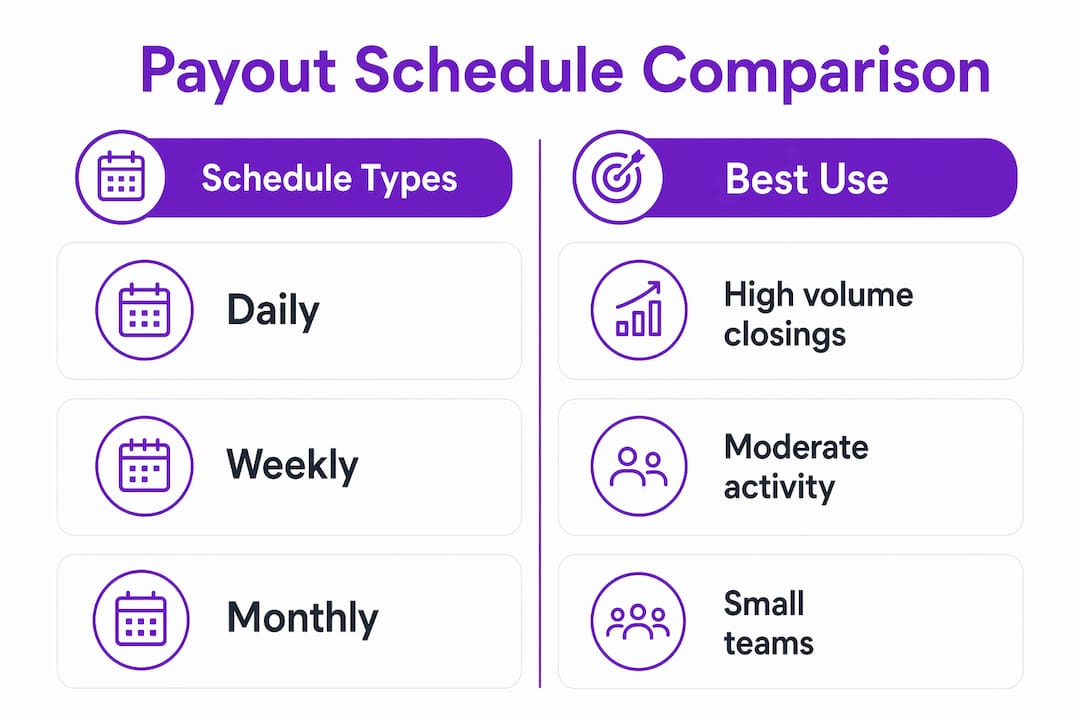
- Select your payout frequency. Stripe offers daily, weekly, or monthly automatic payout options. For real estate, weekly or bi-weekly schedules align best with closing cycles and agent expectations. Daily payouts work for high-volume teams; monthly payouts create cash flow friction for agents.
- Switch the payout mode from manual to automatic. In Stripe, this requires navigating to your payout settings and selecting an automatic schedule. Switching does not release pending funds immediately, so plan for a brief overlap period.
- Handle pending versus available funds. During the transition, some funds will be in a pending state and will not disburse automatically until they clear. A one-time manual or instant payout may be required to clear currently available commissions before the automated schedule takes over.
- Configure your payout bank account. Confirm the destination bank account is verified and matches the legal entity name on your brokerage license. Mismatches here trigger compliance flags and payment holds.
- Set approval gates for exceptions. Not every commission is clean. Build in a review step for split disputes, referral fee calculations, and co-op commissions before the automated trigger fires.
- Test with a small cohort. Run your first automated cycle with two or three agents before expanding to the full roster. Verify amounts, timing, and bank delivery before scaling.
Payout schedule comparison for real estate brokerages
| Schedule | Best for | Key consideration |
|---|---|---|
| Daily | High-volume teams with frequent closings | Requires real-time accounting sync |
| Weekly | Mid-size brokerages with regular closing cycles | Most common; balances cash flow and admin load |
| Monthly | Small brokerages with low transaction volume | Simplest to manage; agents may prefer faster options |
| Per-closing | Transaction-based commission structures | Requires event-triggered automation, not time-based |
Pro Tip: Treat the per-closing trigger as your long-term goal. When your accounting system fires a payment event the moment a transaction closes and funds clear, you eliminate the scheduling problem entirely. Brokerpay is built around this model.
What are the benefits and compliance advantages of automated payouts?
The operational case for automation is strong. The compliance case is stronger.
Automated payout systems reduce errors by validating payment data upfront, catching unsupported account types and incomplete information before a transfer is attempted. Rule-based validation reduces failed payments, and automated workflows speed transfers while maintaining compliance better than manual spreadsheets ever could. For a brokerage processing 50 or more closings per month, this validation layer alone eliminates hours of error correction.
Compliance improvements go beyond payment accuracy. End-to-end automation includes scheduled payout triggers, validation, and reconciliation features with audit-ready logs. Platforms provide real-time tracking, compliance checks, and transaction-level exportable reports. This matters enormously under RESPA, where brokerages must document that every fee paid was earned, disclosed, and properly split. A manual spreadsheet is not an audit trail. An automated system with timestamped, immutable records is.
The scalability benefit is underappreciated. A brokerage with 20 agents can manage manual payouts. A brokerage with 200 agents cannot. Automation removes the linear relationship between headcount and administrative labor, which means your operations team does not need to grow proportionally as you add agents or expand into new markets.
“Successful commission automation differs from mere spreadsheet elimination by including dispute approvals and audit trails for reconciliation efficiency.” This distinction separates platforms that process payments from platforms that protect brokerages.
Key compliance and operational benefits include:
- Integrated W-9 and 1099 data capture at the payee level, not at year-end
- Automated sanction screening before each disbursement
- Immutable transaction records that satisfy federal audit requirements
- Reduced re-keying errors from accounting system integration
- Faster agent payments that improve retention and satisfaction
What are common pitfalls when moving from manual to automated payments?
Most migration failures are predictable. Knowing them in advance cuts your risk significantly.
The pending funds gap. Most automated payout systems require funds to clear before auto-disbursement begins. During your cutover, you will likely have commissions sitting in a pending state that the new schedule will not touch until they clear. Plan a manual sweep of available balances on the day you activate automation so no agent payment falls through the gap.
Broken approval workflows. Brokerage commission splits, overrides, and dispute management require approval workflows and immutable records within automation to avoid month-end spreadsheet reconciliations. If you automate the payment trigger but leave the approval process in email threads or verbal agreements, you have not solved the problem. You have just moved it downstream.
Unverified bank integrations. A payout platform that is not confirmed live with your bank before go-live will delay your first automated cycle. Confirm micro-deposit verification is complete and API keys are active in production, not just in sandbox, before your first scheduled run.
Skipping the phased rollout. Activating automation for your entire agent roster on day one is the fastest way to generate complaints and distrust. Start with a pilot group of five to ten agents who understand the transition and can provide feedback. Expand only after two clean cycles.
Pro Tip: Assign a single point of contact inside your brokerage to own the automation migration. Distributed responsibility means no one catches the edge cases: the agent with two bank accounts, the referral fee paid to an out-of-state broker, or the co-op commission that requires a different split calculation.
Key takeaways
Automated commission payouts work because they replace error-prone manual steps with validated, scheduled, and auditable workflows that scale with your brokerage without adding administrative headcount.
| Point | Details |
|---|---|
| Map before you migrate | Document every step in your current payout process to identify exceptions before automation exposes them. |
| Clean payee data is non-negotiable | Collect and validate W-9 data for every agent before activating any automated payout schedule. |
| Handle pending funds at cutover | Clear available balances manually on migration day so no agent payment falls into a timing gap. |
| Build approval gates into automation | Dispute resolution and split overrides must have defined workflows inside the system, not outside it. |
| Treat your accounting system as the source of truth | Commission automation should react to payment events from your accounting platform, never require manual re-exports. |
Why brokers underestimate the governance problem
I have worked with brokerages that spent months selecting a payment platform and two days thinking about governance. That ratio is backwards. The technology for automating payouts is mature and accessible. The hard part is defining who approves what, when, and with what documentation before the system fires a payment.
The brokerages that get this right treat their accounting system as the authority. Every commission calculation flows from a closed transaction record, gets validated against the split agreement on file, routes through an approval step for anything outside standard parameters, and only then triggers a payment. The ones that struggle treat automation as a faster version of their spreadsheet, which means they automate the speed but not the accuracy.
The compliance dimension is where I see the most underestimation. RESPA violations do not come from bad intentions. They come from undocumented fee arrangements and payments that cannot be traced to a disclosed agreement. An automated system with proper audit logs does not just speed up your payouts. It creates the paper trail that protects your license.
My honest recommendation: before you evaluate any platform, spend a week documenting your current exception rate. How many commission payments per month require a manual correction, a dispute resolution, or a split recalculation? That number tells you exactly how much governance infrastructure your automation needs to include. If you skip that step, you will automate your exceptions right along with your standard payments, and the exceptions will be harder to catch.
— Wes
How Brokerpay handles commission automation for real estate brokerages
Real estate brokerages have compliance requirements that generic payment platforms were not designed to meet. Brokerpay is built specifically for this problem.
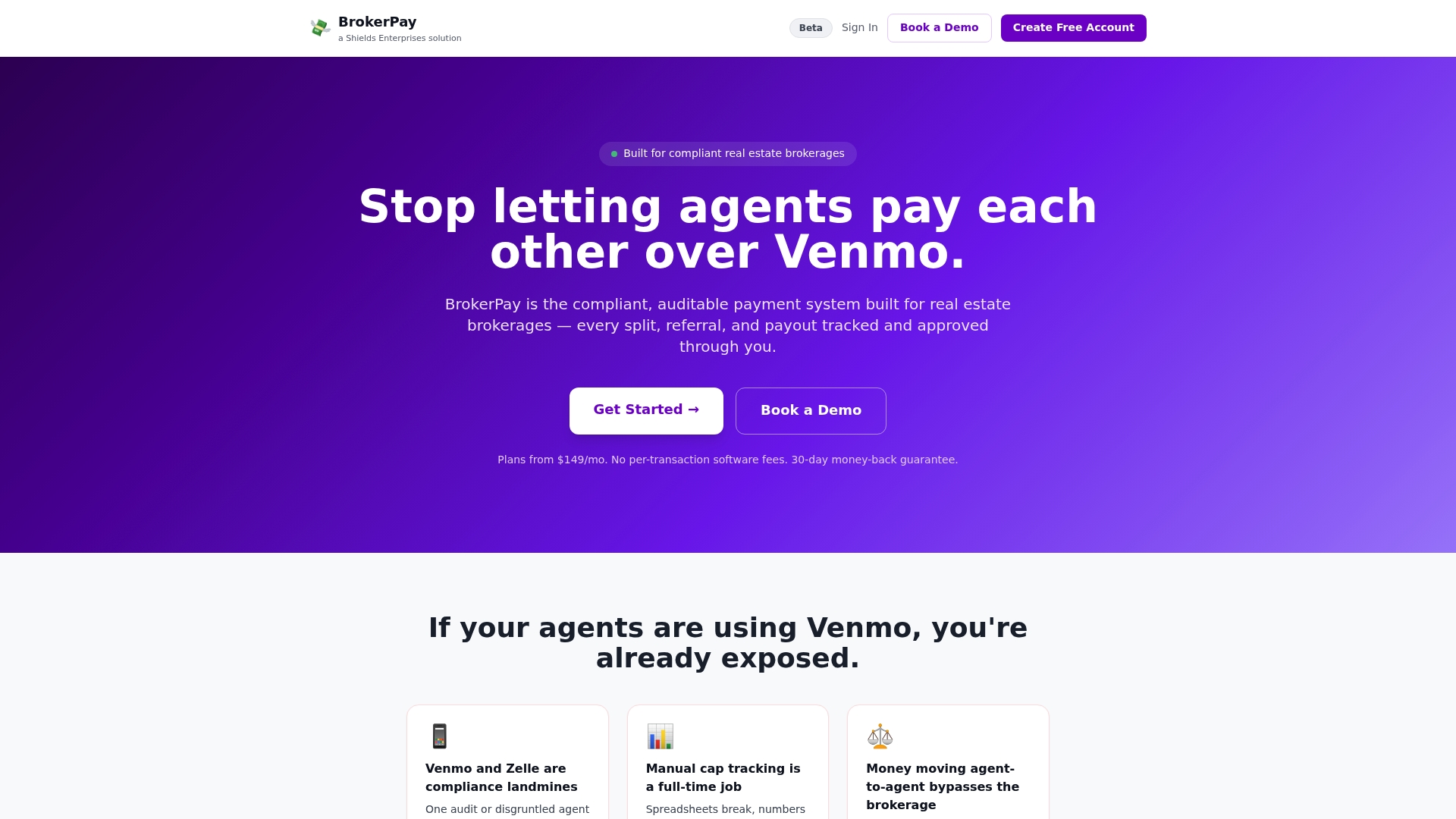
Brokerpay tracks, documents, and processes agent splits, referral fees, and co-op commissions inside a single platform that keeps your brokerage RESPA-compliant. It eliminates the Venmo and Zelle workarounds that create federal liability, and it replaces the month-end reconciliation spreadsheet with transaction-level records that are audit-ready from day one. If you are ready to move your commission payments off manual processes and onto a system built for real estate compliance, Brokerpay is where that transition starts.
FAQ
What does it mean to switch from manual to automated payouts?
Switching from manual to automated payouts means replacing hand-keyed, spreadsheet-driven commission payments with a scheduled, rule-based system that validates payee data and disburses funds automatically. The goal is to remove human intervention from routine payment steps while preserving approval workflows for exceptions.
How long does the transition to automated payouts take?
Most brokerages complete a phased transition in four to eight weeks, including data cleanup, integration testing, and a pilot rollout with a small agent cohort. Skipping the data preparation phase is the most common reason transitions take longer than expected.
Do automated payout systems handle 1099 reporting?
Yes. Platforms like Avalara integrate directly with payout workflows to collect W-9 data at the payee level and generate 1099 forms automatically at year-end, removing the manual data collection process that creates errors and compliance risk.
What happens to pending funds when I switch to automatic payouts?
Pending funds do not disburse automatically the moment you activate an automated schedule. A one-time manual or instant payout is required to clear currently available balances before the automated system takes over the ongoing disbursement cycle.
Is automated payout software compliant with RESPA requirements?
Automated payout platforms that include immutable transaction records, documented split agreements, and traceable audit logs support RESPA compliance by creating the documentation that manual processes cannot reliably produce. Brokerpay is designed specifically around these requirements for real estate brokerages.