Compliant Co-op Payment Workflows: 8 Real Examples

Compliant co-op payment workflows are structured, documented processes that govern how real estate brokerages collect, authorize, disburse, and reconcile cooperative payments in accordance with RESPA, state escrow rules, and fiduciary standards. Most brokerages understand the regulatory exposure in theory but struggle to translate that into actual workflow design. The examples below close that gap. Each one reflects a core design pattern shared by the most audit-ready operations: authorization gating before funds move, automatic ledger posting after funds clear, and an immutable record of every approval decision. Platforms like Brokerpay, GTC Sys, and CommunityPay each demonstrate how these patterns work in practice.
1. Examples of compliant co-op payment workflows: three-way trust account reconciliation
Monthly trust account reconciliation is the foundational compliant payment process every broker must get right. Florida Realtors confirms that brokers must reconcile trust accounts monthly using a three-balance match: the bank statement, the brokerage’s internal cash account, and the client or property sub-ledger. This same structure applies across virtually every state with escrow licensing requirements.
The workflow runs in five steps. First, the bank statement is extracted at month-end. Second, each transaction is matched line by line against the brokerage’s books. Third, the property or client sub-ledger is reconciled against both. Fourth, any exceptions are flagged and escalated before the period closes. Fifth, the reconciliation is signed by the responsible broker and filed.

Unresolved ledger mismatches signal compliance risk and must block payment processing until resolved. That is not optional. A single uncleared exception left open across a month-end creates the kind of accumulating regulatory exposure that state auditors flag immediately.
Pro Tip: Automate bank statement extraction using your accounting software’s direct bank feed rather than manual CSV imports. This eliminates transcription errors and cuts reconciliation time by more than half.
2. Automated payment collection and ledger posting
A compliant HOA or co-op payment collection workflow does more than accept money. CommunityPay’s portal shows owners a single exact payment amount that already incorporates current dues, past-due balances, special assessments, and any applicable late fees. This eliminates the most common source of short payments: owner confusion about what is actually owed.
Once a payment clears, the workflow posts it automatically to the ledger without manual intervention. Overpayments generate an automatic credit applied to the next period. Short payments trigger a flag and a notification to the collections contact. The system then reconciles posted payments against imported bank transactions, producing a daily match report.
This design matters because manual ledger posting introduces timing gaps between when money arrives and when the books reflect it. Those gaps create the conditions for double-posting, missed credits, and reconciliation failures at month-end.
Key elements of a compliant collection workflow include:
- A single owner-facing balance that consolidates all charges before payment is initiated
- Automatic ledger posting triggered by payment clearing, not by manual entry
- Credit application logic for overpayments with audit trail notation
- Short payment flags routed to a designated compliance contact
- Daily bank transaction import and automated matching against posted payments
Pro Tip: Reduce your compliance exposure by routing all payment data through a tokenized payment provider like Stripe or Dwolla rather than handling raw card or bank account numbers internally. This limits PCI scope and centralizes security policy in a purpose-built infrastructure.
3. Commission and referral payment authorization workflow
Commission payout workflows are where most brokerages accumulate the greatest compliance risk, because the steps between deal close and agent payment are rarely documented with the rigor auditors expect. A compliant workflow separates calculation from execution. Commission automation engines validate deal data and calculate splits first, then route the result to a broker or manager for explicit approval before any payment is triggered.
The workflow follows this sequence:
- Deal data is ingested from the transaction management system, including sale price, commission rate, and agent split percentages.
- The system calculates gross commission, applies splits, and runs a duplicate check against prior payouts for the same transaction ID.
- The calculated payout is presented to the approving broker with full deal context attached.
- The broker approves or rejects. Rejections require a written reason stored in the audit log.
- Approved payouts are queued for release only after the transaction has closed and commission funds have been received by the brokerage.
- Payment is executed and the approval history, payout amount, and timestamp are recorded as an immutable audit artifact.
For referral fees specifically, payment triggers within 30 days post-disbursement, with a signed referral agreement and a completed W-9 required before any amount is released. The workflow assigns a unique referral ID to each transaction and issues a 1099-NEC at year-end automatically.
4. Disbursement authorization gating and fraud prevention
Releasing escrow funds without a documented legal trigger is the fastest path to a RESPA violation. A compliant disbursement workflow gates fund release on one of three outcomes: a recorded closing, a mutually signed termination agreement, or a court order. No other condition authorizes disbursement.
GTC Sys emphasizes that authorization documents must be treated as immutable workflow artifacts. E-signature capture is linked directly to the disbursement event, meaning the signed release document and the payment record share a common transaction ID. Auditors reviewing the file see the permission and the payment as a single connected record, not two separate entries that must be manually correlated.
The fraud prevention architecture in this workflow includes:
- Wire instructions delivered only through authenticated, encrypted channels, never via email attachment
- Dual-approval requirements for disbursements above a defined dollar threshold
- Workflow reminders and calendar automation for regulatory deadlines, because most reconciliation failures result from calendar and process errors rather than technology failures
- Immutable audit logs that record every access event, approval decision, and status change
Payment processing in real estate trust accounts is fundamentally workflow control. Authorization artifacts are the core compliance requirement, not the movement of money itself.
5. Scheduled compliance analysis and deadline automation
Regulatory deadlines do not wait for busy closing seasons. A compliant co-op funding workflow builds deadline management directly into the payment calendar rather than relying on individual brokers to track filing dates manually. Compliant workflows must integrate timely reminders and thorough documentation to prevent common violations, including failure to deliver required annual statements.
In practice, this means the workflow system generates automated reminders at 30, 14, and 7 days before each regulatory deadline. Annual escrow statement delivery is scheduled as a workflow task with a completion confirmation required before the task closes. Monthly reconciliation windows are locked in the system calendar, and the reconciliation cannot be marked complete without all three balances matching and a supervisor signature captured.
This approach treats compliance as a scheduled operational process rather than a reactive response to audit notices.
6. Tokenized payment infrastructure for reduced compliance scope
Building payment processing from scratch inside a brokerage platform creates unnecessary regulatory surface area. The most defensible co-op reimbursement methods push sensitive payment inputs into purpose-built infrastructure and build real estate business logic on top. Platforms like Stripe, Dwolla, and Modern Treasury handle PCI-compliant routing, tokenization, and settlement, allowing the brokerage layer to focus on authorization logic and audit trail capture.
This architecture means the brokerage never stores raw bank account numbers or card data. All sensitive inputs are tokenized at the point of entry and the token is what flows through the brokerage’s workflow engine. If the brokerage system is ever audited or breached, the exposure is limited to workflow metadata rather than payment credentials.
For real estate professionals evaluating platforms, the question to ask is not whether the platform accepts payments. The question is whether the platform delegates raw payment data handling to a regulated infrastructure provider or manages it internally.
7. Exception escalation and payment blocking workflow
A compliant workflow does not simply flag exceptions. It blocks further payment processing until those exceptions are resolved. Trust account reconciliation must block closure or payment if ledger exceptions remain unresolved, because unresolved mismatches accumulate regulatory risk that compounds across periods.
The escalation workflow works as follows. When the automated matching process identifies a discrepancy, it creates an exception record with the transaction ID, the amount in question, and the date the discrepancy was first detected. The exception is routed to the responsible broker with a resolution deadline. Until the exception is marked resolved with a documented explanation, the system prevents any new disbursements from the affected account.
This hard block is what separates a genuinely compliant workflow from a workflow that generates reports but does not enforce consequences. Documentation without enforcement is not compliance. It is record-keeping.
8. Comparison of workflow types and situational recommendations
Not every brokerage needs every workflow type at the same level of sophistication. The table below maps each workflow example to its primary compliance control, automation level, and the brokerage context where it applies most directly.
| Workflow type | Primary compliance control | Automation level | Best suited for |
|---|---|---|---|
| Three-way trust reconciliation | Three-balance match with signed sign-off | Medium (bank feeds + manual review) | All brokerages with escrow accounts |
| Automated collection and ledger posting | Real-time posting on payment clearing | High | HOA, co-op, and property management |
| Commission and referral authorization | Broker approval before payout execution | High | Transaction-volume brokerages |
| Disbursement gating and fraud prevention | E-signed authorization linked to payment | High | All brokerages handling escrow |
| Deadline and compliance calendar automation | Scheduled reminders with completion gates | Medium | Brokerages with recurring regulatory filings |
| Tokenized payment infrastructure | PCI scope reduction via provider delegation | High | Platforms building payment features |
| Exception escalation and payment blocking | Hard block on unresolved ledger mismatches | High | Brokerages with high transaction volume |
Small brokerages operating with manual processes should prioritize the three-way reconciliation workflow and the disbursement gating workflow first, as these address the two highest-frequency audit findings. Larger operations with dedicated transaction coordinators benefit most from full commission automation and exception blocking. Brokerpay is built to support the authorization controls, ledger posting, and audit trail requirements that appear across all of these workflow types.
Key takeaways
Compliant co-op payment workflows require authorization gating, automated ledger posting, and immutable audit trails to meet RESPA and state escrow standards.
| Point | Details |
|---|---|
| Three-way reconciliation is non-negotiable | Match bank statement, brokerage books, and sub-ledger monthly with a signed sign-off. |
| Authorization must precede every disbursement | Gate fund release on a recorded close, signed termination, or court order, with e-signature linked to the payment record. |
| Commission workflows separate calculation from execution | Validate splits and run duplicate checks before routing to broker approval, never after. |
| Exceptions must block payments, not just generate reports | Unresolved ledger mismatches should prevent further disbursements until documented resolution is confirmed. |
| Tokenized infrastructure limits compliance exposure | Delegating raw payment data to providers like Stripe or Dwolla removes PCI scope from the brokerage layer. |
What I’ve learned about compliance workflows after years in brokerage payments
Most brokerages treat compliance as a documentation problem. They assume that if they have the right forms and the right signatures somewhere in a folder, they are covered. That assumption is wrong, and it is the reason so many brokerages fail state audits on process grounds rather than fraud grounds.
The workflows that actually hold up under scrutiny share one characteristic: they make non-compliance structurally impossible rather than just discouraged. A workflow that flags an exception but still allows disbursement is not a compliant workflow. It is a warning system that people learn to ignore.
The human factors matter more than most technology vendors admit. I have seen brokerages with sophisticated platforms still fail reconciliation because no one owned the exception resolution step. The technology flagged the problem. Nobody was accountable for fixing it before month-end. That is a process design failure, not a software failure.
The other pattern I keep seeing is brokerages that automate the easy parts, like payment collection and ledger posting, but leave the high-risk steps, like disbursement authorization and referral fee documentation, on email and verbal approval. That is exactly backwards. Automate where errors are low-stakes. Enforce hard controls where the regulatory exposure is real.
Audit logs are not just for auditors. Brokers who maintain clean, timestamped approval histories have a defense against agent disputes, wire fraud claims, and state investigations that brokers relying on email threads simply do not have. That protection is worth more than the cost of any platform.
— Wes
How Brokerpay handles compliant co-op payment workflows
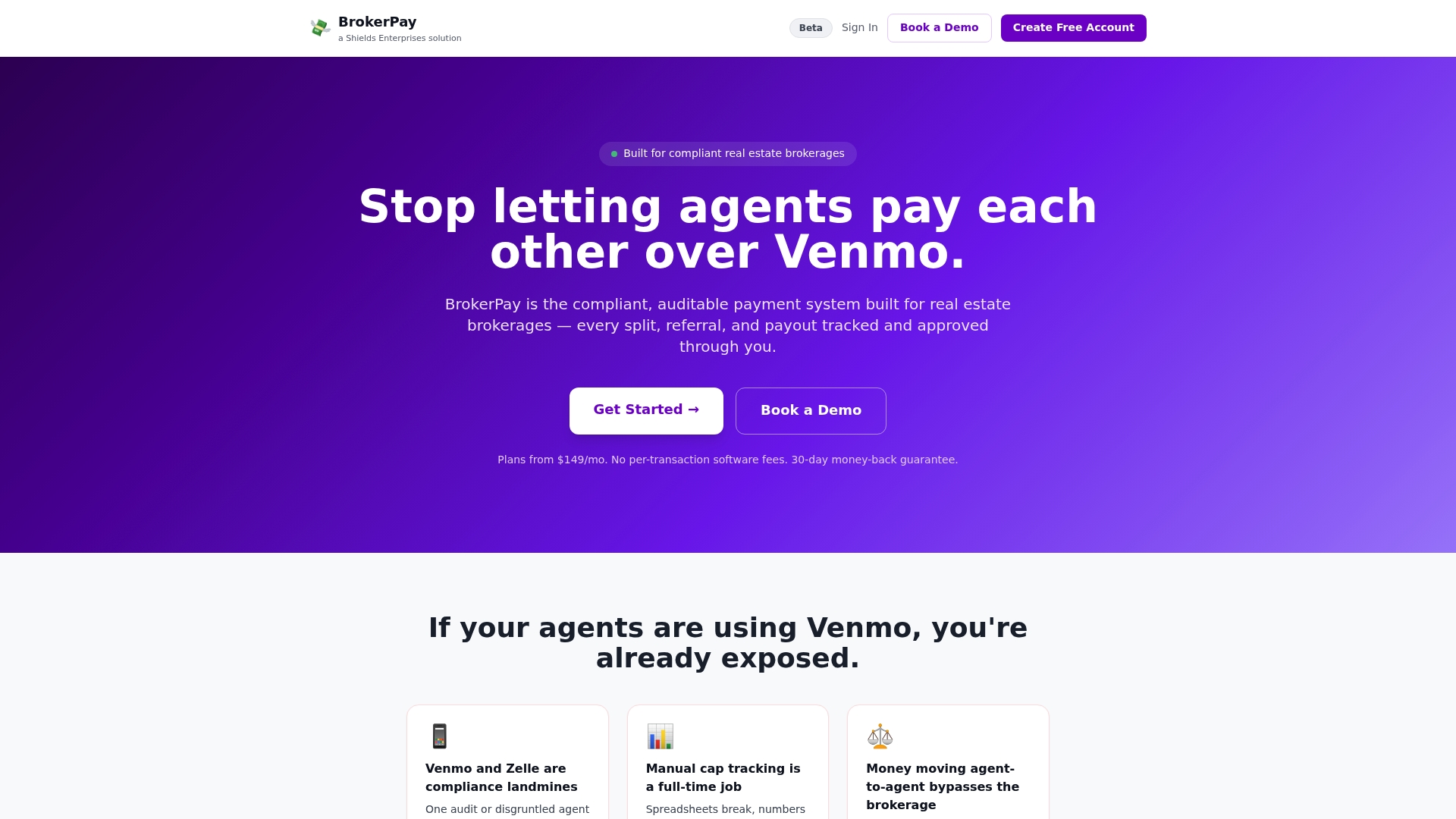
Brokerpay is built specifically for real estate brokerages that need to process co-op commissions, agent splits, and referral fees without creating federal liability through Venmo, Zelle, or informal payment methods. The platform tracks and documents every payment with authorization controls, automatic ledger posting, and audit trail capture built into the core workflow rather than bolted on as an afterthought. Brokerages using Brokerpay get the disbursement gating, approval history, and reconciliation support that state regulators expect to see. If your brokerage is still routing co-op payments through personal payment apps, visit Brokerpay to see what a purpose-built compliant payment platform looks like in practice.
FAQ
What is a compliant co-op payment workflow?
A compliant co-op payment workflow is a structured process that governs how cooperative commissions or dues are collected, authorized, posted to a ledger, and disbursed in accordance with RESPA and applicable state escrow regulations. It requires documented authorization before funds move and an immutable audit trail after they do.
How often must trust account reconciliation occur?
Trust account reconciliation must occur monthly. Florida Realtors and equivalent state regulators require a three-balance match between the bank statement, brokerage books, and client sub-ledger, signed by the responsible broker each period.
What documents are required before a referral fee can be paid?
A signed referral agreement and a completed W-9 are required before any referral fee is released. Payment should trigger only after the underlying transaction has closed and commission funds have been received by the brokerage, with a 1099-NEC issued at year-end.
Why should brokerages avoid Venmo or Zelle for co-op payments?
Venmo and Zelle do not provide the authorization gating, ledger integration, or audit trail documentation that RESPA and state escrow rules require. Using them for co-op or commission payments creates federal liability and leaves brokerages without a defensible record of approval decisions.
What happens if a ledger exception is not resolved before month-end?
Unresolved ledger exceptions must block further payment processing from the affected account. Leaving mismatches open across a period boundary accumulates regulatory risk and is one of the most common findings in state trust account audits.