Why Commission Tracking Prevents Tax Issues for Agents

Commission tracking is the process of systematically recording and managing every dollar of commission income to maintain tax compliance and prevent audit-triggering errors. For independent real estate agents, this practice is not optional. The IRS cross-references 1099 forms from every brokerage you worked with against your personal return, and any mismatch can generate a tax notice, a penalty, or a full audit. Brokerpay and tax professionals who work with real estate agents agree: the agents who face the fewest tax problems are the ones who know exactly what they earned, from whom, and when.
Why commission tracking prevents tax issues before they start
Accurate commission tracking works because it eliminates the information gap between what you earned and what the IRS expects to see. When your records match your 1099s to the dollar, there is nothing for the IRS to question. When they do not match, even a minor clerical error can trigger a CP2000 notice, which is the IRS’s automated letter asserting you underreported income.
The core mechanism is simple. Every commission payment you receive from a brokerage gets logged with the amount, the source, the date, and the applicable split or referral fee. That log becomes your source of truth at tax time. Without it, you are reconstructing your income from memory, bank statements, and emails, which is both time-consuming and error-prone.
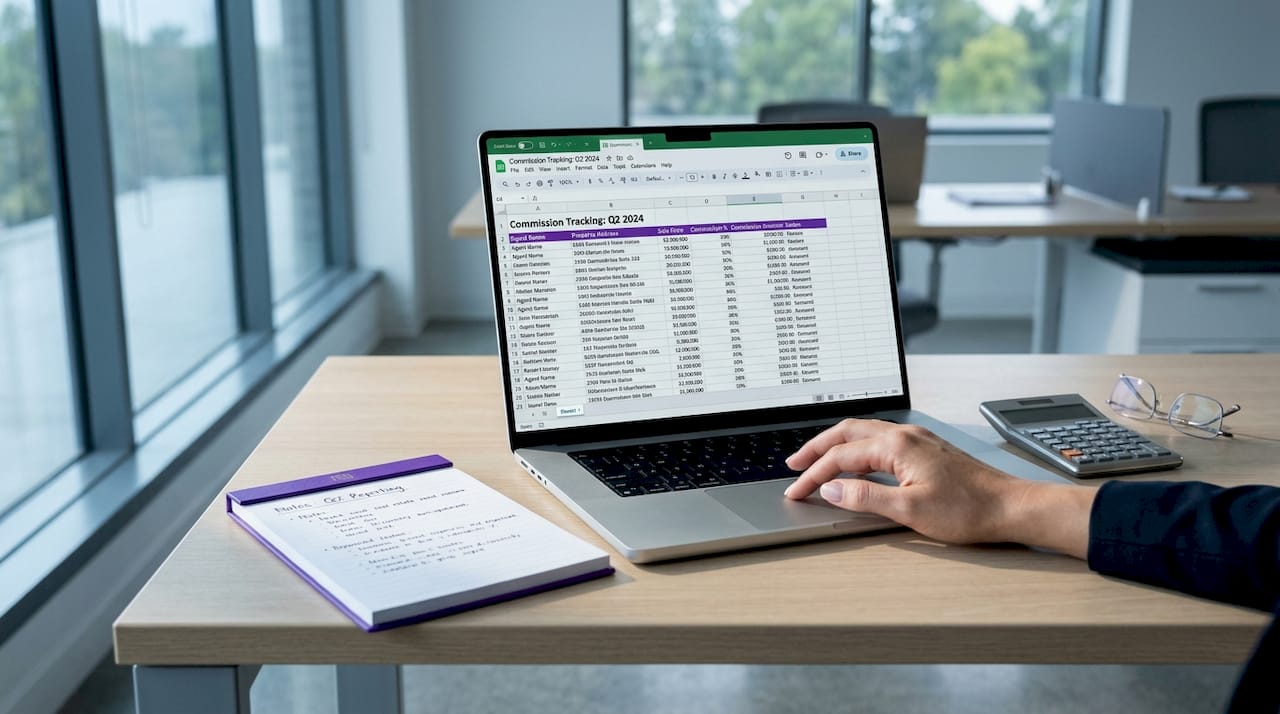
Independent agents working with multiple brokerages face the highest risk. The IRS receives a 1099-NEC from each brokerage you worked with, and it adds them up automatically. If your return does not account for every one of those forms, the system flags the discrepancy. Failure to reconcile multiple 1099s from different brokerages is a leading cause of CP2000 audit notices for agents. That single fact explains the importance of commission tracking more clearly than any abstract argument.
How does commission tracking reduce errors in tax reporting?
Manual commission tracking using spreadsheets produces calculation error rates between 3% and 8%, while automated tracking systems reduce that range to 0.1% to 0.5%. That is a 90% or greater reduction in errors. For a real estate agent earning $180,000 in gross commissions, a 3% error rate means up to $5,400 in misreported income. That is enough to trigger a notice and potentially a penalty.
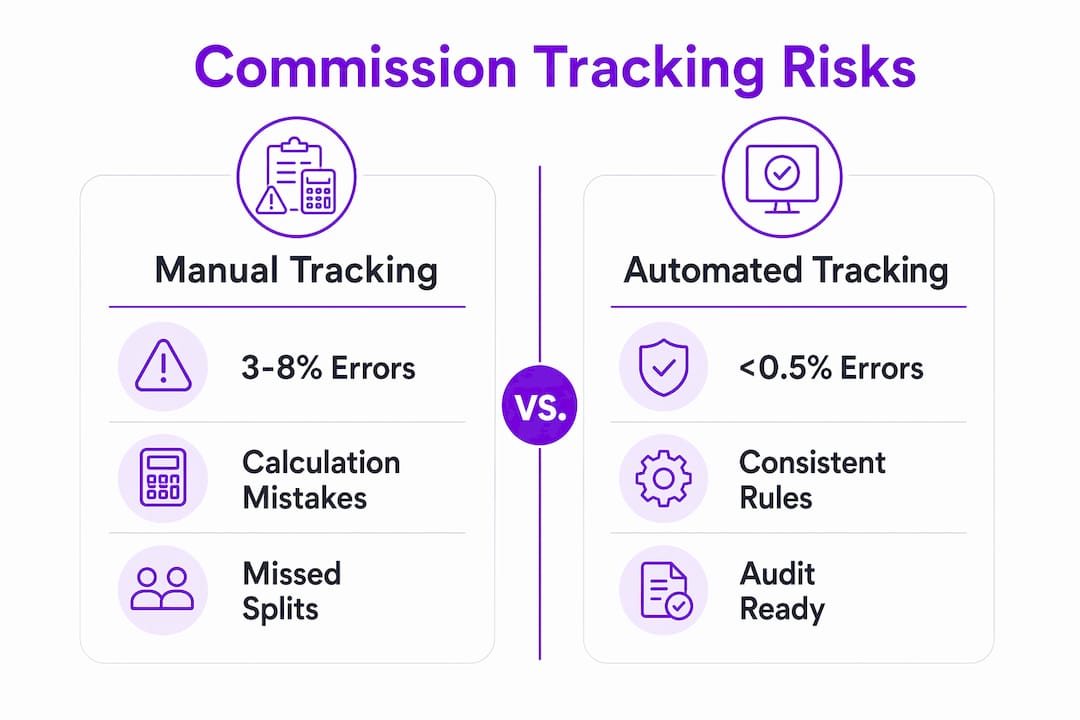
The errors that cause the most damage are not dramatic. They are transposed numbers, missed splits, and commissions recorded in the wrong tax year. These small mistakes create mismatches between your records and the 1099s your brokerages file with the IRS. The IRS does not know your spreadsheet had a typo. It only knows your reported income does not match what it received from three different brokerages.
| Error type | Manual tracking risk | Automated tracking risk |
|---|---|---|
| Calculation mistakes | 3% to 8% error rate | 0.1% to 0.5% error rate |
| Split misallocations | High, no rule enforcement | Low, plan rules applied consistently |
| Missing 1099 income | Common with multiple brokerages | Flagged automatically |
| Wrong tax year recording | Frequent with manual entry | Timestamped at transaction level |
| Audit trail availability | None or incomplete | Full log of every calculation |
Pro Tip: Use commission tracking software that integrates directly with your CRM and brokerage systems. Real-time data sync eliminates the manual re-entry step where most errors occur.
What are the tax compliance risks of poor commission tracking?
The tax implications of commissions are more complex than most agents realize, and poor tracking amplifies every one of those complexities. The IRS treats real estate agents as independent contractors, which means you are responsible for self-employment tax, quarterly estimated payments, and accurate income reporting across every brokerage relationship you hold.
The most common compliance failures include:
- CP14 and CP2000 notices. A CP14 is a balance-due notice triggered when you owe taxes you did not pay. A CP2000 is generated when the IRS’s records of your income do not match your return. Both are direct consequences of mismatched 1099 income and inadequate tracking.
- Missed quarterly estimated payments. Commission payouts vary monthly, which makes predicting your quarterly tax obligation genuinely difficult without precise tracking. Agents who underestimate payments face underpayment penalties on top of the tax owed.
- S-Corp routing errors. Some agents route commissions through an S-Corp to reduce self-employment tax. This strategy can work legally, but routing commissions through an S-Corp without proper legal alignment to your income-earning contracts triggers IRS reallocations. The IRS taxes income based on who earned it under the licensing agreement, not where the money was deposited.
- State-level misreporting. Agents working across state lines must track commissions by state. Failing to do so creates exposure to state tax authorities in addition to the IRS.
- Informal payment methods. Agents who accept commission splits via Venmo or Zelle often have no formal documentation of those transactions. That creates a gap between actual income and reported income that is very difficult to explain during an audit.
The pattern across all of these risks is the same. Poor records create uncertainty, and uncertainty invites scrutiny.
How does audit readiness from tracking software protect agents?
An audit trail is a chronological log of every commission calculation, split, override, and approval in your system. Automated commission tracking software provides exactly this, and it satisfies both finance teams and tax authorities because every number is traceable to a specific transaction and timestamp.
The practical benefit during an IRS audit is significant. When an auditor asks you to substantiate $240,000 in commission income across four brokerages, you can produce a complete record in hours rather than days. Without that record, you are pulling together bank statements, emails, and brokerage portals manually, and the gaps in that reconstruction become the auditor’s focus.
Transparency also reduces disputes between agents and brokerages before they become tax problems. Rep-facing dashboards that show detailed commission calculations reduce dispute rates by 40% or more. When agents can see exactly how their commission was calculated, including splits, referral fees, and adjustments, they catch errors early. Early correction means your 1099 reflects the right number before it is filed with the IRS.
Pro Tip: Keep detailed records of every split, override, and deal-level adjustment. If the IRS questions a commission amount, your ability to show the calculation step by step is your strongest defense.
The combination of accurate records and transparent calculations creates a compliance posture that is genuinely difficult to challenge. Agents who maintain detailed commission logs are not just better prepared for audits. They are less likely to be audited in the first place because their returns are internally consistent.
Manual tracking vs. automated systems: which protects you better?
The comparison between manual and automated commission tracking comes down to one question: how much compliance risk are you willing to carry?
Manual tracking using Excel or Google Sheets gives you control and costs nothing upfront. But it requires you to enforce your own calculation rules, reconcile your own 1099s, and build your own audit trail. Most agents do not have the time or accounting background to do this consistently. The result is a system that works well in simple situations and fails under complexity.
Automated tracking software integrates with CRM and billing systems, applies consistent plan rules, and generates audit trails automatically. The upfront cost is real, but the compliance benefit is measurable. Error rates drop by 90% or more, disputes resolve faster, and your tax preparer has clean data to work with at year-end.
For independent agents working with multiple brokerages, handling referral fees, or operating across state lines, manual tracking is not a realistic compliance strategy. The complexity exceeds what a spreadsheet can reliably manage. Automated systems handle that complexity by design.
Practical steps to improve your commission tracking today
Improving your commission management does not require a complete system overhaul. These steps produce immediate compliance benefits:
- Build a unified income ledger. Record every commission payment in one place, regardless of which brokerage paid it. Include the amount, source, date, split details, and any referral fees. This ledger becomes your reconciliation tool at tax time.
- Track by state and brokerage. If you work in more than one state, tag each commission with the state where the transaction closed. State tax authorities have their own cross-referencing systems.
- Fund quarterly estimated taxes from your ledger. Use your running commission total to calculate your estimated tax obligation each quarter. The IRS requires quarterly payments from independent contractors, and underpayment penalties add up quickly.
- Work with a tax professional who knows real estate. A general CPA may not understand the nuances of 1099-NEC income, self-employment tax, or S-Corp structuring for agents. Find someone who works specifically with real estate professionals.
- Replace informal payment methods with documented systems. If you are receiving commission splits via Venmo or Zelle, you are creating undocumented income. Switch to a platform that generates a paper trail for every transaction.
Key takeaways
Accurate commission tracking is the single most effective way for independent real estate agents to prevent IRS notices, reduce audit risk, and stay compliant with self-employment tax obligations.
| Point | Details |
|---|---|
| Tracking prevents IRS mismatches | Reconciling all 1099s against a unified ledger stops CP2000 notices before they start. |
| Automated systems cut errors by 90% | Spreadsheets produce 3% to 8% error rates; software brings that down to under 0.5%. |
| Audit trails resolve disputes fast | Logged calculations, splits, and overrides let you respond to auditors in hours, not days. |
| Quarterly tax accuracy requires tracking | Variable commission income makes estimated payments unpredictable without real-time records. |
| Informal payments create compliance gaps | Venmo and Zelle transactions leave no documentation, which becomes a liability during audits. |
What I have seen happen when agents skip this step
I have watched agents with strong production years walk into tax season completely unprepared because they had no system for tracking what they earned. Not because they were careless people. Because they were busy closing deals and assumed the numbers would sort themselves out. They do not.
The agents who get CP2000 notices are almost never the ones who cheated. They are the ones who worked with three brokerages, received six 1099s, and never reconciled them against a single source of record. The IRS does not distinguish between intentional underreporting and sloppy bookkeeping. The penalty is the same.
What I have also seen is how quickly the problem resolves when agents adopt even a basic automated tracking system. The first year they use it, their tax preparer spends half the time on their return. The second year, they stop dreading April entirely. The shift is not just financial. It is psychological. Knowing your numbers removes a specific kind of anxiety that independent agents carry year-round.
The agents who treat commission tracking as a compliance tool rather than an administrative burden are the ones who scale without tax problems. That is not a coincidence. It is a direct result of having clean, auditable records from day one.
— Wes
Stop paying commissions the wrong way
Independent agents and brokers who rely on informal payment methods are building a compliance liability with every transaction. Brokerpay is a commission payment platform built specifically for real estate brokerages. It tracks, documents, and processes agent splits, referral fees, and co-op commissions in a single auditable system, eliminating the Venmo and Zelle workarounds that create federal exposure.
Every payment processed through Brokerpay generates a complete record that satisfies IRS documentation requirements and keeps your brokerage RESPA-compliant. If your current process cannot produce a clean audit trail on demand, it is time to fix that before tax season forces the issue.
FAQ
What is commission tracking for real estate agents?
Commission tracking is the systematic recording of every commission payment, split, referral fee, and adjustment an agent receives across all brokerages. It creates the income documentation required for accurate tax filing and audit defense.
How does poor commission tracking trigger an IRS audit?
The IRS automatically cross-references 1099-NEC forms from all brokerages against your tax return. When the totals do not match, the system generates a CP2000 notice. Agents working with multiple brokerages face the highest risk of this mismatch.
Can I track commissions manually with a spreadsheet?
Spreadsheets produce calculation error rates between 3% and 8%, compared to under 0.5% for automated systems. Manual tracking works for simple situations but creates significant compliance risk for agents with multiple income sources, splits, or cross-state transactions.
How often should I update my commission records?
Update your commission ledger at the time of each payment, not at year-end. Real-time recording prevents the reconciliation errors that cause 1099 mismatches and makes quarterly estimated tax calculations accurate.
Do commission splits and referral fees need to be tracked separately?
Yes. The IRS taxes the full commission you earned before splits, not the net amount you received. Tracking splits and referral fees separately documents how gross income was distributed and protects you if the IRS questions the difference between your 1099 total and your reported income.