Why Zelle Is Risky (Not Illegal) for Real Estate

Zelle payments are not categorically illegal in real estate transactions, but their use creates serious legal exposure that every broker needs to understand before the next closing. The question of why Zelle illegal real estate payments became a common search reflects a real confusion in the industry. Brokers and agents have heard warnings, seen deals go sideways, and watched colleagues lose money with no recourse. The core issue is not a statute banning Zelle. It is a combination of authorized-push-payment fraud vulnerabilities, weak audit trails, and a regulatory environment that leaves professionals exposed in ways that wire transfers and escrow accounts simply do not.
Why Zelle real estate payments create legal risk
Zelle operates as a bank-to-bank transfer network owned by Early Warning Services, a consortium of major U.S. banks including JPMorgan Chase, Bank of America, and Wells Fargo. The transfers are instant and, in most cases, irreversible. That speed is the feature that makes Zelle attractive for splitting dinner bills and the same feature that makes it dangerous for five-figure real estate transactions.
The governing legal framework is Regulation E, codified at 12 CFR Part 1005, which protects consumers from unauthorized electronic transfers. The critical word is unauthorized. When a fraudster tricks a broker into sending money to the wrong account, the broker technically authorized the transfer. The bank treats it as a legitimate transaction. Regulation E’s consumer protections do not apply, and disputes must be filed within 60 days of the statement showing the transaction.

This is the authorized-push-payment (APP) fraud model. APP fraud occurs when a victim approves a transfer under deception, such as a fake wire instruction email or an impersonated title company. Because the victim clicked send, the bank has no obligation to reverse the payment. Zelle’s instant transfer speed compounds the problem by giving fraudsters a narrow window to move funds before anyone realizes what happened.
The regulatory picture grew more complicated in 2023 when the CFPB filed suit against Zelle’s parent company over inadequate fraud controls. That case was later dropped under new leadership, but state attorneys general continue enforcement actions that keep the legal environment unsettled. Zelle’s parent company began reimbursing some impersonation scam victims in mid-2023, but reimbursement covers mainly impersonation fraud, not the broader range of APP scams that target real estate professionals.
- Regulation E protects against unauthorized transfers, not deception-induced authorized ones
- APP fraud victims who approved the transfer have limited recourse under current law
- The 60-day dispute window is strict and often missed in complex real estate transactions
- State-level enforcement actions continue despite the CFPB dropping its federal case
- Reimbursement policies vary by bank and cover only select fraud categories
Pro Tip: Before any Zelle transfer in a real estate context, call the recipient directly on a verified phone number to confirm account details. Do not use contact information from the email or message requesting payment.
How Zelle compares to traditional real estate payment methods
Real estate transactions have historically relied on wire transfers, cashier’s checks, and escrow accounts because those instruments generate standardized, auditable records. Zelle generates a transaction confirmation and a screenshot. Those two things are not equivalent.
| Feature | Zelle | Wire Transfer / Escrow |
|---|---|---|
| Transfer speed | Instant, often irreversible | 1 to 3 business days, reversible with bank intervention |
| Audit trail | Transaction ID and screenshot only | SWIFT confirmation, escrow instructions, title company records |
| Fraud recourse | Limited under Regulation E for APP fraud | Stronger dispute mechanisms and title insurance coverage |
| Bank holds | Risk models trigger holds on large or unusual transfers | Predictable settlement with advance notice |
| Verification artifacts | Screenshots can be fabricated | Standardized documentation from licensed intermediaries |
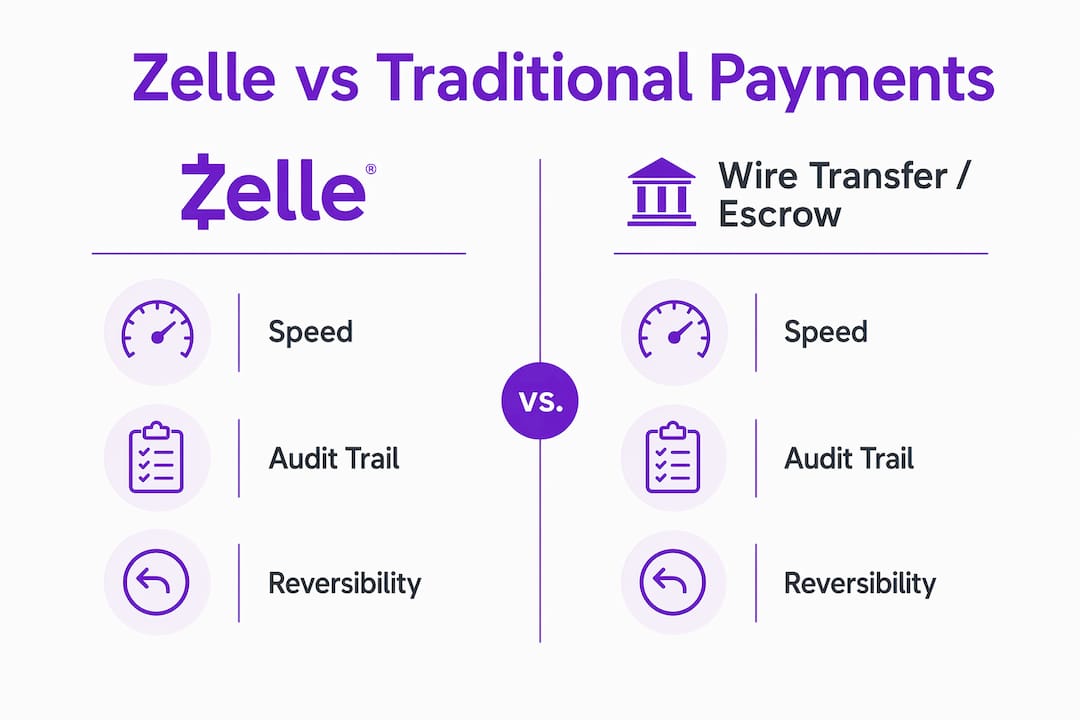
The audit trail gap is not a minor inconvenience. Real estate workflows require auditable instruments like wire transfers or escrow instructions because disputes, title claims, and RESPA compliance reviews all depend on documented proof of payment. A Zelle screenshot does not satisfy that standard.
The bank hold problem is equally disruptive. Banks freeze large Zelle transfers when their fraud risk models flag unusual behavior, which is exactly what a large, one-time real estate payment looks like. A frozen transfer at closing creates cascading problems: delayed possession, contract breach exposure, and client trust damage that is hard to repair.
Fake Zelle receipts and screenshots add another layer of risk. Fraudsters exploit enrollment gaps and interface mimicry to create convincing fake confirmations. A broker who releases keys or disburses a commission based on a screenshot that turns out to be fabricated has no clean legal remedy. That scenario is not hypothetical. It is a documented fraud pattern targeting real estate professionals specifically.
Pro Tip: Never accept a Zelle screenshot as proof of payment for any real estate transaction. Require bank statement confirmation showing the credit before releasing anything of value.
Common myths about the illegality of Zelle in real estate
The most persistent myth is that FinCEN regulations specifically ban or criminalize Zelle payments in real estate. That is not accurate. The FinCEN Residential Real Estate Rule, which would have imposed anti-money laundering reporting requirements on certain residential transactions, was vacated by a federal court and enforcement suspended as of mid-2026. No federal law categorically prohibits using Zelle for real estate payments.
What the regulatory environment does create is uncertainty. FinCEN’s AML focus on real estate remains active, even as specific reporting rules are in flux. Brokers who assume the suspended enforcement means reduced scrutiny are misreading the situation. The underlying anti-money laundering framework still applies, and using an unauditable payment channel like Zelle for large transactions draws exactly the kind of attention regulators are trained to notice.
Here is what is actually true about Zelle and real estate legality:
- No federal statute makes Zelle payments illegal for real estate transactions
- The FinCEN Residential Real Estate Rule is vacated and enforcement is suspended as of mid-2026
- Risk arises from fraud exposure and operational gaps, not from a specific prohibition on Zelle
- State-level enforcement actions and ongoing litigation create policy uncertainty that varies by jurisdiction
- The legal compliance picture for real estate payment reporting involves overlapping regimes that change faster than most brokers track
The practical implication is that brokers cannot rely on a static reading of the rules. The regulatory environment around real estate payment methods is actively evolving, and what is permissible today may carry different obligations next quarter.
Practical risk management for brokers using Zelle
If you choose to use Zelle for any real estate-related payment, the following steps reduce your exposure without requiring you to abandon the tool entirely. The goal is to layer verification and documentation around Zelle’s inherent weaknesses.
-
Require bank statement confirmation. Verification against bank statements rather than screenshots is the single most effective fraud prevention step. Ask the recipient to confirm the credit appears in their account before you take any action that depends on the payment being received.
-
Avoid large lump-sum transfers. Banks flag unusual transfer patterns, and a single large Zelle payment to a new recipient is exactly the profile that triggers a fraud hold. If Zelle is the agreed method, consider whether the transaction size is appropriate for the channel.
-
Verify recipient identity through an independent channel. Call the recipient on a phone number you sourced independently, not from the payment request itself. Confirm the account details verbally before sending. This one step defeats the majority of APP fraud attempts targeting real estate professionals.
-
Document every step. Create a written record of who authorized the payment, what verification steps you took, and when each action occurred. If a dispute arises, your documentation is your defense. A Zelle transaction ID alone will not protect you.
-
Brief your clients and co-op partners. Many Zelle fraud attempts in real estate succeed because a client or junior agent in the transaction chain did not know the verification protocol. Buyer and borrower education on payment fraud is part of your professional responsibility, not optional.
-
Evaluate purpose-built alternatives. For commission splits, referral fees, and co-op payments, platforms designed for real estate compliance provide the audit trails and RESPA documentation that Zelle cannot. Brokerpay is built specifically for this use case, tracking and documenting every payment in a format that survives regulatory review.
Pro Tip: Use Zelle only for low-stakes, easily reversible transactions between verified parties you have worked with before. For anything touching a closing, commission disbursement, or escrow-adjacent payment, use a documented payment method with a proper audit trail.
Key takeaways
Zelle is not illegal in real estate, but its design makes it a poor fit for high-stakes transactions where fraud recourse is limited and audit trails are required.
| Point | Details |
|---|---|
| Zelle is legal but risky | No federal law bans Zelle in real estate; risk comes from fraud exposure and weak documentation. |
| Regulation E gaps | APP fraud victims who approved transfers have limited refund rights under current consumer protection law. |
| FinCEN rule suspended | The Residential Real Estate Rule was vacated; enforcement is on hold as of mid-2026, but AML obligations remain. |
| Audit trail is the core problem | Zelle screenshots can be fabricated and do not meet the documentation standard real estate workflows require. |
| Verification is your best defense | Bank statement confirmation and independent identity verification reduce fraud risk more than any policy change. |
The real problem brokers keep ignoring
I have spent years watching brokers treat Zelle as a convenience tool without thinking through what happens when something goes wrong. The honest answer is: not much happens in your favor. You approved the transfer. The bank processed it. Regulation E does not care that you were deceived.
What concerns me most is the false confidence that comes from the FinCEN rule suspension. Brokers hear “enforcement suspended” and interpret it as “we are in the clear.” That reading misses the point entirely. The AML framework is still active. State regulators are still watching. And the fraud patterns targeting real estate professionals are getting more sophisticated, not less.
The brokers I have seen handle this well share one habit: they treat every payment instruction as potentially compromised until independently verified. That is not paranoia. It is the correct professional posture given the documented fraud environment. Switching to automated payout workflows for commissions and co-op fees removes the human verification burden entirely and creates the paper trail that protects you in a dispute.
Zelle has legitimate uses. Splitting a lunch tab with a colleague is fine. Disbursing a $15,000 co-op commission to an agent you have never worked with before is not a Zelle transaction. Know the difference, and build your workflows accordingly.
— Wes
Stop using Zelle workarounds for commission payments
Real estate brokerages that process commission splits, referral fees, and co-op payments through Zelle or Venmo are creating federal liability with every transaction. Brokerpay eliminates that exposure.

Brokerpay is a compliant commission payment platform built specifically for real estate brokerages. It tracks, documents, and processes every agent split and co-op payment with a full audit trail, keeping your brokerage RESPA-compliant without the manual verification burden that Zelle requires. Agents get paid accurately and on time. Brokers get documentation that survives regulatory review. You can also explore compliant co-op payment workflows to see exactly how other brokerages have replaced Zelle workarounds with auditable processes.
FAQ
Is using Zelle for real estate payments actually illegal?
Zelle payments are not categorically illegal in real estate. No federal statute prohibits their use, but the combination of authorized-push-payment fraud risk and weak audit trails creates serious legal and operational exposure for brokers.
What is authorized-push-payment fraud and why does it matter for brokers?
APP fraud occurs when a victim approves a transfer under deception, such as a fake wire instruction. Because the victim authorized the payment, Regulation E consumer protections generally do not apply and banks are not required to issue refunds.
Did the FinCEN rule ban Zelle in real estate transactions?
No. The FinCEN Residential Real Estate Rule addressed anti-money laundering reporting requirements and was vacated by a federal court. Enforcement is suspended as of mid-2026, and the rule never specifically banned Zelle.
Why do banks freeze large Zelle transfers in real estate deals?
Banks use automated fraud risk models that flag large or unusual transfers, particularly to new recipients. A single large real estate payment fits that profile exactly, which is why holds and freezes disrupt closings when brokers rely on Zelle.
What is the safest alternative to Zelle for real estate commission payments?
Purpose-built platforms like Brokerpay provide automated, auditable payment workflows designed for RESPA compliance. They generate the documentation that Zelle cannot, reducing fraud exposure and eliminating the manual verification steps that create errors and liability.