How to Set Up Co-op Commission Payments for Brokers

Co-op commission payments are the broker-to-broker compensation splits executed at closing when a listing brokerage pays the buyer’s agent brokerage for services rendered in a real estate transaction. Getting the process right requires more than a handshake agreement. To set up co-op commission payments correctly, brokers need documented split rules, defined payment triggers, RESPA-compliant disclosure procedures, and a platform that creates an auditable record of every dollar moved. Without these elements, you are one disputed transaction away from a federal compliance problem or a costly agent dispute.
How to set up co-op commission payments: the compliance foundation
Before you configure any software or sign any co-op agreement, you need to understand the legal framework that governs every payment you make. RESPA Section 8 is the federal statute that controls this space, and it is not forgiving.
RESPA Section 8 prohibits kickbacks and unearned referral fees in any real estate settlement transaction. That prohibition covers cash payments, non-cash benefits, and any split that does not reflect services actually performed. The practical implication: every co-op payment you make must be tied to a real service, and the amount must reflect fair market value for that service.

The good news is that RESPA does not prohibit referral fees or commission splits between licensed real estate brokers, provided those conditions are met. The statute’s Section 8(b) bans fee splits only when they are unearned or when no services were provided. This means a standard buyer’s agent co-op commission is permissible as long as the buyer’s agent actually worked the transaction.
State ethics rules add another compliance layer. Illinois REALTORS’ updated Article 7, effective 2026, requires brokers to disclose and obtain informed client consent whenever they receive compensation from more than one party in a transaction. Similar disclosure obligations exist under the NAR Code of Ethics nationally. Compliance is not just a federal question. It is also a state licensing and professional ethics question.
Here is a practical compliance checklist to run before processing any co-op payment:
- Confirm both parties hold active real estate licenses in the transaction’s jurisdiction
- Verify the co-op amount reflects fair market value for services performed
- Document what specific services the receiving broker performed
- Obtain written client disclosure and consent when compensation comes from multiple parties
- Retain all documentation in a transaction file for audit purposes
Pro Tip: RESPA compliance depends on substance, not labels. Calling a payment a “co-op commission” does not make it compliant. Ask two questions before every payment: Did the receiving broker perform a real service? Is the amount consistent with fair market value? If both answers are yes, you are on solid ground.
What tools and prerequisites do you need first?
Setting up a co-op commission payment system without the right infrastructure produces the same result every time: manual errors, missed payments, and no audit trail. The tools you choose determine how scalable and defensible your process will be.
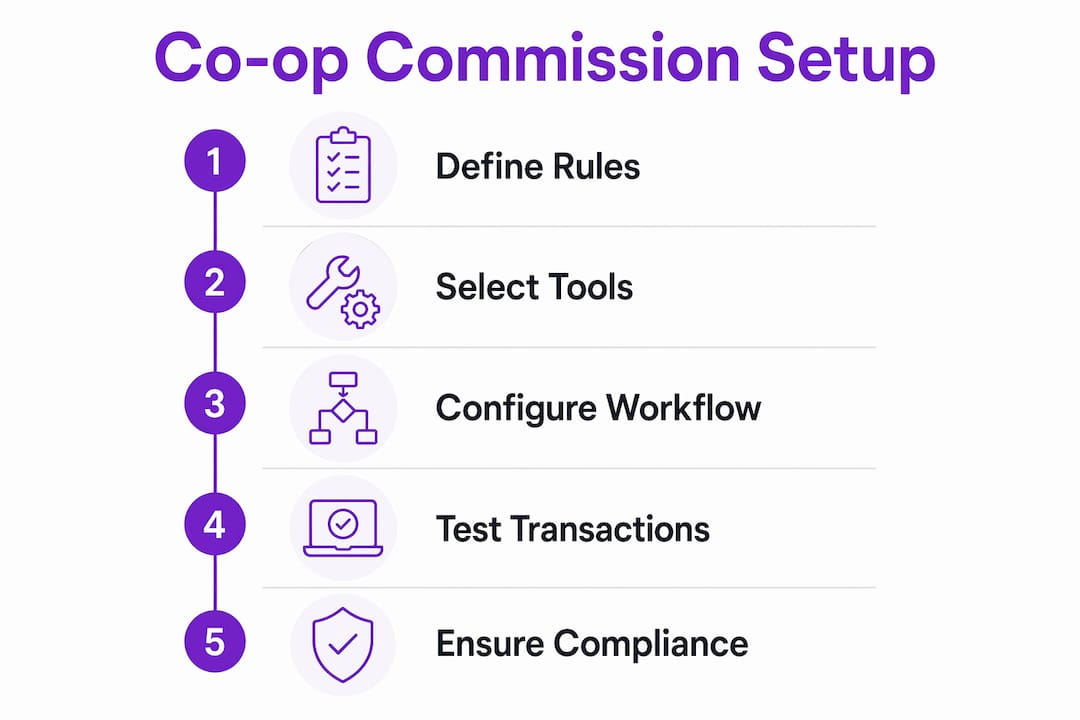
At minimum, you need three components in place before you configure any commission workflow. First, a CRM or transaction management system that records deal data, parties, and closing dates. Second, a commission management platform that can hold split rules, schedules, and payment preferences. Third, a documented commission plan that defines how splits are calculated for each transaction type.
Platforms like NetSuite offer a Partner Commissions and Royalties feature that allows brokerages to create named commission plans, assign them to specific partners, and configure calculation rules with date constraints. This prevents overlapping or conflicting commissions within the same date range, which is one of the most common sources of payment disputes in multi-agent transactions.
The table below shows why automation consistently outperforms manual management for co-op commission workflows:
| Capability | Manual (spreadsheets) | Automated platform |
|---|---|---|
| Rule enforcement | Inconsistent, human-dependent | Uniform across all transactions |
| Audit trail | Fragmented or absent | Complete, timestamped records |
| Error rate | High, especially at volume | Low, rules applied systematically |
| Dispute resolution | Slow, requires manual reconstruction | Fast, documented history available |
| Compliance documentation | Manual assembly | Auto-generated per transaction |
Automating commission calculations reduces errors, enforces consistent rule application, and improves auditability compared to manual spreadsheet management. For a brokerage processing more than a handful of transactions per month, the operational case for automation is clear.
Step-by-step process to establish co-op commission workflows
With compliance requirements understood and tools selected, you can build the actual workflow. Follow these steps in order. Skipping steps creates gaps that surface as disputes later.
-
Define your commission split hierarchy. Establish the base co-op percentage, then layer any sub-splits for team leads, referral sources, or transaction coordinators. Every split tier needs a named rule and a calculation basis (gross commission income, net commission, or a fixed dollar amount).
-
Configure payment triggers. Defining payment triggers precisely — whether at booking, invoicing, or cash receipt — is the single most effective way to prevent timing disputes. In NetSuite and similar platforms, this maps to the “Commissions Paid By Default On” preference. Choose the trigger that matches your brokerage’s cash flow model and apply it consistently.
-
Set the commission eligibility period. Separate eligibility timing from payment timing. Separating eligibility period from payment timing leads to smoother operations by preventing premature payments on transactions that may still fall through. A common configuration is to set eligibility at a defined number of days after booking, with payment triggered on collection.
-
Assign commission plans to partners with date constraints. Each co-op partner should have a named plan assigned with a start date and, where applicable, an end date. This prevents a plan from applying to transactions outside its intended scope.
-
Document chargeback and advance procedures. Define in writing what happens when a transaction falls through after a commission advance has been paid. Who owes what, by when, and through what process? This belongs in your commission operations playbook before you process your first payment.
-
Build your exception-handling workflow. Disputes happen. Define the escalation path: who reviews a disputed payment, what documentation is required, and what the resolution timeline is.
The table below summarizes the workflow with responsible roles:
| Step | Action | Responsible party |
|---|---|---|
| 1 | Define split hierarchy and calculation rules | Broker of record |
| 2 | Configure payment triggers in commission platform | Brokerage admin |
| 3 | Set eligibility period and payment timing | Brokerage admin |
| 4 | Assign commission plans to co-op partners | Transaction coordinator |
| 5 | Document chargeback and advance procedures | Broker of record |
| 6 | Build exception and dispute resolution workflow | Compliance officer |
Pro Tip: Run a test transaction through your entire workflow before going live. Use a closed deal from the prior quarter and trace every dollar from gross commission through each split tier to the final payment. If the numbers do not reconcile manually, your configuration has a gap.
Common challenges when managing co-op commission payments
Even well-configured systems produce disputes. Knowing where problems originate lets you address them before they escalate.
The most common source of co-op commission disputes is ambiguous split terms. When the co-op agreement says “standard split” without defining what standard means for that transaction type, both sides fill in the blank differently. The fix is contract language that names the exact percentage, the calculation basis, and the payment trigger for every scenario.
Reconciliation challenges are the second major friction point. When a transaction closes in one accounting period but the co-op payment processes in the next, the timing mismatch creates reconciliation errors that take hours to untangle. Commission operations playbooks that document reconciliation steps and exception handling procedures reduce this problem significantly.
Here are the top mistakes brokers make when managing co-op commission payments:
- Using Venmo, Zelle, or personal payment apps for broker-to-broker transfers, which creates federal liability and no compliant audit trail
- Failing to document what services the receiving broker performed before processing payment
- Setting payment triggers at booking rather than collection, leading to premature payouts on deals that fall through
- Omitting chargeback terms from co-op agreements, leaving no recourse when a deal reverses after payment
- Skipping client disclosure when compensation comes from multiple parties, violating state ethics rules
For real-world examples of how compliant workflows handle these scenarios, the compliant co-op payment workflows guide from Brokerpay covers eight transaction types with documented procedures for each.
Best practices for maintaining compliant and scalable co-op commission systems
A co-op commission system that works for ten transactions per month will break at fifty if you have not built it to scale. The practices below keep operations clean as volume grows.
Formalize everything in a commission operations playbook. This document should cover split hierarchies, payment triggers, eligibility periods, chargeback rules, advance procedures, reconciliation steps, and exception workflows. A well-built playbook documents rules, hierarchies, and exception handling to scale commission payment workflows and avoid disputes. It also becomes your primary defense document if a payment is ever challenged.
Disclosure and consent management deserve their own documented process. Under the NAR Code of Ethics and Illinois REALTORS rules, disclosure policies and client consent are compliance layers that extend beyond federal law. Build a checklist into your transaction approval process that confirms disclosure was obtained and documented before any co-op payment is released.
Audit your commission system quarterly. Pull a sample of ten transactions and trace each payment from the co-op agreement through the split calculation to the final disbursement. If you find a discrepancy, fix the configuration before it compounds across hundreds of transactions. Reviewing commission structures in your market periodically also helps you confirm your split percentages remain competitive and compliant with current market norms.
Pro Tip: Build your disclosure checklist into your transaction management system as a required field, not an optional reminder. If the disclosure confirmation is not checked, the transaction cannot advance to payment processing. This single structural change eliminates the most common compliance gap brokers face.
Key takeaways
A compliant co-op commission system requires defined split rules, documented payment triggers, RESPA-aligned service verification, and an auditable platform. Manual processes cannot deliver all four consistently at scale.
| Point | Details |
|---|---|
| RESPA compliance is non-negotiable | Every co-op payment must reflect actual services performed and fair market value compensation. |
| Payment triggers prevent disputes | Define whether commissions are paid on booking, invoicing, or collection before processing any transaction. |
| Separate eligibility from payment timing | Setting an eligibility period distinct from payment timing reduces premature payouts and reconciliation errors. |
| A playbook scales your operations | Documented rules for splits, chargebacks, advances, and exceptions protect you as transaction volume grows. |
| Disclosure is a compliance layer | State ethics rules and the NAR Code require written client consent when brokers receive compensation from multiple parties. |
Why I think most brokers underestimate the compliance risk here
I have seen brokerages that ran co-op payments through Zelle for years without incident and concluded the process was fine. It was not fine. They were one audit or one disgruntled agent away from a RESPA inquiry with no documentation to defend themselves. The absence of a problem is not evidence of a compliant system.
The brokers who handle this well share one trait: they treat the payment infrastructure as seriously as the transaction itself. They do not separate “how we close deals” from “how we pay each other.” Those are the same process, and they both need documentation, defined rules, and an audit trail.
The other thing I have learned is that automation does not just reduce errors. It changes the conversation when a dispute arises. When every payment has a timestamped record tied to a specific transaction, a specific split rule, and a specific trigger event, disputes resolve in minutes instead of days. That alone is worth the investment in a proper platform. If you are still manually tracking splits in a spreadsheet or moving money through personal payment apps, the switch to automated payouts is not a future project. It is an overdue one.
— Wes
How Brokerpay handles co-op commission payments for brokerages
Brokerpay is built specifically for the compliance and documentation requirements that co-op commission payments demand. It tracks, documents, and processes agent splits, referral fees, and co-op commissions in a single platform, keeping your brokerage RESPA-compliant and eliminating the Venmo and Zelle workarounds that create federal liability.
Every payment processed through Brokerpay generates a complete audit trail tied to the transaction, the parties, the split rules applied, and the payment trigger that released the funds. When a dispute arises or an audit comes, you have documentation ready. Brokerpay also supports the disclosure and consent workflows that state ethics rules now require, making compliance a built-in feature rather than an afterthought. If you are ready to replace manual processes with a purpose-built system, Brokerpay is where brokerages start.
FAQ
What is a co-op commission in real estate?
A co-op commission is the portion of the total commission paid by the listing brokerage to the buyer’s agent brokerage as compensation for services rendered in a transaction. It is a broker-to-broker payment, not a direct agent-to-agent transfer.
Does RESPA prohibit co-op commission payments between brokers?
RESPA does not prohibit co-op commissions between licensed brokers as long as the receiving broker performed actual services and the compensation reflects fair market value. Payments that are unearned or not tied to services performed violate Section 8.
What payment trigger should I use for co-op commissions?
Setting payment on collection rather than booking reduces the risk of paying out on transactions that fall through before closing. Separating eligibility timing from payment timing is the configuration approach that produces the fewest reconciliation errors.
Do I need client disclosure for co-op commission payments?
Yes. Under the NAR Code of Ethics and state rules like Illinois REALTORS’ updated Article 7 effective 2026, brokers must disclose and obtain informed client consent whenever they receive compensation from more than one party in a transaction.
Why is using Venmo or Zelle for co-op payments a compliance risk?
Personal payment apps create no compliant audit trail, do not document the services performed or the split rules applied, and cannot generate the transaction-level records required for RESPA defense. They also expose the brokerage to federal liability if a payment is ever challenged or audited.