Top 6 NexGenCommissions.com Alternatives 2026

Selecting commission management software that actually fits your brokerage’s transaction volume, workflows, and reporting needs creates confusion when every vendor looks similar. Many products lock key features behind high pricing tiers, require manual reconciliation, or lack transparent information on integrations and support. This comparison explains pricing, automation scope, and integration details for six NexGenCommissions.com alternatives so you can pick the strongest fit for your brokerage without second guessing each vendor’s limitations.
Table of contents
- BrokerPay
- Loft47
- BrokerSumo
- Brokerage Engine
- Upfront
- AccountTECH darwin.Cloud
- Comparison of alternatives
Brokerpay
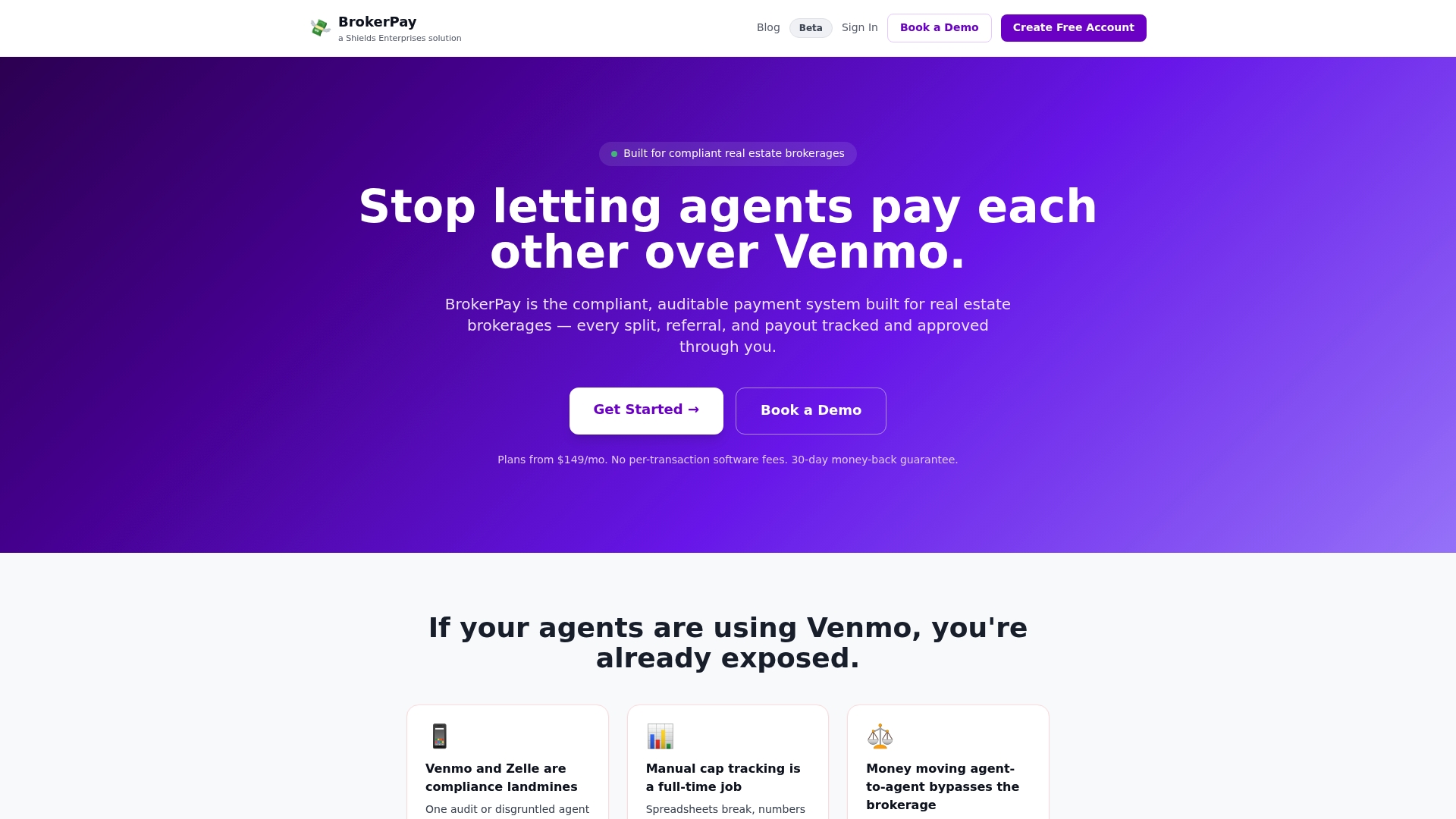
At a glance
Earnest money tracking moves from submission to closing with built in title confirmation. That feature removes a common manual checkpoint for escrow management.
BrokerPay centralizes agent splits, referral fees, and co op commissions in one auditable system. It replaces unsecured Venmo and Zelle workflows that expose brokerages to federal liability.
Core features
- Agent payment requests with approval workflow: Agents submit requests that route to designated approvers for documented sign off.
- Automated transfer log and audit trail: Every transfer records who approved, when, and why for audit readiness.
- Cap tracking per agent: Annual limits, volume, and projected date show remaining capacity for each agent.
- ACH transfers through Stripe ACH: Moves funds via bank rails while keeping a ledger of payment events.
- Earnest money tracking with title confirmation: Tracks earnest deposits from receipt through closing with title verification.
Key differentiator
Provides an all in one compliant platform with approval workflows, audit trails, and automatic tracking for internal brokerage transactions. The combination keeps commission splits and earnest funds documented in one place. That reduces the need for manual spreadsheets and email chains when reconciling agent payouts.
Pros
-
Provides compliance and auditability that reduce legal and regulatory exposure. The platform stores approvals and transfer logs for downstream review.
-
Automates repetitive tasks such as cap tracking and approval routing. That cuts the time staff spend checking agent eligibility manually.
-
Keeps full transaction logs and an audit trail tied to each payment event. Auditors and compliance officers get a clear paper trail.
-
Built in controls block agent to agent bypasses of brokerage processes. That control lowers the chance of unauthorized transfers.
-
Dashboard offers a single place to monitor payments, approvals, and earnest money status. Managers see outstanding approvals and capped agents at a glance.
Cons
- May not suit brokerages that require custom accounting integrations, since complex general ledger linking is limited and may need manual reconciliation.
Notable integrations
- Stripe ACH
Stripe ACH handles the platform s ACH processing and bank transfers. BrokerPay depends on that third party for actual fund movement and settlement.
Who it’s for
Mid sized to large real estate brokerages that need auditable workflows for agent payments. Teams that process referral fees, co op commissions, or earnest funds will see immediate administrative value.
Smaller sole brokers or very small teams may find the controls heavier than their needs. Organizations that require deep accounting automation should evaluate integration needs first.
Unique value proposition
Plans start at $149/mo for up to 50 agents, which makes a compliance first payment workflow available without per transaction fees. That pricing point lets growing brokerages replace informal Venmo and Zelle practices while keeping a predictable monthly cost.
By centralizing approvals and audit logs under a single subscription, firms reduce time spent on dispute resolution and produce a consistent compliance record for regulators and title partners.
Real world use case
A regional brokerage replaced Venmo transfers with BrokerPay to capture every split and referral fee in one ledger. The office used cap tracking to prevent overpaying agents when multiple referral chains overlapped.
Title confirmations attached to earnest deposits shortened closing reviews. The brokerage reported fewer reconciliation errors after moving approvals into the platform.
Pricing
Plans from $149/mo for up to 50 agents. The vendor lists premium tiers from $299 and custom enterprise pricing by quote. There are no per transaction fees, which simplifies budgeting for recurring payments.
Website: https://brokerpay.io
Loft47
At a glance
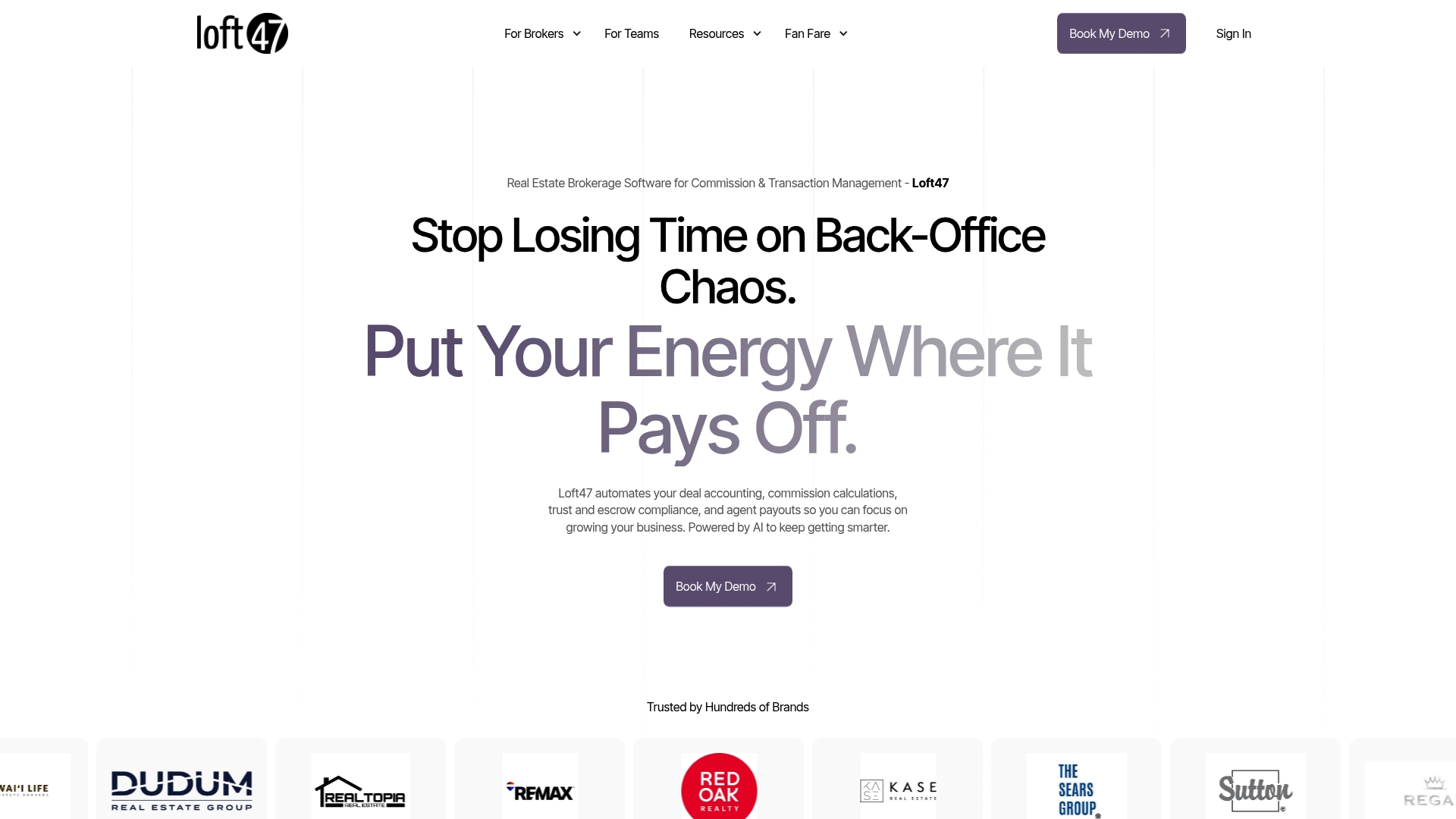
Loft47 reports it is trusted by over 200 brokerages and claims billions in transaction volume. That vendor figure indicates the product targets brokerages with high transaction throughput. The platform focuses on AI powered automation for commissions, escrow, and deal accounting. This emphasis shows it tries to reduce manual back office work for larger brokerages.
Core features
-
Automates deal accounting, commission calculations, trust and escrow compliance, and agent payouts. These features reduce manual spreadsheet work and centralize financial records.
-
AI powered contract reading and compliance checks that parse documents and flag exceptions. The automation aims to cut review time on routine items.
-
Customizable deal rules by deal type, location, or team for complex splits, caps, and fees. Rules can reflect local commission structures and team overrides.
-
Integrations with transaction and accounting tools such as Dotloop, SkySlope, QuickBooks Online, Xero, and Docusign. Data flows help keep accounting and transaction platforms aligned.
-
Real time dashboards and reporting with Google Sheets output and Loft47 Pro analytics. Reports show cash flow, payouts, and deal status at a glance.
Key differentiator
Loft47 centers on AI powered automation combined with flexible customization for complex commission and compliance workflows. That focus makes the platform better suited for brokerages that run many unique split rules or manage multiple compliance regimes. Brokerages with simple payout needs will find parts of Loft47 more than they require.
Pros
-
All in one CRM and marketing management suite with an intuitive interface. Teams get lead and deal context in the same place as commission data.
-
Robust deal management with AI assisted workflows that reduce repetitive review tasks. This helps operations staff process deals faster.
-
Flexible commission support for complex splits, caps, and fee structures. The rule engine handles conditional logic across teams and locations.
-
Automated compliance checks, payout automation, and real time transaction tracking. These features reduce manual reconciliation between escrow and accounting.
-
Custom dashboards and reporting that feed Google Sheets or Loft47 Pro dashboards. Managers can build the exact views they need for cash flow and performance.
Cons
-
Customer support responsiveness has been criticized for being slow and not very helpful. Slow support increases risk for teams that need fast fixes.
-
Billing and account management issues have been reported by some users. Account problems can interrupt access to critical financial functions.
-
Some features sometimes do not fulfill promotional marketing claims. Users should validate specific capabilities during a trial.
-
Mobile application offers limited functionality compared to the desktop version. Field agents may need to use the desktop for full feature access.
When it may not fit
Loft47 may not fit small brokerages that need a lightweight payout tool. It adds complexity that smaller teams will not use. Firms that require fast, hands on vendor support should plan for potential service delays. Agencies that need full mobile parity will find the platform lacking for field workflows.
Notable integrations
- Dotloop
- SkySlope
- QuickBooks Online
- Xero
- Docusign
- Rechat
- Payload
- Zum Rails
Who it’s for
Mid sized to large brokerages seeking automation, scalability, and integration in their back office operations. Teams with complex commission plans and multiple compliance requirements will get the most value. Smaller brokerages with simple splits should evaluate lighter tools first.
Real world use case
A brokerage with 100 plus agents uses Loft47 to automate commission calculations and manage escrow compliance. The system generates real time performance dashboards and issues automated payouts. The operation reduced manual errors and reclaimed hours previously spent reconciling spreadsheets.
Pricing
Pricing starts at $600 per month for the base license and scales with brokerage size. Additional AI and deal processing services are available at $10 per deal or via custom plans. Contact Loft47 for a quote on high volume or enterprise configurations.
Website: https://loft47.com
BrokerSumo
At a glance
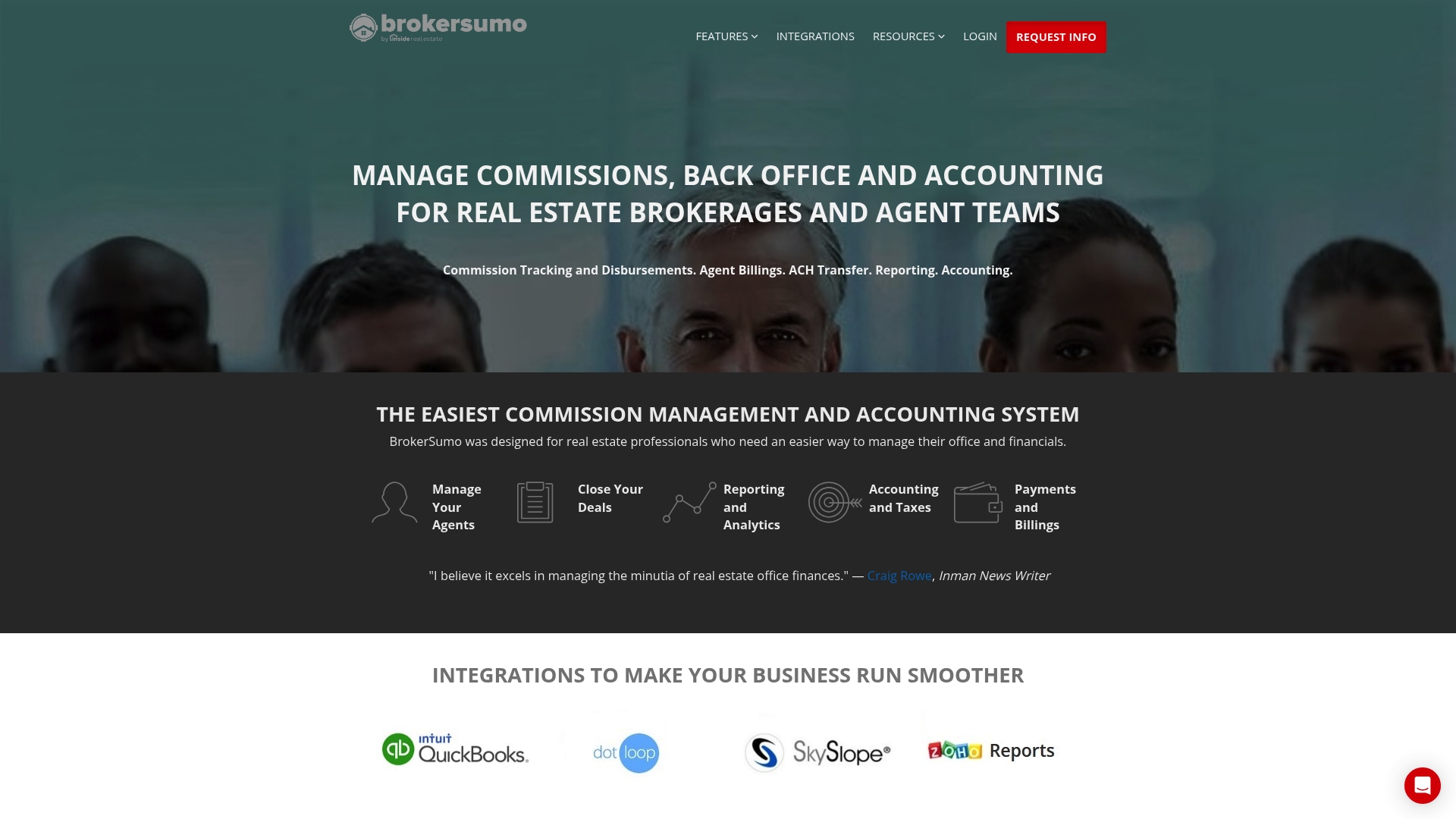
BrokerSumo automates commission split math and supports ACH transfers for agent payouts. The platform combines transaction tracking with accounting syncs to reduce manual ledger work. That focus makes it practical for brokerages that need a single system for commissions and bookkeeping.
Core features
- Agent onboarding and billing management, including charge tracking and statements.
- Transaction pipeline tracking to record deals from contract to close.
- Automatic commission split calculation that applies agent and office splits.
- ACH transfers for direct agent payments to bank accounts.
- Syncing with QuickBooks to keep accounting records aligned.
Key differentiator
BrokerSumo’s product angle is its narrow focus on real estate commission workflows. It groups pipeline, split math, payments, and accounting syncs into one interface. For brokerages that handle many agent payouts each month, that tight alignment reduces reconciliation steps.
Pros
- Built for real estate teams and brokerages, so forms and fields match closing workflows. This reduces configuration time compared with general accounting tools.
- Automates commission calculations and disbursements, which cuts repetitive spreadsheet work. Users can set splits and referral rules ahead of closing.
- Integrates with popular market tools such as QuickBooks and SkySlope to keep transaction and ledger data consistent. That lowers the risk of duplicate entry.
- Offers detailed reporting and analytics to produce agent statements and office-level summaries. Reports help with tax preparation and monthly close.
- Secure data handling on AWS infrastructure gives IT teams a familiar hosting model. Security controls match expectations for financial records.
Cons
- No detailed third party user reviews are available in the provided sources, so public experience signals are limited. You will need to validate fit with a trial or demo.
- Pricing details are not specified in vendor materials, so budgeting requires direct vendor contact. That adds a procurement step for brokerages.
- Requires setup for integrations such as QuickBooks and Dotloop, which may need bookkeeping or IT time. Expect initial configuration work for accurate syncs.
When it may not fit
If your office uses an in-house accounting system that cannot accept QuickBooks exports, BrokerSumo may not integrate cleanly. Small teams with only occasional commissions might find the platform heavier than necessary. Also, brokerages that need extensive public user reviews to validate a vendor should plan a pilot before full rollout.
Notable integrations
- QuickBooks
- Dotloop
- SkySlope
- Dropbox
- EZ Coordinator
- Zoho Reports
Who it’s for
BrokerSumo fits brokerages, team leaders, and independent brokers who process regular agent commissions and need accounting syncs. It also suits offices that want consolidated transaction pipelines and payment rails. Smaller teams should weigh setup effort against their transaction volume.
Real world use case
A large brokerage uses BrokerSumo to capture each closed transaction, calculate splits, and push payouts via ACH. The office then syncs closing details to QuickBooks for the general ledger. That sequence reduces manual journal entries and speeds month end close.
Pricing
Pricing is not specified in the public product summary and appears to be a paid service. Contact BrokerSumo sales for tier details and seat or transaction pricing. Ask about setup fees and integration support during your evaluation.
Website: https://brokersumo.com
Brokerage engine

At a glance
Built by real estate industry insiders to eliminate disconnected systems and manual workarounds. Brokerage Engine consolidates transactions, commissions, accounting, listings, compliance, and reporting into a single back office. The platform emphasizes automation and real time dashboards to reduce administrative load and reveal cash flow and compliance issues faster.
Core features
Brokerage Engine offers automated commissions calculation and payout processing that removes spreadsheet math from closing day. It provides integrated accounting and financial dashboard functionality so finance teams can reconcile transactions without exporting multiple reports. The product includes transaction and compliance management, MLS and vendor listing integrations, and task management for listing, marketing, and onboarding workflows. Each area is organized to keep documents, tasks, and financials in one place.
Key differentiator
The system was developed by people with direct brokerage experience to replace disconnected tools and manual workarounds. That focus results in workflows mapped to brokerage operations instead of generic accounting or CRM flows. The outcome is fewer handoffs between systems, which reduces loss of data and speeds up agent support.
Pros
-
Platform built for brokerages. The product aligns its features to brokerage operations rather than retrofitted accounting tools.
-
Automates routine finance work. Automated commission math and payout processing remove repetitive calculations.
-
Real time dashboards. Financial and transaction dashboards surface cash flow and compliance status for managers and owners.
-
Task and listing support. Built in task management and MLS integrations keep listing, marketing, and onboarding steps visible to teams.
-
Centralizes records. Documents, commissions, and transaction histories live together, which helps audit readiness and reporting.
Cons
-
Limited public reviews. Third party review sources in the product data do not report clear user pros and cons, which creates uncertainty about long term user experience.
-
Onboarding effort likely. As with many all in one back office systems, implementation and training will require dedicated time from operations teams.
-
Pricing and limits unclear. The vendor does not publish standard pricing in the provided data, which makes budget planning harder.
Who it’s for
Brokerage Engine fits brokerage owners and operations managers who need an all in one back office tailored to real estate. It suits firms that prefer industry mapped workflows over generic finance or CRM tools. The platform targets teams ready to consolidate transaction, commission, and compliance work into a single system.
Real world use case
A growing brokerage adopts Brokerage Engine to bring its commissions, transaction records, and compliance documents into one system. Finance stops reconciling across three spreadsheets. Managers get clearer visibility into commission liabilities and agent payouts before and after closings.
Pricing
Pricing is not published in the product data. The vendor marks pricing as informational only, so you will likely need to contact Brokerage Engine for a tailored quote based on transaction volume and feature set.
Website: https://brokerageengine.com
Upfront
At a glance
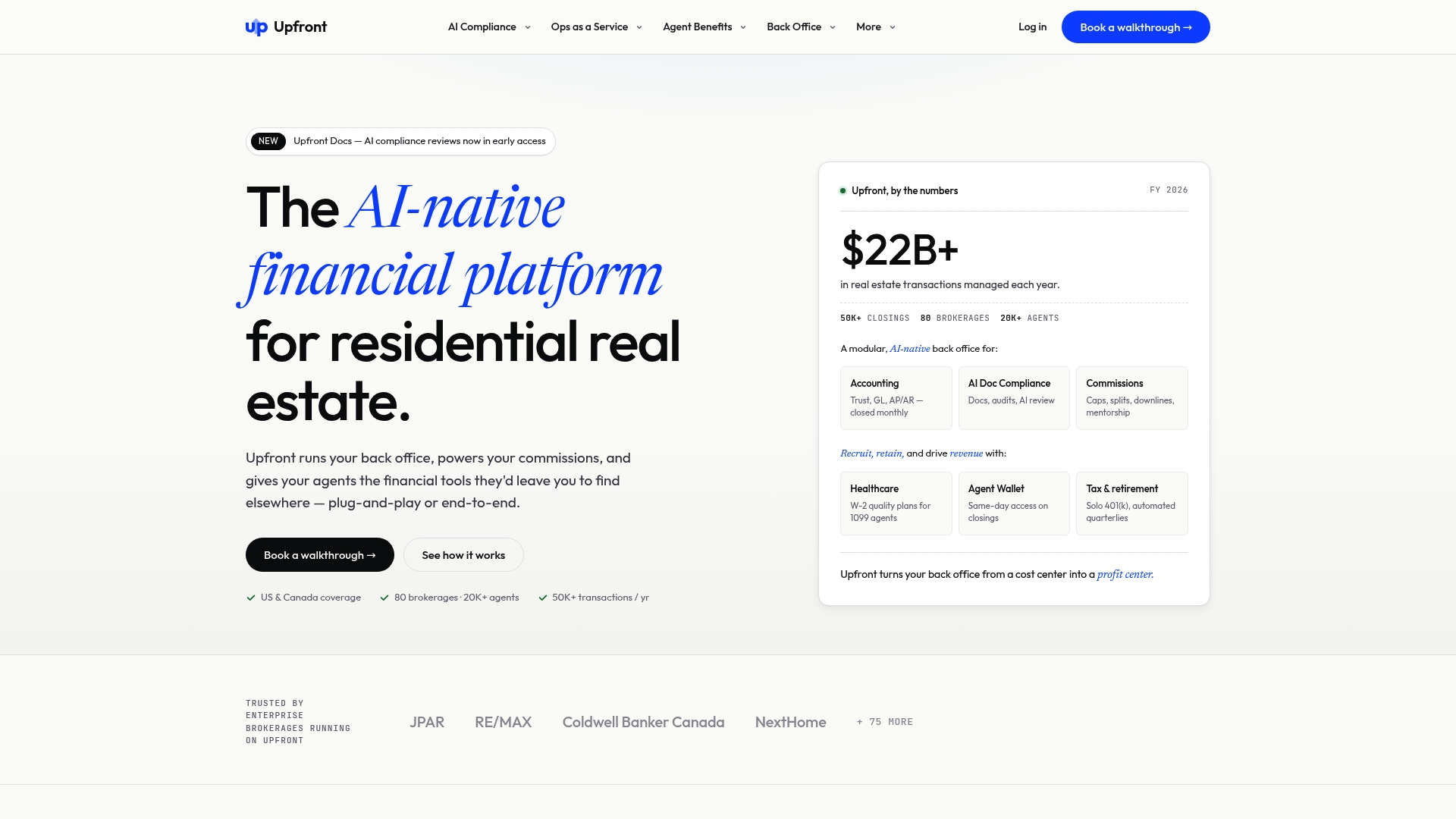
A single unified ledger handles trust accounting, commission disbursement, and reporting. The platform pairs that ledger with AI compliance reviews and configurable rules for transaction documentation. Upfront targets residential brokerages and franchise systems in the US and Canada that want a consolidated back office with agent financial tools and optional operations outsourcing.
Core features
- AI-powered compliance reviews with fast turnaround and audit trails for each transaction.
- Unified ledger that records trust accounting, commissions, and reporting in one place.
- Modular back-office management plus optional operations as a service for migration and ongoing support.
- Configurable rules for transaction documentation and role based access across franchise or multi entity structures.
- Real time agent communication and reporting that records approvals and compliance checks.
Key differentiator
Upfront puts the accounting and commission flows into a single ledger and links that ledger to automated compliance checks. That combination reduces the number of separate reconciliation points. The platform also offers modular operations outsourcing when brokerages need people as well as software.
Pros
- Modern modular design. The product data highlights separate back office, compliance, agent finance, and operations modules that can be adopted independently.
- Automation that reduces manual work. Upfront advertises AI driven reviews and configurable rules to cut time spent on documentation and reconciliation.
- Franchise and multi entity support. The platform includes role based access and royalty calculations for networks that manage multiple broker entities.
- Fast deployment and migration help. The vendor reports migration support aimed at replacing legacy systems and shortening cutover timelines.
- Customizable compliance rules. Teams can map local procedures and audit requirements into the platform without code.
Cons
- No independent user reviews. There is little third party feedback available, so real world satisfaction and long term reliability are unclear.
- Custom pricing only. Pricing is based on transaction volume and services, which makes direct comparison against other vendors harder.
- Limited public detail on support performance. The product data does not include metrics for response times or SLA terms.
When it may not fit
If you need out of the box pricing for easy vendor comparisons, the custom pricing model may slow procurement. Smaller brokerages with very low transaction volume may find the onboarding overhead higher than expected. The lack of third party reviews increases the risk for buyers who require proven references before selecting a back office vendor.
Who it’s for
Residential brokerages and franchise groups in the US and Canada that want a single ledger for trust accounting and commission flows. Organizations that need configurable compliance rules and role based controls will find the platform aligned with their needs. Teams planning a migration from legacy systems and willing to engage a vendor for custom onboarding are the ideal fit.
Real world use case
A regional brokerage migrated from legacy systems to Vero for trust and transaction management while using Upfront for branded agent financial tools and compliance review. That setup reduced manual reconciliation work and automated commission disbursements according to the configured rules. The brokerage also used Upfront’s operations service during the first 90 days to stabilize workflows and reporting.
Pricing
Pricing is custom and depends on deal volume, services selected, and operating hours. Vendors set costs based on transaction throughput and whether you buy software only or include operations support. Ask for a volume based proposal and a clear statement of work before committing.
Website: https://myupfront.com
AccountTECH darwin.Cloud

At a glance
Starts at $525 per month and includes setup. That price point is the clearest concrete detail AccountTECH advertises for brokerages that need a fully managed back office. The product targets mid sized to large brokerages and franchises with multi company accounting needs. Expect an emphasis on automated commission math and centralized reporting.
Core features
AccountTECH packages core back office functions that brokerages ask for most often. It groups accounting, commission payouts, and reporting into a single cloud product.
- Cloud based real estate accounting software for ledger and financial workflows.
- Automated commission calculations and agent payments that reduce manual posting.
- Extensive customizable reporting and dashboards for regional and company level views.
- Integrations with MLS, CRM, banking, and transaction systems for data flow.
- Multi company and multi franchise support inside one platform.
Key differentiator
AccountTECH was built specifically for real estate accounting and not adapted from a generic accounting tool. It emphasizes integrating transaction, MLS, CRM, and financial data inside the same back office. That design reduces reconciliation work when commissions are calculated from transaction records and agent splits across entities.
Pros
-
Wide scope of real estate specific features. The product bundles commission calculations, bookkeeping, and analytics in one place so teams do fewer manual exports.
-
Strong automation focus. Automated payouts and commission logic cut repetitive journal entries and reduce calculation errors.
-
Supports multi company and franchise setups. Firms with regional legal entities can run reporting and consolidated financials inside the same account.
-
Flexible reporting and dashboards. You can tailor views for operations, finance, and franchise owners without building separate spreadsheets.
-
Security and compliance emphasis. AccountTECH highlights protections and controls for brokerages that handle third party funds.
Cons
-
Public third party reviews do not list consistent weaknesses. That makes it harder to see common user pain points in independent feedback.
-
Platform complexity may require dedicated onboarding and training for administrators and accounting staff.
-
The product description includes a trailing placeholder labeled “limitations:” which suggests documentation or marketing artifacts may need cleanup.
When it may not fit
If your brokerage runs fewer than a dozen agents and uses simple commission splits, the platform may be more capability than you need. Small shops with minimal accounting staff may pay for features they do not use. Also expect an onboarding project for firms that lack dedicated accounting resources.
Notable integrations
- MLS systems
- CRM platforms
- Banking and payment processors
- Transaction management software
- APIs for custom integrations
These connections support pulling transaction and agent data directly into accounting workflows.
Who it’s for
Mid sized to large real estate brokerages, franchises, and MLS organizations that need centralized financial management are the best fit. Teams that run multiple legal entities and require automated commission logic will extract the most value.
Real world use case
A large franchise uses darwin.Cloud to calculate agent commissions across regions. The platform handles multiple legal entities, posts payments to bank integrations, and produces real time analytics for franchise owners and finance teams.
Pricing
AccountTECH advertises a starting price of $525 per month which includes setup. The company states costs scale based on agent count and the breadth of integrations and services requested.
Website: https://accounttech.com
Comparison of alternatives
Selecting the right real estate commission management software is essential for streamlining processes and adhering to compliance regulations in the industry. With various capable solutions available, such as BrokerPay, Loft47, BrokerSumo, Brokerage Engine, Upfront, and AccountTECH darwin.Cloud, it’s important to identify which platform best addresses your organizational needs.
Integration and customization
Integration with existing systems is critical for maintaining efficient data interchange. Loft47 stands out in this area, providing connections to platforms like Dotloop, SkySlope, QuickBooks Online, and Docusign. This versatility enhances data flow across operational workflows, ensuring consistency and reducing manual input.
Compliance and reporting features
BrokerPay excels by offering compliance-focused functionalities, including automated transfer logs and title verification for earnest money tracking, all at an affordable monthly fee without per-transaction costs. This makes it a compelling option for brokerages seeking to centralize compliance tasks within their budget frameworks.
Best fit
- BrokerPay: Designed for brokerages emphasizing effective compliance tracking and regular agent payments management.
- Loft47: Recommended for agencies requiring extensive integrations and automation in their accounting workflows.
- BrokerSumo: A conservative approach for managing commissions using predefined straightforward systems.
- Upfront: Suitable for organizations that benefit from modular implementations and operational outsourcing services.
- AccountTECH darwin.Cloud: Tailored for larger brokerages needing advanced multi-entity support with financial analytics.
Our pick
For brokerages seeking cost-effective and compliance-oriented commission management, BrokerPay provides a valuable solution. Its all-in-one approach, featuring authorization workflows and auditable summaries, minimizes regulatory risks while enhancing operational clarity. However, organizations with unique integration needs or requiring analytics may find options like Loft47 or AccountTECH more suitable, depending on their priorities and scale.
To assist in selecting a commission management platform tailored to your needs, the table below outlines the key features, differentiators, and other relevant considerations for several notable platforms, beginning with Brokerpay.
| Product Name | Key Features | Key Differentiator | Best For | Pricing | Limitation |
|---|---|---|---|---|---|
| Brokerpay | Agent payments, audit trail, ACH transfers, cap tracking | Compliance-focused platform centralizing internal transactions, reducing manual processes | Mid-sized to large brokerages needing audit workflows | From $149/month for up to 50 agents | May lack extensive accounting system integrations |
| Loft47 | AI-powered commission and document compliance | Automation and rule customization for complex workflows | Mid-large brokerages with complex accounting | From $600/month; additional per transaction fees | Reported slow customer support |
| BrokerSumo | Automated commission splits, ACH payments, QuickBooks sync | Focused on streamlining agent commissions and accounting syncs | Small to mid-sized real estate teams and brokers | Not disclosed | May require extensive setup for integrations |
| Brokerage Engine | Centralized transactions, commissions, compliance | Built specifically for real estate operations without reliance on generic software | Real estate brokerages consolidating back-office operations | Not disclosed | Limited public reviews, requiring trial or demo for evaluation |
| Upfront | AI compliance, unified ledger, modular deployment | All financial processes and agent tools in one platform, with extensive automation and analytics | Residential brokerages in US and Canada | Custom pricing | Requires vendor engagement, limited available user reviews |
| AccountTECH darwin.Cloud | Full accounting and commission workflows | Centralized system with MLS and CRM integrations for automated and real-time financial insights | Mid to large brokerages with multiple entities | From $525/month | May be overly complex for small or less active brokerages |
Discover a smarter way to handle real estate commissions with Brokerpay
When exploring nexgencommissions.com alternatives, managing agent splits, referral fees, and co-op commissions without creating compliance risks is a top priority. Manual Venmo and Zelle transfers in brokerages expose teams to federal liability and complicate auditing. Brokerpay offers a compliant commission payment platform built specifically for real estate brokerages. Its automated approval workflows, audit trails, and earnest money tracking keep your transactions documented and RESPA-compliant in one centralized system.
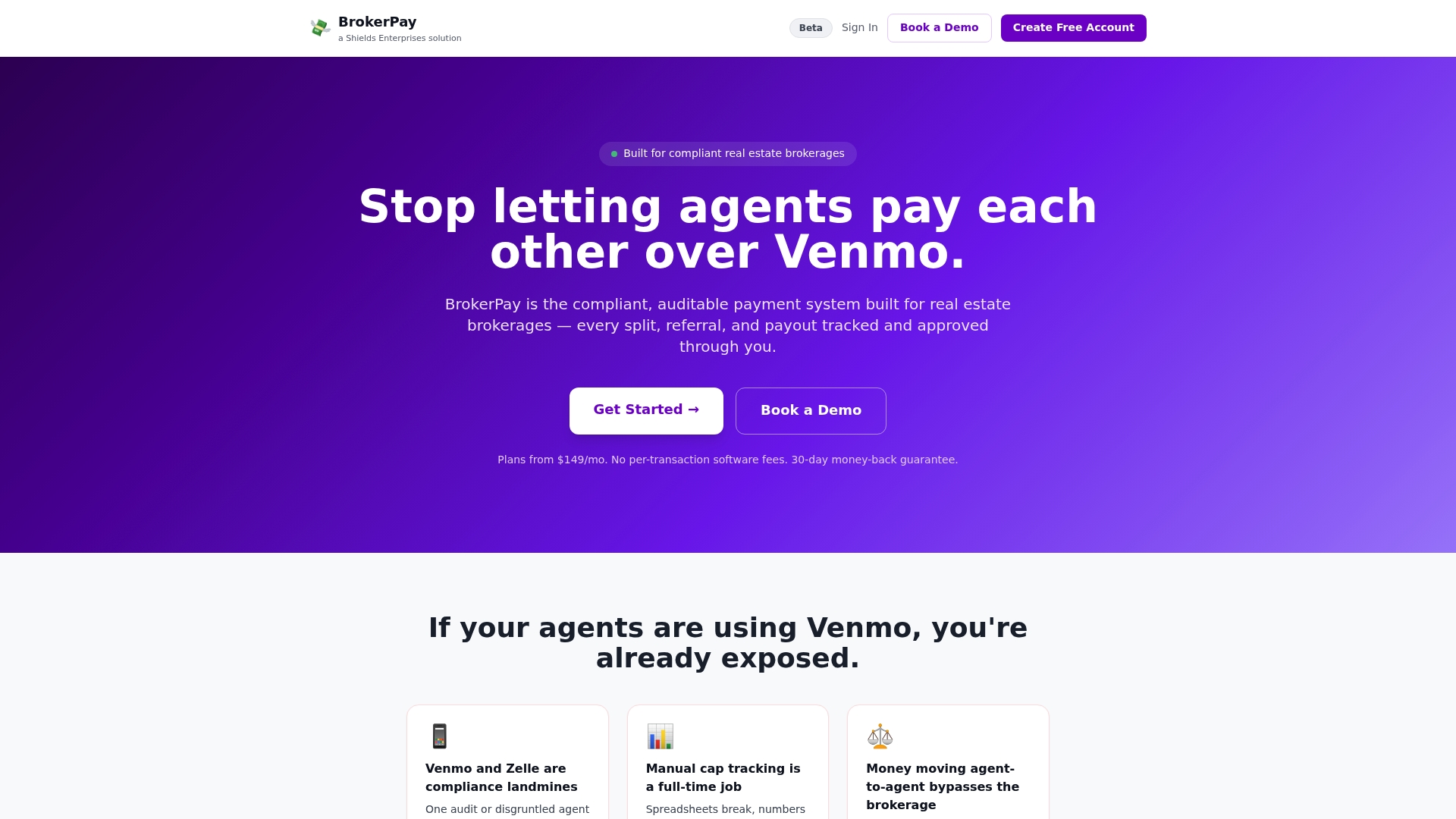
Avoid the risk of unsecured payment methods and save time reconciling spreadsheets by switching to Brokerpay. Visit Brokerpay now to see how you can simplify payment processing while maintaining full audit readiness. Start tracking and approving agent payments with complete transparency and compliance today.
FAQ
What features make Brokerpay a suitable choice for commission management?
Brokerpay offers robust agent payment requests with an approval workflow that facilitates documented sign-off. This capability allows for efficient tracking of agent payouts while maintaining compliance and audit trails, making it ideal for real estate brokerages.
How does Brokerpay compare to loft47 in terms of commission complexity?
Loft47 excels in supporting complex commission structures with customizable deal rules and AI-powered compliance checks. Brokerpay, on the other hand, is tailored for brokerages that need straightforward commission management and prefer to avoid the complexity associated with extensive customization.
Can i track my agents’ commission caps using Brokerpay?
Yes, Brokerpay provides cap tracking per agent, allowing you to monitor annual limits, volumes, and projected dates to see remaining capacity. This feature is essential for managing agent payouts effectively and preventing overpayments.
What pricing tiers does Brokerpay offer for its services?
Brokerpay starts at $149 per month for up to 50 agents, making it an accessible option for mid-sized brokerages looking for a compliant commission management solution. With no per transaction fees, budgeting becomes easier.
Does Brokerpay provide an audit trail for transactions?
Brokerpay includes an automated transfer log and audit trail that records who approved each transaction, when, and why, ensuring audit readiness. This functionality supports compliance efforts and provides transparency for financial processes.