How to Pay Agents Without Venmo or Zelle

Paying real estate agents without Venmo or Zelle means using compliant enterprise payment methods, specifically ACH transfers, Real-Time Payments (RTP) networks, and payment orchestration platforms built for brokerage operations. Consumer peer-to-peer (P2P) apps are not designed for commercial use, and relying on them exposes your brokerage to federal liability, account freezes, and broken audit trails. The right alternative payment methods are faster to reconcile, easier to document, and built to survive a compliance audit. This guide covers every compliant option available to brokerages in 2026, plus a step-by-step process to make the switch.
Why venmo and zelle create federal liability for brokerages
The core problem is not speed. It is legality. P2P apps ban commercial use explicitly in their Terms of Service, which means every commission you send through Venmo or Zelle is a potential Terms of Service violation. Violations lead to frozen accounts, which means your agents do not get paid on time and your brokerage scrambles to cut manual checks.
The operational fallout is predictable. Brokerages relying on Venmo face emergency check-cutting and accounting chaos when accounts are frozen. That is not a hypothetical. It happens regularly to brokerages that treat P2P apps as a shortcut for sending money without apps designed for business.
Beyond account freezes, the compliance exposure is serious:
- No audit trail. Venmo and Zelle do not generate the transaction records required for RESPA compliance or IRS 1099 reporting.
- No KYC or AML controls. Consumer apps do not perform the Know Your Customer (KYC) or Anti-Money Laundering (AML) checks that federal financial regulations require for business payouts.
- No reconciliation data. Without structured transaction data, your accounting team cannot match commission payments to closed deals without manual effort.
- No dispute resolution. If an agent claims they did not receive a payment, a Venmo screenshot is not sufficient documentation for a legal or regulatory proceeding.
Pro Tip: Before your next commission payout, pull your last 90 days of Venmo or Zelle transactions and ask your compliance officer whether they would survive a RESPA audit. The answer will accelerate your decision to switch.
The liability is not abstract. Brokerages are fiduciaries. Using consumer apps for fiduciary-grade payouts creates a gap between your legal obligations and your actual practices. That gap is where federal exposure lives.
What compliant payment methods replace venmo and zelle?
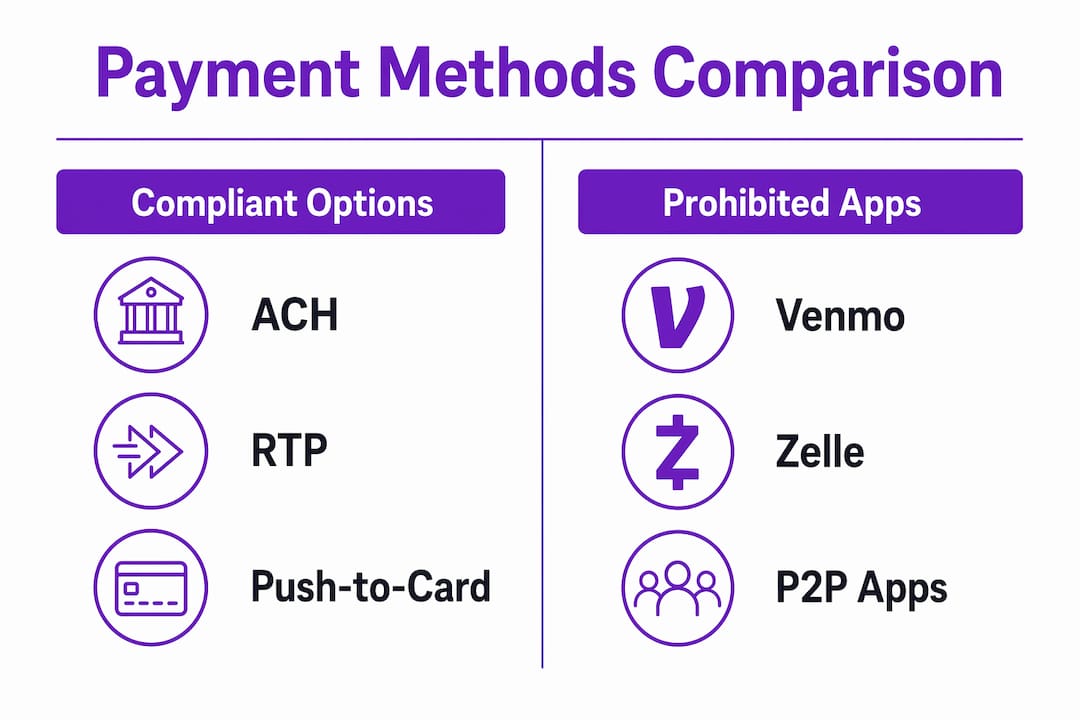
The industry standard for paying agents online is ACH (Automated Clearing House) bank transfers. ACH is the backbone of business-to-business payments in the United States, and it is built for exactly this use case. Automated ACH transfers satisfy compliance requirements and reduce reconciliation time by 50–70% compared to manual P2P methods. That time savings compounds across every closing cycle.

Beyond ACH, brokerages have three additional compliant options worth understanding:
Real-Time Payments (RTP) Networks. The RTP network, operated by The Clearing House, settles payments in seconds rather than days. Unlike Venmo, RTP operates within the regulated banking system. Agents get fast payments. Brokerages get audit-ready records. Both sides win.
Push-to-Card Transfers. Services like Visa Direct and Mastercard Send push funds directly to an agent’s debit card within 30 minutes. Push-to-card services handle KYC and AML compliance automatically, which removes a significant compliance burden from your operations team.
Payment Orchestration Platforms. These platforms sit above individual payment rails and let you manage ACH, RTP, and push-to-card from a single interface. Payment orchestration enables brokerages to unify multiple payment methods, centralize reconciliation, and maintain full compliance with federal regulations throughout the payout lifecycle.
Here is how compliant methods compare to consumer P2P apps:
| Feature | ACH / RTP / Push-to-Card | Venmo / Zelle |
|---|---|---|
| Commercial use permitted | Yes | No |
| Audit trail generated | Yes | No |
| KYC / AML compliance | Built in | Not available |
| 1099 reporting support | Yes | No |
| Account freeze risk | Very low | High |
| Settlement speed | 1–3 days (ACH) / seconds (RTP) | Instant |
| Dispute documentation | Full records | Screenshots only |
43% of users will abandon payment platforms that lack their preferred compliant channels. That statistic applies to agents too. When you offer direct-to-bank payments with clear documentation, agents trust the process more, not less.
Pro Tip: If agents push back on ACH settlement times, offer RTP or push-to-card as the default. Speed objections disappear when agents see funds in their account within the hour.
How to implement a compliant commission payment system
Replacing Venmo and Zelle is a process, not a single decision. Follow these steps to build a payment system that holds up under compliance review.
-
Audit your current payment volume. Count how many agents you pay per month, the average commission size, and how many unique payment methods you currently use. This baseline determines which platform tier you need.
-
Select a platform that integrates with your accounting software. Your payment platform must connect to QuickBooks, Xero, or your brokerage management system. Unified payment platforms that integrate with accounting software reduce errors and automate reconciliation. Disconnected systems create the same manual chaos you are trying to leave behind.
-
Automate ACH payouts and 1099 reporting. A unified ledger with automated 1099 reporting simplifies commission management and keeps your brokerage audit-ready year-round. Do not wait until January to discover your payment records are incomplete.
-
Verify agent banking information before the first payout. Collect routing numbers, account numbers, and identity verification documents for every agent. This step satisfies KYC requirements and prevents payment failures on day one.
-
Configure audit trail and reconciliation settings. Every transaction should generate a timestamped record tied to a specific deal, agent, and commission split. This is the documentation that protects you in a RESPA review or IRS inquiry.
-
Communicate the change to agents with a clear timeline. Give agents at least two weeks notice. Explain why the change is happening, what they need to provide, and when the first compliant payout will occur. Resistance drops sharply when agents understand the change protects their commissions too.
A few operational details matter here. Confirm that your platform supports co-op commission splits and referral fee payments, not just direct agent payouts. Check whether the platform handles commission tracking for tax compliance automatically. These features separate a real estate payment platform from a generic payment processor.
What challenges arise when moving away from p2p apps?
The most common objection is speed. Agents accustomed to instant Venmo transfers will notice that ACH takes 1–3 days to settle. ACH settlement is slower than instant P2P apps but delivers the audit trails and transparency that protect both parties. Address this directly by offering RTP or push-to-card as your default method where available.
The second challenge is data quality. Payment failures spike when banking information is incomplete or outdated. Enterprise platforms reduce transaction failure rates by 30–40% compared to P2P payments, but only when agent data is accurate. Build a verification step into your onboarding process for every new agent.
Here are the most common migration issues and how to handle them:
- Agent resistance. Hold a short walkthrough session showing agents exactly how to submit banking information and when to expect payments. Familiarity reduces friction faster than any policy document.
- Delayed first payouts. Plan for a two-week overlap period where you run both systems simultaneously. This prevents any agent from missing a commission during the transition.
- KYC documentation gaps. Some agents will not have a government-issued ID on file. Build a simple document collection workflow before you go live.
- Reconciliation mismatches. Run a parallel reconciliation for the first 30 days to catch any discrepancies between your new platform and your accounting records.
Pro Tip: Assign one person on your operations team as the payment transition lead. A single point of contact for agent questions cuts resolution time in half and prevents misinformation from spreading through your agent network.
Transparency and reliability outweigh speed for most agents when they understand the tradeoff. Traceable, direct-to-bank payments reduce disputes and lost commissions over time. That is a stronger value proposition than instant delivery with no paper trail.
Key takeaways
Compliant commission payments require ACH transfers, RTP networks, or payment orchestration platforms, not consumer P2P apps that ban commercial use and generate no audit trail.
| Point | Details |
|---|---|
| P2P apps are prohibited for business | Venmo and Zelle Terms of Service ban commercial use, risking account freezes and compliance violations. |
| ACH is the industry standard | ACH transfers reduce reconciliation time by 50–70% and generate the audit records brokerages need. |
| Orchestration unifies compliance | Payment orchestration platforms centralize multiple payment methods and maintain federal compliance throughout every payout. |
| Agent data quality prevents failures | Verified routing and account numbers cut transaction failure rates by 30–40% versus P2P methods. |
| Speed objections have a solution | RTP and push-to-card services settle in seconds or minutes within the regulated banking system. |
The real cost of treating payment infrastructure as an afterthought
I have watched brokerages rationalize Venmo and Zelle for years. The argument is always the same: it is fast, agents like it, and nothing bad has happened yet. That last part is the problem. “Nothing bad has happened yet” is not a compliance strategy. It is a countdown.
The brokerages I respect most treat their payment infrastructure as an operational lever, not a back-office inconvenience. They know that every commission payout is a documented transaction in a regulated industry. They know that a single frozen Venmo account during a high-volume closing week can cost them agent relationships that took years to build.
What I find most telling is the speed argument. Agents do not actually value speed above everything else. Fast payments do not guarantee better agent experience. Security and transparency rank higher when you ask agents what they actually want from a commission payment. They want to know the money is coming, when it is coming, and that there is a record if something goes wrong. ACH and RTP deliver all three. Venmo delivers none.
The brokerages that will grow in 2026 are the ones that build payment systems their agents trust and their compliance officers can defend. That is not a complicated standard. It just requires treating payment infrastructure as seriously as you treat your listing agreements.
— Wes
Stop using workarounds. start using Brokerpay.
Brokerpay is built specifically for brokerages that need to pay agents online without the compliance risks of Venmo or Zelle. It tracks agent splits, referral fees, and co-op commissions in a single platform, generates audit-ready records automatically, and keeps your brokerage RESPA-compliant on every payout.
Brokerpay handles 1099 documentation, reconciliation, and KYC verification so your operations team is not rebuilding the wheel every closing cycle. If you are ready to replace your P2P workarounds with a compliant commission payment platform built for real estate, Brokerpay is the direct answer. You can also explore automated payout workflows to see exactly how the transition works for brokerages at your volume.
FAQ
Why can’t brokerages use venmo or zelle to pay agents?
Venmo and Zelle explicitly prohibit commercial use in their Terms of Service. Brokerages that use them for commission payments risk account freezes, payment disruptions, and zero audit trail for RESPA or IRS compliance.
What is the best alternative payment method for agent commissions?
ACH bank transfers are the industry standard for compliant agent commission payments. For faster settlements, RTP networks and push-to-card services like Visa Direct settle within seconds while remaining fully within the regulated banking system.
How long does ACH take to pay agents?
ACH transfers settle in 1–3 business days. Brokerages that need faster secure payment options can use RTP networks, which settle in seconds, or push-to-card services that deliver funds within 30 minutes.
What is a payment orchestration platform for brokerages?
A payment orchestration platform unifies ACH, RTP, and push-to-card into a single interface with centralized reconciliation and compliance reporting. It eliminates manual patchwork and keeps every payout audit-ready.
Does switching from venmo to ACH require agents to do anything?
Yes. Agents must provide verified banking information, including routing and account numbers, before the first ACH payout. This one-time setup step also satisfies KYC requirements and prevents payment failures going forward.