Common Informal Payment Platform Risks for Brokers

Informal payment platforms are defined as peer-to-peer (P2P) apps and unverified money transfer networks used outside regulated business payment channels. Venmo, Zelle, Cash App, and cross-border systems like hundi fall into this category. E-commerce fraud losses are projected to exceed $100 billion by 2029, and financial institution fraud losses are expected to rise 150% by 2030. For real estate professionals processing agent splits, referral fees, and co-op commissions, the common informal payment platform risks are not theoretical. They are active, compounding, and increasingly expensive.
1. What are the primary fraud risks in informal payment platforms?
Authorized Push Payment (APP) fraud is the dominant threat on informal platforms. A scammer impersonates a title company, co-op agent, or broker, sends a fake invoice, and the victim authorizes the transfer. The money moves instantly and cannot be recalled.
Instant payment methods like FedNow and Pix are designed for irrevocable transfers, which means victims have almost no dispute window once a transaction clears. Credit cards offer 60-day chargeback windows. Venmo and Zelle offer none. That asymmetry matters enormously when a real estate deal involves five- or six-figure commission payments.

Account takeover is a related threat. A bad actor gains access to a broker’s P2P account through phishing, then reroutes pending payments. The broker often does not discover the breach until agents report missing funds.
Key fraud vectors on informal platforms include:
- Fake invoice scams targeting brokers who pay agent splits via P2P apps
- Impersonation of title companies or co-op agents requesting urgent transfers
- Phishing links sent via SMS or email to capture P2P login credentials
- Account takeover through credential stuffing on reused passwords
Pro Tip: Treat any smartphone used for P2P payments as a mobile bank vault. Enable biometric authentication, use a unique password, and never approve transfers from shared or public Wi-Fi networks.
2. How do legal and regulatory risks affect businesses using informal payment methods?
Using unverified cross-border transfer networks creates direct criminal exposure. Informal remittance channels like hundi bypass legal frameworks entirely, and penalties include asset forfeiture, criminal prosecution, and in some jurisdictions, deportation. Real estate brokerages that process international referral fees through informal channels face the same exposure as individual users.
Regulatory noncompliance also triggers account freezes. Payment platforms are required to file Suspicious Activity Reports (SARs) under the Bank Secrecy Act. A brokerage routing large, irregular commission payments through a personal Venmo account can trigger an automated SAR filing without any warning.
Legal risks from informal payment use include:
- RESPA violations when commission splits lack proper documentation
- IRS reporting gaps when informal payments bypass 1099 requirements
- Account closure triggered by SAR filings on flagged transaction patterns
- Asset forfeiture for cross-border transfers routed through unregulated networks
Legitimate international transfers often qualify for cash-matching bonuses of up to 2.5% through regulated channels. Using informal networks forfeits those incentives entirely, adding a direct financial cost on top of the legal exposure.
Pro Tip: Document every commission payment with a paper trail that includes the payee, amount, transaction date, and purpose. Informal platforms rarely generate compliant records automatically.
3. What operational and financial challenges do informal platforms create?
Informal payments lack integration with accounting software, which forces manual reconciliation. Manual tracking increases error rates and undermines audit reliability. For a brokerage processing 50 or more transactions per month, that manual workload compounds quickly into a serious compliance liability.
Tax compliance is a direct casualty. When agent splits are paid through Venmo or Cash App, those transactions do not automatically generate 1099 records. The brokerage carries the burden of reconstructing payment histories at tax time, often from screenshots and memory. Proper commission tracking prevents tax issues that can otherwise surface during an IRS audit.
Operational challenges from informal payment platforms include:
- No native accounting integration with QuickBooks, Xero, or similar platforms
- Manual receipt generation required for every transaction, increasing administrative labor
- Sudden payment holds when platforms flag unusual transaction volumes
- Delayed fund access when accounts are under review for terms-of-service violations
- No dispute resolution process for incorrect or duplicate payments
P2P apps carrying business payments risk sudden restrictions due to account eligibility violations. Platforms monitor for personal-to-business transaction patterns and can freeze accounts algorithmically, with no advance notice and no guaranteed timeline for resolution.
4. How do security and privacy vulnerabilities make informal payments risky?
P2P platforms use personal identifiers, typically a phone number or email address, as the payment key. Using personal identifiers as payment keys creates a target-rich attack surface. Scammers can cross-reference a broker’s phone number across messaging apps, social media, and public real estate listings to build a profile and launch a direct social engineering attack.
Social engineering has become the dominant fraud vector in digital payments, surpassing technical system hacking. The human element is now the primary vulnerability. A convincing text message impersonating a known agent is more effective than any malware attack.
Visual payment confirmations compound the problem. Screenshot-based payment confirmations can be spoofed or replayed with basic image editing tools. A fraudulent buyer can present a fake Venmo screenshot as proof of earnest money, and without cryptographic verification, the broker has no reliable way to confirm the funds actually moved.
“Fast payment systems built on trust rather than cryptographic verification leave merchants with nearly impossible recovery paths when fraud occurs.” — BusinessAMLive
AI-driven scams are accelerating this threat. Deepfake audio and video now enable real-time impersonation of known contacts. A broker could receive a voice message that sounds exactly like a trusted agent requesting an urgent wire reroute. Enterprise-grade mobile security, including app-level authentication and transaction confirmation protocols, is no longer optional for brokerages handling significant payment volumes.
5. How do informal payment risks compare to formal business payment solutions?
The trade-off between informal and formal payment platforms is not just about convenience. It is about risk-adjusted cost. The table below maps the key differences across the factors that matter most to real estate professionals.
| Risk Factor | Informal Platforms (Venmo, Zelle, Cash App) | Formal Business Solutions |
|---|---|---|
| Fraud recourse | None. Transfers are irrevocable. | Dispute windows of 60–120 days depending on method |
| Regulatory exposure | High. No SAR controls or RESPA documentation. | Low. Built-in compliance reporting. |
| Operational integration | None. Manual reconciliation required. | Native accounting software integration. |
| Dispute resolution | No formal process. | Structured chargeback and mediation process. |
| Audit trail | Screenshots only. Not legally sufficient. | Timestamped, documented transaction records. |
| Account stability | Subject to algorithmic freezes. | Stable with dedicated business support. |
Informal platforms are acceptable for low-value, personal transactions between trusted parties. They are not acceptable for brokerage commission payments, referral fees, or co-op transactions. The moment a payment carries legal, tax, or regulatory significance, the informal platform creates more risk than it eliminates.
Understanding what a real estate payment gateway actually provides makes this comparison concrete. Formal gateways generate compliant records, integrate with accounting systems, and carry dispute resolution infrastructure that P2P apps simply do not offer.
Switching from manual to automated payouts eliminates the reconciliation gap and reduces the operational cost of managing agent splits at scale.
Key takeaways
Informal payment platforms create compounding fraud, legal, and operational risks that formal business payment solutions are specifically designed to eliminate.
| Point | Details |
|---|---|
| APP fraud is the top threat | Irrevocable instant transfers give brokers no recourse after a scam payment clears. |
| Legal exposure is real | RESPA violations, IRS gaps, and SAR filings can result from informal commission payments. |
| Manual reconciliation costs add up | No accounting integration means higher error rates and audit risk at tax time. |
| Screenshot confirmations are not proof | Spoofed payment images are undetectable without cryptographic verification. |
| Formal platforms reduce total risk cost | Dispute resolution, compliance records, and account stability justify the switch. |
Why informal payment risks compound faster in real estate
Real estate transactions are high-value, time-pressured, and involve multiple parties who often communicate across different channels. That combination is exactly what fraud operators target. I have seen brokerages lose five-figure commission payments to APP fraud because an agent received a spoofed text that looked identical to a message from the broker. The payment cleared in seconds. The recovery process took months and ultimately failed.
The operational side is just as damaging, even when no fraud occurs. A brokerage running 80 transactions per month through Venmo is generating 80 manual reconciliation entries, 80 potential 1099 gaps, and 80 opportunities for a platform algorithm to flag the account and freeze access. That is not a payment system. That is a liability accumulation engine.
My honest view is that the “it’s faster and easier” argument for informal platforms collapses the moment you price in one account freeze during a closing cycle. The delay alone can cost more than a year of platform fees for a compliant solution. Real estate professionals who treat payment infrastructure as a back-office afterthought are the ones who end up in front of a compliance officer explaining why agent splits were processed through a personal Venmo account.
The compliant co-op payment workflows that formal platforms enable are not bureaucratic overhead. They are the documentation that protects you when a transaction is disputed, audited, or investigated.
— Wes
Stop using Venmo for commission payments
Brokerpay is built specifically for real estate brokerages that need to process agent splits, referral fees, and co-op commissions with full compliance and zero manual reconciliation. Every transaction is tracked, documented, and RESPA-compliant by default. You get the audit trail that Venmo and Zelle cannot provide, and your agents get paid on time without account freeze risk.
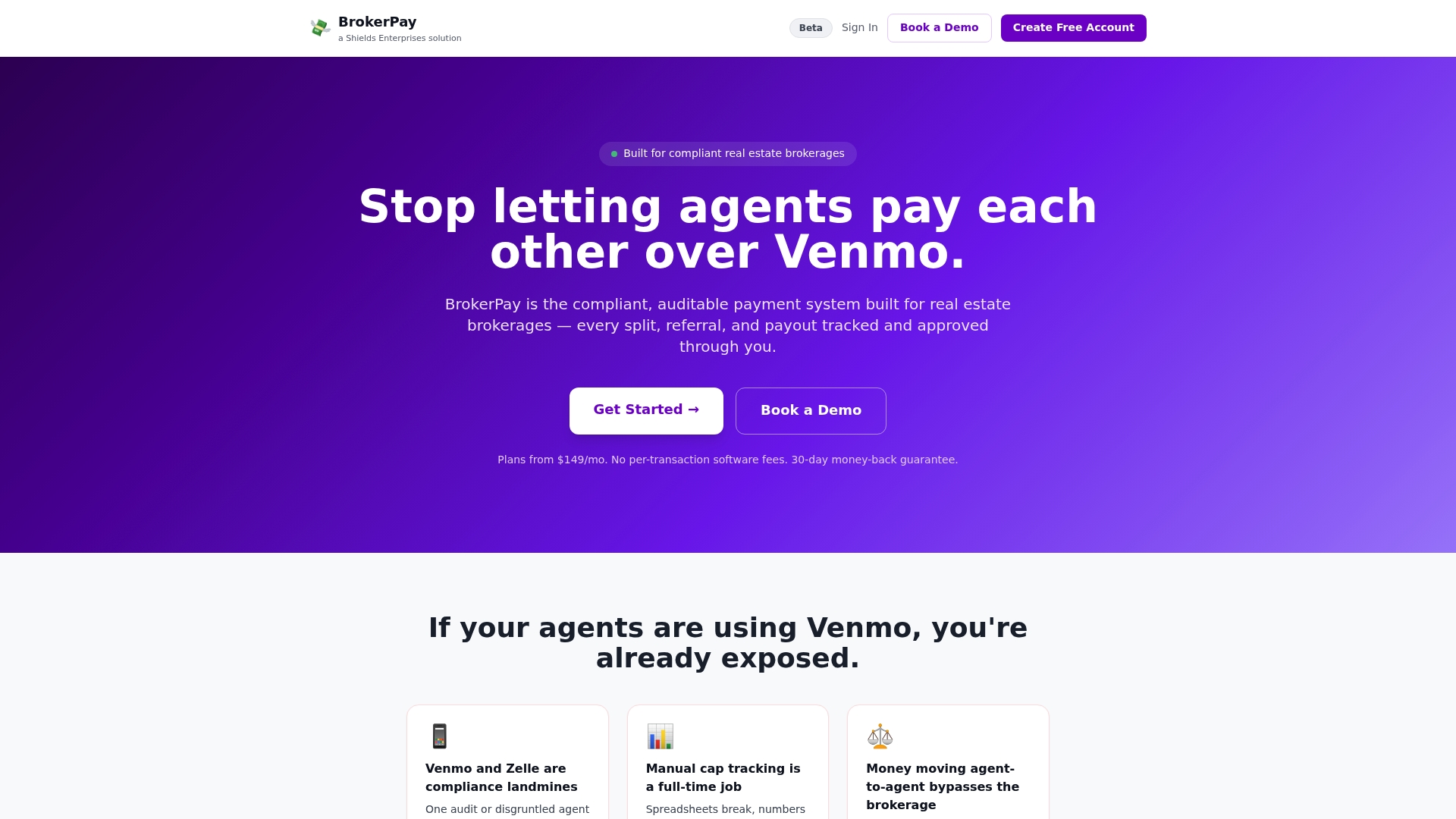
If your brokerage is still routing commission payments through informal platforms, the risks covered in this article are active in your operation right now. Replace your Venmo workarounds with a payment platform built for the legal and operational demands of real estate.
FAQ
What are the most common informal payment platform risks for brokers?
The most common risks are APP fraud with no recourse, RESPA documentation failures, IRS reporting gaps, and account freezes from P2P platform terms violations. Each risk compounds when informal platforms are used for high-value commission payments.
Are Venmo and Zelle safe for real estate commission payments?
Venmo and Zelle are not designed for business commission payments. They offer no dispute resolution, no compliance documentation, and no accounting integration, making them unsuitable for RESPA-regulated transactions.
Can using informal payment platforms trigger an IRS audit?
Yes. Informal payments that bypass 1099 reporting requirements create tax compliance gaps. The IRS cross-references payment platform data, and missing records from P2P transactions can trigger an audit or penalty.
How does APP fraud work on P2P payment apps?
Authorized Push Payment fraud occurs when a scammer impersonates a known party and tricks the victim into authorizing a transfer. Instant payment platforms like FedNow and Pix make these transfers irrevocable, leaving victims with no recovery path.
What is the safest payment method for real estate agent splits?
A compliant business payment platform that generates documented transaction records, integrates with accounting software, and supports RESPA compliance is the safest method for processing agent splits and referral fees.