Real Estate Payment Reconciliation Process Explained

The real estate payment reconciliation process is defined as the systematic matching of internal accounting records against external financial statements to verify every payment is accurately recorded. In practice, this means comparing rent rolls, tenant ledgers, escrow accounts, and bank statements to confirm that no dollar is missing, duplicated, or misallocated. For real estate professionals and accountants, this process is not optional bookkeeping. It is a critical internal control that prevents inaccurate reporting, fraud, and missed invoices across every transaction type.
What is the real estate payment reconciliation process?
Payment reconciliation in real estate is the structured workflow of confirming that every payment received or disbursed matches both the internal general ledger and the external bank record. The process covers rent payments, security deposits, escrow disbursements, agent commissions, referral fees, and co-op payments. Each of these payment types carries its own timing, documentation, and compliance requirements.
The general ledger is the primary source of truth, not the bank statement. Relying on bank feeds alone misses internal misallocations between client trust accounts and operating accounts. A payment may appear correctly on a bank statement while being posted to the wrong tenant account or property in the ledger. That kind of error only surfaces through a full reconciliation.

Real estate reconciliation also underpins tax-ready records and credible cash flow reporting. Regular bank reconciliations give investors and brokerages the accurate numbers they need for tax filings and investment decisions. Without them, financial statements are unreliable.
What are the key steps in the reconciliation process?
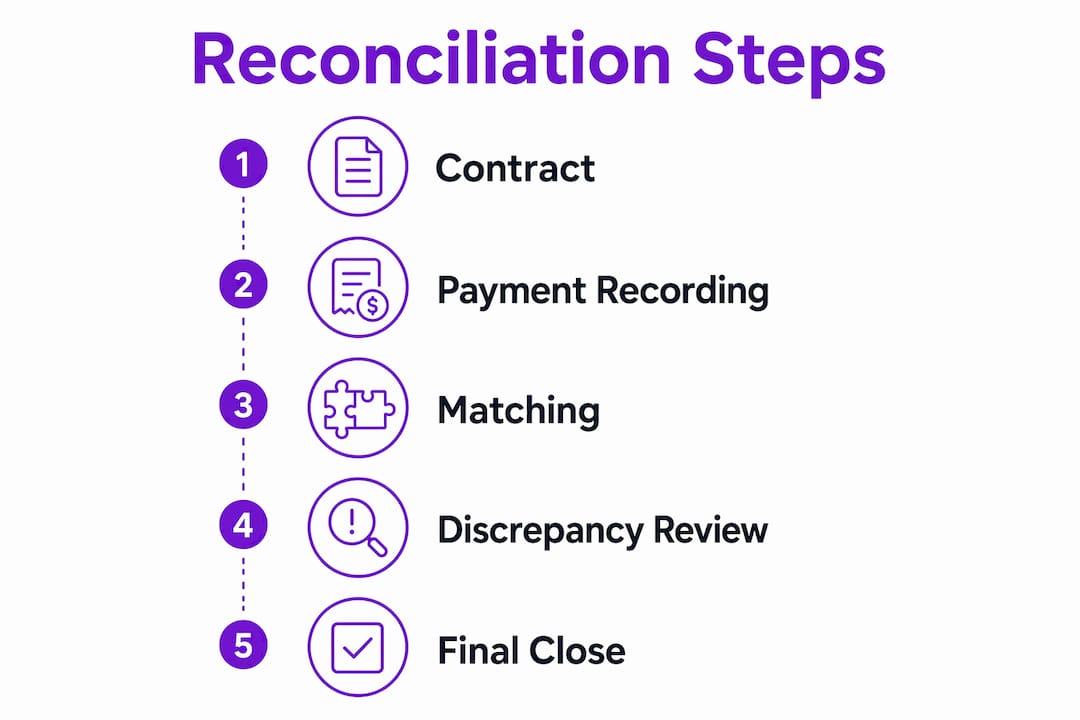
The reconciliation workflow follows a clear sequence. Skipping any step creates gaps that compound over time.
- Collect source documents. Gather bank statements, tenant ledgers, rent rolls, lease agreements, escrow account records, and any payment receipts for the period.
- Reconcile the rent roll. Match each tenant’s expected payment against what was actually received and posted in the ledger. Flag any underpayments, overpayments, or missing entries.
- Compare bank deposits to ledger entries. Every deposit on the bank statement must correspond to a specific ledger posting. Timing differences are common but must be documented.
- Identify discrepancies. Discrepancies fall into three categories: missing transactions, duplicate postings, and misallocated amounts. Each requires a separate resolution path.
- Investigate and resolve exceptions. Trace each discrepancy to its source. Correct posting errors, contact tenants for missing payments, and document every adjustment with a clear audit trail.
- Close the period. Once all exceptions are resolved, lock the period in the accounting system and retain supporting documents per your state’s record retention requirements.
- Review escrow and trust accounts separately. Trust accounts must be balanced exactly as mandated by fiduciary law, with disbursements only after signed releases or closing confirmations are logged.
Typical residential escrow reconciliations run 30–45 days from contract to close, with final reconciliation occurring three business days before closing alongside the lender’s Closing Disclosure. That timeline leaves little room for unresolved discrepancies.
Pro Tip: Run reconciliations daily or weekly for high-volume portfolios. High-volume firms that reconcile daily reduce discrepancy investigation time by up to 80% compared to monthly-only processes.
How does reconciliation ensure compliance and fiduciary responsibility?
Real estate brokerages and property managers operate under strict fiduciary obligations. These obligations require that client money, specifically security deposits and escrow funds, never comingle with operating funds. Security deposits and escrow funds must be held in dedicated bank accounts, sometimes accruing interest, and require thorough per-tenant reconciliation across deposits, deductions, and refunds.
State real estate commissions mandate that trust accounts balance to the penny. The consequences of failing that standard are serious:
- License suspension or revocation for brokers who cannot produce accurate trust account records on demand
- Civil liability to clients whose funds were mishandled, even unintentionally
- Federal audit exposure when escrow or commission payments do not match reported income
- RESPA violations when co-op commissions or referral fees are paid outside compliant channels
“Separating reconciliation of trust funds from operating funds is not optional. It is a legal obligation requiring clear audit trails and complete segregation of client money.” — GTC Systems
The audit trail is the mechanism that makes compliance provable. Every adjustment, correction, and disbursement must be logged with a date, amount, user, and reason. Without that trail, a brokerage cannot demonstrate compliance to a state auditor or defend against a client dispute.
Real Time Payments and FedNow are changing the timing side of this equation. These networks are moving commission disbursements from the legacy 2–3 day settlement window toward same-day payouts in 2026. Faster payments mean reconciliation must keep pace, which makes real-time tracking tools a practical necessity rather than a luxury.
What are common errors in real estate payment reconciliation?
Errors in real estate financial reconciliation cluster around a predictable set of causes. Knowing them in advance lets you build controls that catch them before they compound.
The most frequent problems include:
- Manual posting errors. A payment entered with a transposed digit or assigned to the wrong tenant account creates a mismatch that can take hours to trace.
- Timing mismatches. An ACH payment initiated on the 30th may not clear the bank until the 2nd of the following month. Without a timing note in the ledger, it looks like a missing payment.
- Multi-channel complexity. Tenants and agents pay through ACH, credit cards, checks, wire transfers, and sometimes cash. Each channel has different clearing times and documentation requirements.
- Late fees and concessions. Adjustments like late fees, rent concessions, or lease incentives must be posted correctly or the ledger will never match the bank statement.
- Duplicate transactions. A payment processed twice, once manually and once through an automated system, inflates the ledger until someone catches it.
Detecting discrepancies early, within the accounting period rather than after an audit, significantly reduces correction costs and reputational damage. A misallocated payment found the same week it was posted takes minutes to fix. The same error found six months later during an audit requires reconstructing a paper trail across multiple periods.
Pro Tip: Never accept a bank statement as the final word on accuracy. Cross-check every deposit against the tenant ledger and the lease agreement. The bank confirms money moved. The ledger confirms where it belongs.
What tools and best practices improve reconciliation accuracy?
Automation is the most significant change in real estate payment tracking over the past five years. Automation tools using real-time bank feeds shift reconciliation from a painful month-end task to an efficient daily workflow. The practical effect is fewer errors, faster exception resolution, and a permanent audit trail that requires no manual assembly.
The table below compares manual and automated reconciliation across the dimensions that matter most to real estate accountants.
| Factor | Manual reconciliation | Automated reconciliation |
|---|---|---|
| Error rate | High due to manual data entry | Lower through system matching |
| Time per period | Several hours to days | Minutes for routine periods |
| Audit trail | Requires manual documentation | Generated automatically |
| Discrepancy detection | End of period or later | Real-time or daily |
| Compliance readiness | Dependent on staff diligence | Built into the workflow |
Property management platforms with integrated ledgers, such as those that connect directly to bank feeds and lease data, eliminate the manual import step entirely. That single change removes one of the most common sources of posting errors.
Best practices for real estate bookkeeping practices that hold up under audit include:
- Reconcile trust accounts and operating accounts on separate schedules and never combine their records
- Retain all supporting documents, bank statements, receipts, and adjustment logs, for the period your state requires
- Schedule a formal review of open exceptions at least weekly so nothing ages past the accounting period
- Use automated commission payouts for agent splits and referral fees to eliminate the Venmo and Zelle workarounds that create RESPA exposure
Pro Tip: Accurate commission tracking does more than prevent payment disputes. It also supports tax compliance for agents by creating a documented record of every split, referral fee, and co-op payment received.
The role of automation in real estate sales extends well beyond commission management. Brokerages that connect their CRM, transaction management, and accounting systems create a data flow where reconciliation happens continuously rather than as a periodic scramble.
Key Takeaways
Payment reconciliation in real estate is a continuous compliance and accuracy function, not a periodic bookkeeping task, and brokerages that treat it as such avoid audits, penalties, and financial losses.
| Point | Details |
|---|---|
| General ledger is primary | Never rely on bank statements alone. Cross-check every entry against the tenant ledger and lease. |
| Trust accounts require exact balancing | State law mandates penny-perfect trust account reconciliation with full audit trails before any disbursement. |
| Early error detection saves money | Fixing discrepancies within the accounting period costs far less than correcting them after an audit. |
| Automation reduces risk | Real-time bank feeds and integrated platforms cut manual errors and generate audit trails automatically. |
| Compliance is non-negotiable | RESPA violations, license risk, and federal audit exposure all trace back to poor reconciliation practices. |
The case for treating reconciliation as a daily discipline
I have worked with real estate accountants who treat reconciliation as a month-end ritual, something to endure before closing the books. That mindset is expensive. The brokerages I have seen face state audits almost always had one thing in common: they let exceptions age. A timing mismatch from the 3rd sits unresolved until the 28th, by which point three more transactions have been posted against the same account. Now you are untangling a knot instead of pulling a single thread.
The shift that actually changes outcomes is treating reconciliation as a daily discipline rather than a periodic event. That does not mean spending hours every day. It means checking the exception queue each morning, resolving anything under $500 immediately, and flagging anything larger for same-day review. Most days, that takes fifteen minutes. The months where it saves you are the ones where a duplicate ACH or a misposted escrow disbursement gets caught before it compounds.
The other thing I would push back on is the assumption that automation replaces accounting judgment. It does not. Automated bank feeds are excellent at matching obvious transactions. They are poor at recognizing that a $1,200 deposit belongs to Unit 4B under a lease amendment that was never uploaded to the system. The general ledger still requires a human who understands the underlying agreements. Technology handles the volume. Accountants handle the exceptions that technology cannot classify.
For brokerages managing agent splits and co-op commissions, the compliance dimension adds another layer. Paying agents through personal payment apps is not just sloppy. It is a federal liability. The reconciliation process for commission payments must produce the same documented audit trail as any other trust account transaction.
— Wes
How Brokerpay supports compliant commission reconciliation
Real estate brokerages that process agent splits, referral fees, and co-op commissions need more than a spreadsheet to stay compliant. Brokerpay is built specifically for that workflow.

Brokerpay tracks, documents, and processes every commission payment in a single platform, keeping brokerages RESPA-compliant and eliminating the Venmo and Zelle workarounds that create federal liability. Every split is logged with a full audit trail, every disbursement is tied to a transaction record, and real-time tracking means your books reflect actual payment status rather than what you think cleared last week. For brokerages ready to move from manual to documented, Brokerpay’s commission platform is the direct path to compliant, reconciled payouts.
FAQ
What is the real estate payment reconciliation process?
The real estate payment reconciliation process is the systematic matching of internal accounting records, including rent rolls, tenant ledgers, and escrow accounts, against external bank statements to verify every payment is accurately recorded and accounted for.
How often should real estate payment reconciliation be done?
Experts recommend monthly reconciliation at minimum, but high-volume firms reconcile daily to reduce discrepancy investigation time and catch errors within the same accounting period.
Why must trust accounts be reconciled separately from operating accounts?
State fiduciary law requires that client funds never commingle with operating funds. Trust accounts must balance to the penny, with disbursements only after signed releases are logged, and violations can result in license suspension or civil liability.
What are the most common errors in real estate reconciliation?
The most common errors are manual posting mistakes, timing mismatches between payment initiation and bank clearing, duplicate transactions, and misallocated payments caused by multi-channel payment complexity.
How does Brokerpay help with commission payment reconciliation?
Brokerpay automates the tracking, documentation, and processing of agent splits, referral fees, and co-op commissions, producing a full audit trail for every disbursement and keeping brokerages RESPA-compliant without manual workarounds.