Commission Payment Automation Benefits for Brokerages

Commission payment automation is the process of using software to automatically calculate, process, and distribute agent commissions, eliminating manual errors and payout delays. For real estate brokerages, this shift from spreadsheets to purpose-built platforms like Brokerpay, Commissionly, and Fullcast delivers measurable gains in accuracy, speed, and compliance. The benefits of commission payment automation go beyond saving time. They directly affect agent trust, financial control, and your brokerage’s ability to stay RESPA-compliant without relying on Venmo or Zelle workarounds that create federal liability.
1. What are the top benefits of commission payment automation?
Automated commission management, the industry term for this category of software, solves the core problems that manual processes create: calculation errors, slow payouts, and zero audit trail.
Accuracy that protects your bottom line. Manual commission processes carry 3–8% error rates. Automation cuts that to under 1%, a better than 90% improvement. On a $5 million annual commission spend, that gap represents up to $440,000 in potential errors. Most brokerages never see those losses because they never audit their spreadsheets.

Speed that agents notice. Reconciliation labor drops from 20–40 hours per month to 2–4 hours. Processing time shrinks from five days to under one day. Agents get paid faster, and your operations team stops spending Fridays fixing split calculations.
Transparency that builds trust. Real-time dashboards let agents see their earnings mid-month. That visibility changes behavior. Agents who can track their own commissions course-correct their activity before the month closes, not after.
An audit trail that protects you. Manual processes lack documented audit trails. Automation creates a timestamped record of every calculation, approval, and payment. That record is your defense in a dispute or a regulatory review.
Pro Tip: Run a single month of your current commission data through a trial of any automated platform. The discrepancies you find in that first pass will tell you exactly how much your manual process is costing you.
2. How does commission automation integrate with your existing systems?
Integration is where the benefits of automated commission tracking multiply. A commission platform that connects to your CRM, accounting software, and transaction management system becomes a single source of truth for every deal.
When a transaction closes in your CRM, the commission software pulls the deal data automatically. It validates the split against the agent agreement on file, flags any discrepancy, and queues the payment. No manual data entry. No copy-paste errors between systems.
Automation supports complex multi-tier and co-op commission structures without adding workload. A brokerage running tiered splits, referral fees, and co-op payments simultaneously would need multiple spreadsheets and a dedicated administrator to manage that manually. Automated systems handle all three in one workflow.
Real-time performance data also becomes available to managers. Instead of waiting for month-end reports, a broker-owner can see which agents are tracking toward their cap, which deals are pending payout, and where disputes are forming. That visibility supports proactive decisions, not reactive ones.
Pro Tip: Before selecting a platform, map every commission structure your brokerage uses: tiered splits, referral fees, co-op payments, and team splits. Confirm the software handles all of them natively before you sign a contract.
3. What financial advantages do brokerages gain from automating commissions?
The financial case for automation is concrete. Brokerages with $1 million in revenue typically recover $15,000 to $25,000 in the first year from automation detecting missed splits and calculation errors. A $5 million revenue firm recovers $75,000 to $125,000. Those are not projected savings. They are real dollars that manual processes were losing silently.
Overpayments are the other side of that equation. When a commission is calculated incorrectly in an agent’s favor, recovering that money creates conflict and damages the relationship. Automation prevents overpayments before they happen, eliminating the clawback conversation entirely.
The strategic value goes further. Commission software acts as a data layer that lets you model “what-if” scenarios before rolling out a new comp plan. You can forecast the financial impact of changing your split structure, adding a team override, or introducing a performance bonus, all before a single agent is affected. That capability alone justifies the platform cost for most mid-size brokerages.
| Financial benefit | What it means in practice |
|---|---|
| Recovered missed splits | $15,000–$125,000 recovered in year one depending on revenue |
| Overpayment prevention | Eliminates clawback disputes before they start |
| Comp plan modeling | Forecast cost of new plans before rollout |
| Audit trail protection | Reduces liability exposure in disputes and regulatory reviews |
| Labor cost reduction | Ops team hours shift from calculation to higher-value work |
4. How does automation reduce commission disputes and build agent trust?
Commission disputes are a trust problem before they are a math problem. When an agent does not understand why their check is a certain amount, they assume an error. That assumption creates friction, inquiry calls, and in some cases, departures.
Transparent commission statements with itemized calculations eliminate that ambiguity. An agent can see exactly how their split was calculated, what fees were deducted, and when the payment was processed. That level of detail answers the question before it becomes a complaint.
The numbers confirm this effect. Real-time commission visibility reduces “where is my money” inquiries by 90%. That is not just a morale improvement. It is a direct reduction in administrative workload for your operations staff.
Shadow accounting, the practice where agents track their own commissions in parallel to verify the brokerage’s numbers, drops significantly when agents trust the platform. Transparent dashboards eliminate the need for agents to maintain their own spreadsheets. That trust compounds over time and shows up in retention numbers.
“Agents who can see their earnings in real time stop second-guessing the brokerage. The transparency itself becomes a retention tool.”
Well-designed incentive programs improve sales performance by 22%. Automation amplifies that effect by making the incentive structure visible and verifiable at all times.
5. How does real-time visibility improve agent performance?
Real-time earnings visibility changes how agents manage their own activity. Agents who can track commissions mid-month course-correct their behavior before the period closes. An agent who sees they are $8,000 short of their cap threshold will prioritize differently in the final two weeks of the month than one who finds out at month-end.
This is the performance management angle that most brokerages miss. Commission automation is not just a back-office tool. It is a front-line motivation system. When agents understand exactly what they earn from each deal type, they make better decisions about where to focus their time.
Automated commission visibility also supports proactive coaching. A broker-owner or team lead can see performance trends during the sales cycle, not after it closes. That timing matters. A conversation in week two of the month is actionable. The same conversation in week five is a post-mortem.
Brokerpay’s real-time dashboard gives agents and managers that mid-cycle view, connecting deal activity directly to projected payouts without requiring anyone to run a report manually.
6. What challenges come with switching from manual to automated commission systems?
The transition from manual to automated commission management has predictable friction points. Knowing them in advance makes the switch faster and cleaner.
Cultural resistance is the most common barrier. Agents and administrators who have used the same spreadsheet process for years will question whether the new system is accurate. The fix is a parallel run: process one month manually and through the automated system simultaneously, then compare outputs. The discrepancies that surface make the case better than any demo.
Data quality issues slow most implementations. If your agent agreements, split structures, and deal records live in different places or formats, the integration work takes longer. Audit your data before you start. Clean records mean a faster go-live.
Integration complexity varies by platform. A real estate-focused solution like Brokerpay is built to handle the specific structures brokerages use: co-op payments, referral fees, and tiered splits. A generic sales commission tool will require significant customization to match those requirements. Choosing a real estate-specific platform from the start avoids that rework.
Phased rollouts reduce risk. Start with one transaction type or one team before moving the entire brokerage. That approach builds internal confidence and surfaces edge cases before they affect your full agent roster.
Key takeaways
Commission payment automation delivers measurable financial, operational, and cultural benefits that manual processes cannot replicate, making it a direct competitive advantage for real estate brokerages.
| Point | Details |
|---|---|
| Error reduction | Automation cuts commission errors from 3–8% to under 1%, protecting significant revenue. |
| Labor savings | Monthly reconciliation drops from 20–40 hours to 2–4 hours after implementation. |
| Financial recovery | Brokerages recover $15,000–$125,000 in year one from detected missed splits. |
| Dispute reduction | Real-time transparency cuts agent commission inquiries by 90%. |
| Transition strategy | A phased rollout with parallel processing reduces adoption risk and builds trust. |
What I’ve learned from watching brokerages make this switch
I have seen broker-owners delay automation for years because the manual process “works.” It works the way a leaking pipe works. Nothing has collapsed yet, but the damage is accumulating quietly. The first time an automated platform runs against their historical data, the reaction is almost always the same: disbelief at how many small errors had been compounding unnoticed.
The morale shift is the part that surprises people most. Broker-owners expect to save time. They do not expect their agents to stop calling about commission questions. That reduction in friction changes the relationship between the brokerage and its agents in a way that is hard to quantify but immediately obvious to anyone running the office.
My advice on tool selection: do not use a generic sales commission platform and try to configure it for real estate. The co-op payment structures, RESPA compliance requirements, and referral fee workflows are specific enough that a purpose-built solution pays for itself in avoided customization costs alone. Brokerpay was built for exactly this environment. That specificity matters more than any feature list.
The brokerages that get the most from automation are the ones that treat it as an operational shift, not a software purchase. Train your staff, run the parallel period, and commit to the new process fully. The results follow quickly.
— Wes
How Brokerpay handles commission payments for real estate brokerages
Real estate brokerages that process agent splits, referral fees, and co-op commissions manually are carrying financial and compliance risk that automation eliminates directly.
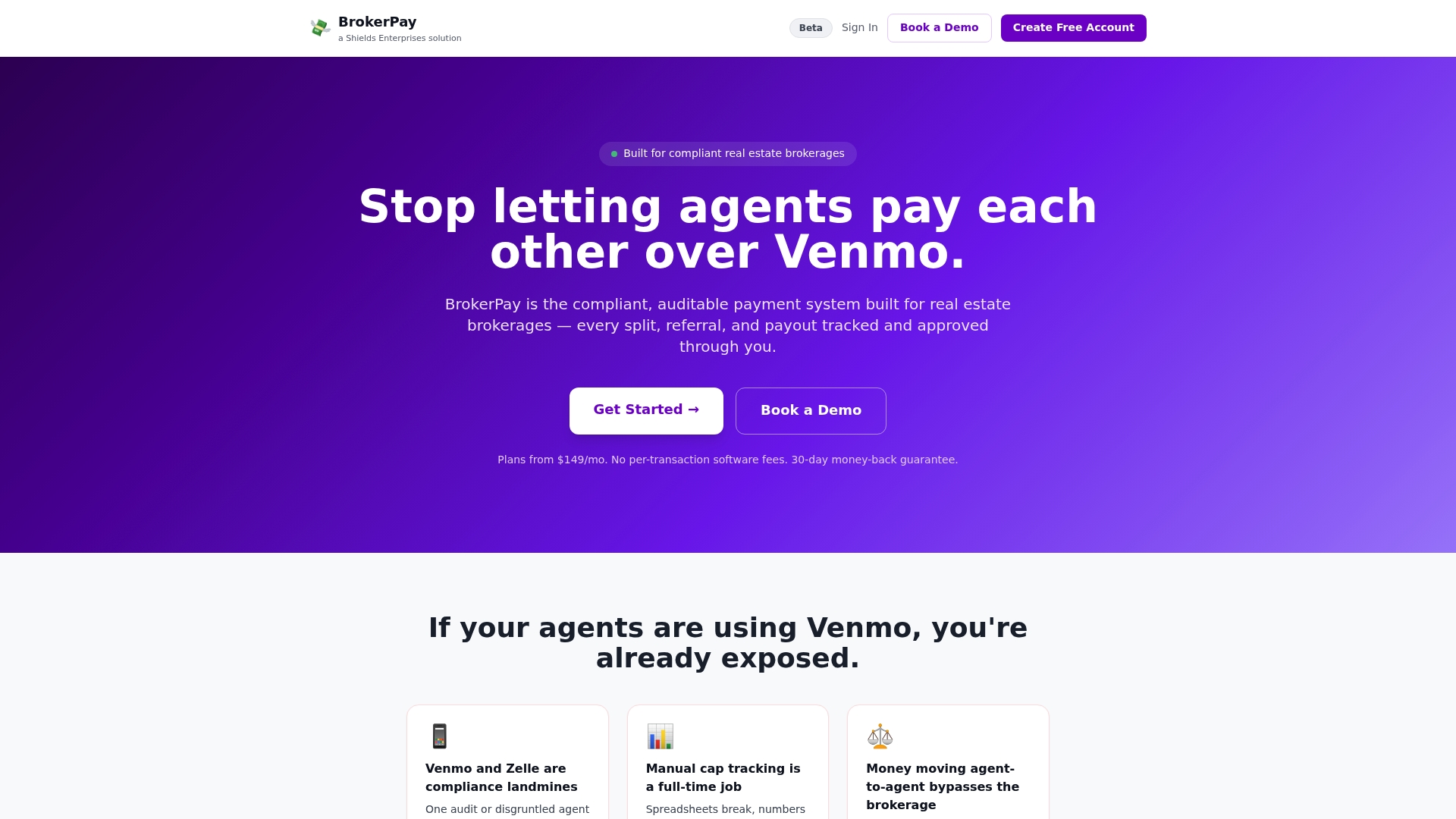
Brokerpay is built specifically for real estate. It tracks, documents, and processes every commission type while keeping your brokerage RESPA-compliant and eliminating the Venmo and Zelle workarounds that create federal liability. Agents get real-time visibility into their earnings. Managers get a full audit trail. Your operations team gets hours back every month. If your brokerage is ready to move past spreadsheets, see how Brokerpay works and request a demo to review your current commission structure with the team.
FAQ
What is commission payment automation?
Commission payment automation is the use of software to calculate, process, and distribute agent commissions automatically. It replaces manual spreadsheet processes with validated, auditable payment workflows.
How much can automation reduce commission errors?
Automation reduces commission errors from a manual rate of 3–8% down to under 1%. On a $5 million commission spend, that improvement can recover nearly $400,000 in previously undetected losses.
Does commission automation work for co-op and referral fee structures?
Yes. Purpose-built platforms like Brokerpay handle multi-tier splits, co-op payments, and referral fees within a single workflow. Generic sales commission tools often require significant customization to support these real estate-specific structures.
How quickly do brokerages see results after switching?
Most brokerages see dispute volume drop within the first quarter. Commission disputes fall by 90% after automated implementation, driven by improved transparency and calculation accuracy.
Is commission automation compliant with RESPA requirements?
Real estate-specific platforms like Brokerpay are designed to maintain RESPA-compliant payment workflows, including documented audit trails for co-op and referral fee transactions. Generic payment tools like Venmo and Zelle do not provide that compliance layer.