Real Estate Joint Venture Fees: What Investors Must Know

A real estate joint venture fee is not a single charge. It is a collection of compensation components paid to the sponsor or operator within a joint venture agreement, covering everything from deal origination to performance incentives. Understanding what is a real estate joint venture fee means understanding acquisition fees, asset management fees, property management fees, and promote structures. These fees are defined in the JV operating agreement and sequenced through a waterfall mechanism that determines who gets paid, when, and how much. Getting this wrong costs investors real money.
What types of fees make up a real estate joint venture fee?
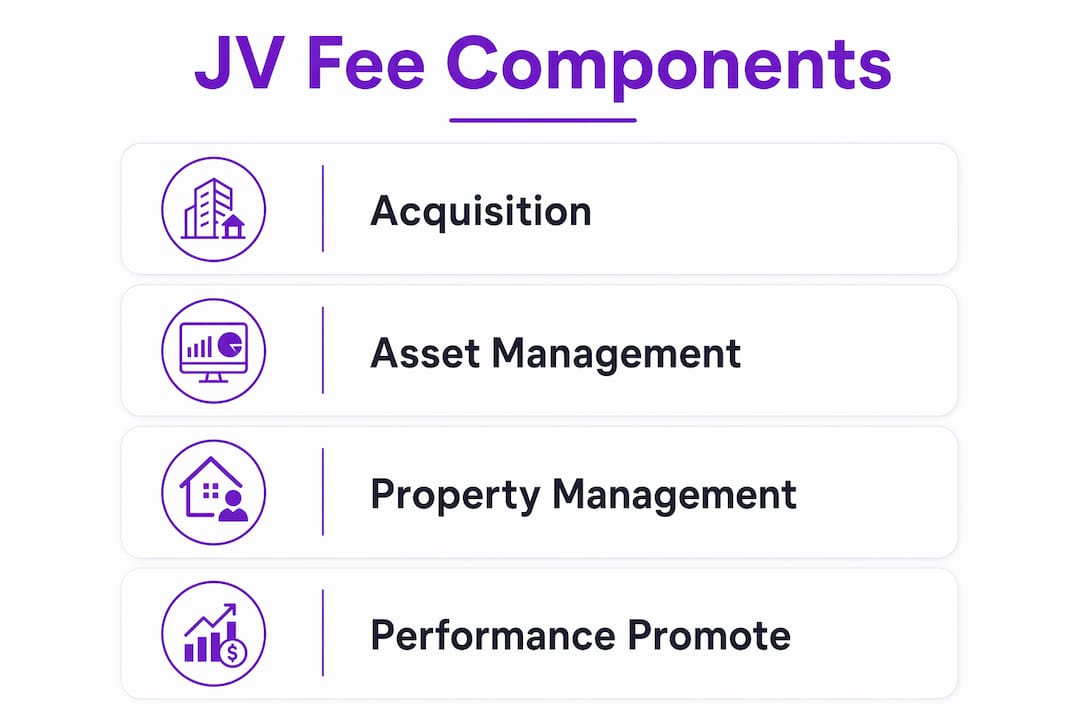
Real estate joint venture fees usually comprise four core categories: acquisition fees, asset management fees, property management fees, and performance-based incentives called promotes or carried interest. Each fee reflects a different role the sponsor plays in the deal. Investors who treat these as one lump sum miss the full picture.
Acquisition fees are paid at closing. They compensate the sponsor for sourcing, underwriting, and closing the deal. These typically range from 1% to 2% of the purchase price, though the exact figure depends on deal size and sponsor track record.

Asset management fees are ongoing charges during the hold period. The sponsor earns these for overseeing the investment, managing lenders, and executing the business plan. These fees are usually calculated as a percentage of invested equity or gross asset value, paid quarterly or annually.
Property management fees cover day-to-day operations. A third-party property manager or the sponsor’s own management arm collects these fees for leasing, maintenance, and tenant relations. In most deals, property management fees run between 3% and 8% of gross collected rents, depending on asset type.
Promote fees, also called carried interest, are the performance-based component. Promote fees give sponsors a disproportionate share of profits once investors receive a preferred return. This structure aligns the sponsor’s incentive with investor outcomes. Promotes typically range from 20% to 30% of profits above preferred returns, with some deals reaching 40% depending on sponsor experience, deal complexity, and asset type.
Two additional fee types appear less often but carry real financial weight:
- Guarantee fees compensate the sponsor for personally guaranteeing project financing. Guarantee fees average 0.5% to 1.5% of the guaranteed financing amount. They function as risk transfer mechanisms, not simple expenses, and affect how much cash is available for distributions.
- Expense reimbursements cover JV-incurred costs such as legal fees, audit expenses, and reporting costs. These are easy to overlook but reduce distributable cash just as directly as any named fee.
Pro Tip: Ask for a full fee schedule before signing any JV agreement. Sponsors are not always required to volunteer every reimbursable expense category upfront.
How are joint venture fees calculated and sequenced within JV waterfalls?
The waterfall is the engine that determines how money flows out of a real estate joint venture. JV waterfalls generally follow a sequence of capital return, preferred return, and increasing promote participation with tiers reflecting sponsor performance. Understanding this sequence is not optional for investors. It is the only way to know when and how much you will actually receive.
Fees interact with the waterfall at every stage. Asset management fees and property management fees are paid from operating cash flow before any distributions reach investors. This means they reduce the base amount available for preferred return calculations. Waterfall definitions critically affect cash flow sequencing and investor returns, and ambiguities about whether fees reduce gross proceeds can materially change investor economics.
The calculation base matters as much as the percentage. Two deals with identical promote rates can produce very different investor outcomes depending on whether the promote is calculated on gross proceeds or net proceeds, or whether the preferred return is measured on committed capital or invested capital. Identical promote percentages can yield materially different economics due to these calculation nuances.
| Waterfall tier | What happens | Fee impact |
|---|---|---|
| Return of capital | Investors receive their original equity back | Management fees already paid from operating cash reduce net equity returned |
| Preferred return | Investors receive a target return (e.g., 8% annually) | Fees paid during hold period reduce the base used to calculate this return |
| Catch-up | Sponsor receives a share to “catch up” to their promote percentage | Timing of fee accrual vs. payment affects when this tier triggers |
| Promote tiers | Profits split between sponsor and investors at escalating rates | Higher promote percentages apply to larger profit pools above each hurdle |
Fee accrual timing adds another layer of complexity. Some fees accrue but are not paid until a liquidity event. Others are paid monthly from operating cash. Accrued fees that are unpaid during the hold period can create a large lump-sum payment at exit, reducing the proceeds available for the promote calculation.
Pro Tip: Model the waterfall with fees paid monthly versus fees accrued to exit. The difference in investor IRR can be significant, even when the fee percentages look identical on paper.
What practical implications do joint venture fees have for investors and sponsors?
Fees shape the economics of every real estate joint venture. Investors who focus only on the promote percentage and ignore operational fees routinely overestimate their returns. Operational and managing-member fees and reimbursements impact distributable cash and preferred return bases and are commonly overlooked relative to promote fees.
Cost overruns create a compounding problem. JV agreements often include clauses that determine cost overrun responsibility after predefined variance thresholds. Some contracts allow roughly 10% variance on line items and project-wide caps before overruns are allocated to the developer. When costs exceed those thresholds, the developer absorbs the excess, which can reduce or eliminate the cash available to pay fees and distributions.
Investors should probe these specific areas before committing capital:
- Fee caps: Does the agreement cap total fees as a percentage of project cost or equity? Uncapped fees in a large development deal can erode returns significantly.
- Reimbursable expense policies: Which expenses qualify for reimbursement? Legal, audit, and reporting costs add up quickly on complex deals.
- Fee deductibility and tax treatment: Management fees paid to the sponsor may be deductible at the JV level, but the tax timing and character of those deductions affect each partner differently.
- Disclosure requirements: The JV operating agreement should explicitly define every fee type, calculation base, and payment timing. Vague language creates disputes.
- Negotiation leverage: Investors with larger equity commitments or repeat relationships with sponsors have more room to negotiate fee caps, reduced acquisition fees, or co-investment rights.
Fee designs often combine service fees for participants with reimbursements for JV-incurred costs. Investors should probe fee caps and reimbursable expense policies before signing. The most common investor mistake is treating the fee schedule as a fixed term rather than a negotiable component of the deal.
How do joint venture fee structures compare across deals and markets?
Fee structures vary by deal type, geography, and sponsor profile. The differences are not cosmetic. They reflect real differences in risk allocation, sponsor compensation philosophy, and market norms.
| Fee type | Typical U.S. range | Canadian JV context |
|---|---|---|
| Acquisition fee | 1%–2% of purchase price | Similar range; often negotiated on development deals |
| Asset management fee | 1%–2% of equity or gross asset value annually | Comparable; sometimes structured as a flat annual fee |
| Property management fee | 3%–8% of gross collected rents | Similar; varies by asset class and market |
| Promote / carried interest | 20%–30% of profits above preferred return | Consistent with U.S. norms; development JVs may reach 30%–40% |
| Guarantee fee | 0.5%–1.5% of guaranteed financing | Common in Canadian construction lending; less standardized in U.S. |
| Development / construction manager fee | Varies widely | Often exceeds management fees in Canadian development JVs |
Syndications and development joint ventures sit at opposite ends of the fee spectrum. Syndications tend to have simpler fee stacks with a single promote tier. Development JVs layer in construction management fees, guarantee fees, and more complex waterfall structures. Sponsors with longer track records and institutional capital partners often accept lower acquisition fees in exchange for larger promote percentages, betting on performance rather than upfront compensation.
Market conditions also shift fee norms. In a competitive capital environment, sponsors may reduce acquisition fees to attract equity. In tighter markets, guarantee fees rise because lender requirements become more demanding. Investors who benchmark fees against current market conditions negotiate better terms than those who accept the first term sheet.
Key takeaways
Real estate joint venture fees are a negotiated framework of acquisition, management, and performance-based charges that directly determine investor returns through waterfall sequencing and calculation base definitions.
| Point | Details |
|---|---|
| Fees are not one charge | JV fees include acquisition, management, property management, and promote components, each with distinct timing and calculation rules. |
| Waterfall sequencing controls timing | Fees paid from operating cash reduce the base for preferred return calculations before investors see distributions. |
| Calculation base changes outcomes | Gross vs. net proceeds and committed vs. invested capital definitions alter investor economics even when promote percentages look identical. |
| Guarantee fees transfer risk | Guarantee fees average 0.5%–1.5% of guaranteed financing and reduce distributable cash, affecting investor risk exposure. |
| Fees are negotiable | Investors with larger commitments or repeat relationships can negotiate fee caps, reduced acquisition fees, and clearer reimbursement policies. |
The fee detail most investors skip until it’s too late
The promote gets all the attention. Investors spend hours negotiating the promote percentage and almost no time on the calculation base, the fee accrual schedule, or the reimbursable expense list. That is the wrong order of priorities.
I have seen deals where two sponsors offered identical 20% promotes but produced materially different investor returns. The difference came down to one word in the waterfall definition: whether the preferred return was calculated on committed capital or invested capital. On a deal where capital is drawn over 18 months, that distinction changes the preferred return base by millions of dollars.
Operational fees deserve the same scrutiny as the promote. Asset management fees paid monthly from operating cash reduce the preferred return base quietly, over years, before anyone runs a final waterfall model. By the time investors notice, the deal is at exit and the math is already done.
My advice is to build a full cash flow model before signing. Test fee timing assumptions. Run the waterfall with fees paid monthly and with fees accrued to exit. If the sponsor cannot explain why the numbers differ, that is a red flag about their financial sophistication, not just their fee structure. Transparency and communication are not soft skills in a JV. They are financial controls.
— Wes
How Brokerpay keeps real estate payments clean and compliant
Managing the financial side of a real estate partnership requires more than a spreadsheet and a handshake. When fees, splits, and co-op commissions move through informal channels like Venmo or Zelle, brokerages create federal liability and lose the documentation trail that protects everyone in the deal.
Brokerpay is a compliant commission payment platform built for real estate brokerages. It tracks, documents, and processes agent splits and referral fees with full RESPA compliance, replacing the informal workarounds that expose brokerages to regulatory risk. Every payment is recorded, every split is documented, and every co-op commission moves through a system built for the real estate industry. For brokerages managing complex partnership payments, Brokerpay removes the guesswork from compliance.
FAQ
What is a real estate joint venture fee?
A real estate joint venture fee is a collective term for the compensation components paid to a sponsor or operator within a JV agreement, including acquisition fees, asset management fees, property management fees, and performance-based promote fees. These fees are defined in the JV operating agreement and sequenced through a waterfall structure.
How does a promote fee work in a real estate JV?
A promote fee gives the sponsor a disproportionate share of profits once investors receive a preferred return. Promotes typically range from 20% to 30% of profits above the preferred return hurdle, with higher tiers possible on complex deals.
Why does the calculation base matter for JV fees?
The calculation base determines what amount the fee percentage is applied to. Two agreements with identical promote rates can yield different investor economics depending on whether the base is gross proceeds, net proceeds, committed capital, or invested capital.
What are guarantee fees in a real estate joint venture?
Guarantee fees compensate the sponsor for personally guaranteeing project financing. They function as risk transfer payments and average 0.5% to 1.5% of the guaranteed financing amount, reducing the cash available for investor distributions.
Are joint venture fees negotiable?
Yes. Fee caps, acquisition fee percentages, and reimbursable expense policies are all negotiable terms in a JV agreement. Investors with larger equity commitments or established sponsor relationships typically have the most leverage to adjust fee structures before signing.