Why Digital Payment Records Matter Legally for Brokers

Digital payment records are legally equivalent to paper records under federal law, making them primary evidence in audits, disputes, and regulatory reviews. For real estate brokerages, this is not a technicality. Every commission split, referral fee, and co-op payment you process creates a document that courts, the IRS, and state regulators can demand and scrutinize. The legal frameworks governing these records, including the ESIGN Act, UETA, and IRS Revenue Procedure 97-22, set clear standards for what qualifies as a valid, admissible record. Understanding why digital payment records matter legally is the first step toward protecting your brokerage from liability.
Why digital payment records matter legally: the federal framework
Electronic records hold the same legal effect as paper records in most contracts and transactions when they meet statutory requirements. Two federal laws establish this foundation: the Electronic Signatures in Global and National Commerce Act (ESIGN) and the Uniform Electronic Transactions Act (UETA). Together, they confirm that a digital payment confirmation carries the same enforceability as a signed paper receipt.
Most states have adopted UETA, which simplifies legal recognition of digital records across state lines. New York is a notable exception. New York operates under its own Electronic Signatures and Records Act (ESRA), which creates additional requirements and uncertainty for brokerages with transactions in that state. If your brokerage operates in New York, you need to verify that your digital records meet ESRA standards, not just UETA.

The Federal Rules of Evidence (FRE) add another layer of legal significance. Under FRE 901 and FRE 803, properly authenticated electronic business records are admissible in court without live testimony. The business records exception to hearsay applies when records are created regularly, in the ordinary course of business, by a stable process. This is exactly the standard your brokerage payment records need to meet.
Key legal requirements for digital payment records to qualify under federal evidence rules:
- Records must be created in the regular course of business, not assembled after a dispute arises
- The record-keeping process must be consistent and documented
- Records must be retrievable and reproducible in a readable format
- Authentication must be possible through metadata, audit trails, or system-generated logs
- No unauthorized alterations can have occurred after the record was created
Pro Tip: Set up your payment system to generate automatic, timestamped confirmations for every transaction. A system-generated record is far stronger evidence than a manually entered spreadsheet entry.
What does the IRS require for electronic payment records?
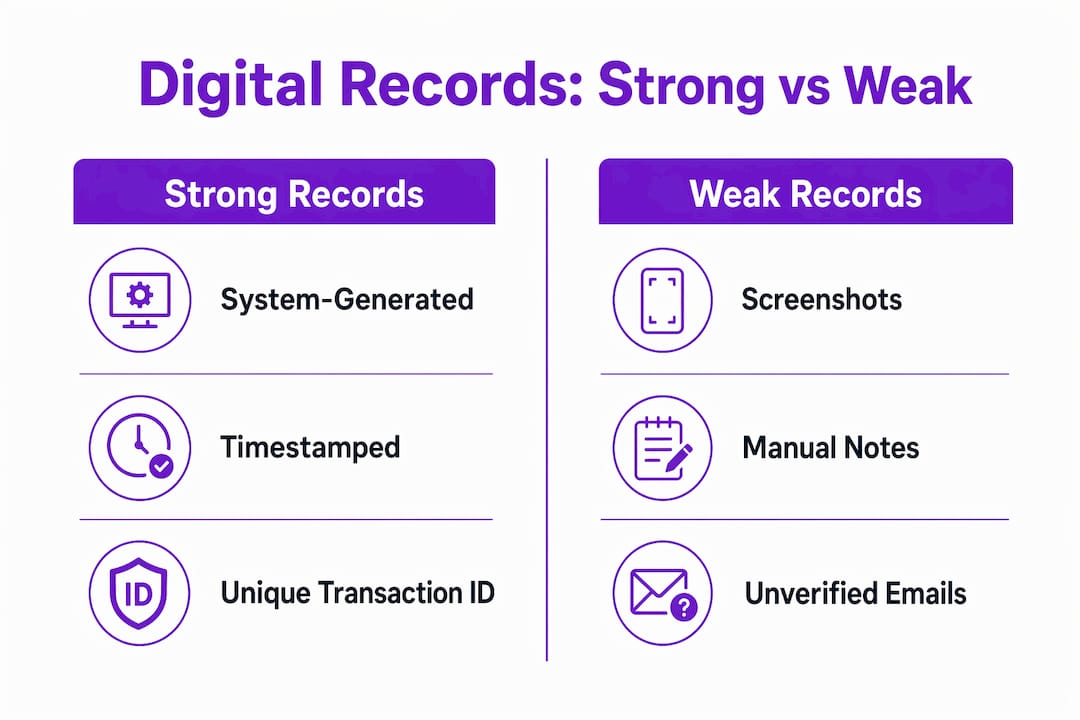
The IRS does not simply accept digital files at face value. IRS Revenue Procedure 97-22 establishes specific standards that electronic recordkeeping systems must meet to be acceptable during a tax audit. The IRS evaluates your system as a whole, not just the individual files you produce.
The four core requirements under Revenue Procedure 97-22 are:
- Accurate reproduction. Your system must produce a complete and accurate copy of the original record on demand. A screenshot or a manually exported CSV that omits fields does not meet this standard.
- Indexing and retrieval. Records must be organized so that any specific transaction can be located and retrieved quickly. Disorganized folders or unnamed files create audit risk.
- Integrity controls. The system must prevent unauthorized changes to stored records. If a payment amount can be edited after the fact without leaving a trace, your records lose credibility.
- Reproducibility across formats. Records must be readable and usable by IRS examiners, meaning proprietary formats that require special software can create problems.
Tax authorities evaluate electronic recordkeeping systems as audit tools, focusing on accuracy and retrievability over mere digital storage. A brokerage that stores payment records in a shared Google Drive folder with inconsistent naming conventions is not meeting this standard. The IRS wants to see a system, not a collection of files.
Poor recordkeeping in a tax dispute carries real consequences. Lost deductions, penalties, and interest are the most common outcomes. For a brokerage processing hundreds of commission payments per year, the financial exposure from inadequate records can be significant. Accurate commission tracking directly reduces this risk by creating a clear, retrievable record of every payment made and received.
Pro Tip: Run a quarterly audit of your payment records to confirm that every transaction from your payment processor matches your internal ledger and your bank statements. Discrepancies found internally are far less costly than discrepancies found by the IRS.
Authentication challenges: when digital records fail in court
Brokerages frequently fail evidentiary tests not because records are missing, but because multiple non-reconcilable versions of the same payment data exist. A processor export, an internal ledger entry, and a bank feed that show slightly different amounts or dates create a credibility problem that opposing counsel will exploit.
Federal Rules of Evidence Rule 1002 requires that a party produce the original record or an accurate substitute. Records that cannot be authenticated may be excluded or given reduced weight in disputes. This is the rule that makes screenshots and informal copies legally dangerous.
What makes a digital record legally strong vs. legally weak
| Strong record | Weak record |
|---|---|
| System-generated export with timestamp and transaction ID | Screenshot taken from a mobile app |
| Audit trail showing who accessed and when | Manually typed summary of payment activity |
| Cryptographically sealed or hash-verified file | Editable spreadsheet with no version history |
| Reconciled across processor, ledger, and bank | Single-source record with no cross-reference |
| Stored in a controlled system with access logs | Saved in a personal email or shared folder |
Chain of custody and forensic certification provide the strongest foundation for authenticating digital payment records. Cryptographic sealing and documented data flows allow courts to independently verify that a record has not been altered. Most brokerages do not need forensic-grade tools for routine operations, but the underlying principles apply: your records need a clear, traceable history from creation to storage.
Practical steps to strengthen record credibility in your brokerage:
- Export payment records directly from your payment processor in their native format, not as reformatted copies
- Reconcile processor records against your accounting system and bank statements monthly
- Store records in a system that logs access and prevents editing after the fact
- Document your record-keeping process in writing so you can demonstrate it follows a consistent routine
- Never rely on Venmo, Zelle, or personal payment apps for commission payments, as these platforms do not generate business-grade audit trails
How strong payment records reduce legal and financial risk for brokerages
Verifiable digital payment records are the first line of defense in commission disputes, vendor payment disagreements, and regulatory investigations. When an agent claims they were underpaid on a split, a timestamped, system-generated payment record resolves the dispute faster and more definitively than any email chain. Courts prefer records kept regularly in the ordinary course of business as inherently reliable. Ad hoc or reconstructed records face significantly higher scrutiny.
RESPA compliance is another direct benefit. The Real Estate Settlement Procedures Act requires that referral fees and co-op commissions be documented and disclosed. A brokerage that processes these payments through a compliant platform with automatic record generation is in a far stronger position during a HUD audit than one relying on informal payment methods. The legal implications of digital transactions extend beyond individual disputes to your brokerage’s overall regulatory standing.
Chargebacks and unauthorized payment claims are also easier to contest with strong records. If a vendor or agent disputes a payment, a complete digital record showing authorization, amount, date, and confirmation gives you a clear rebuttal. Without it, you are arguing from memory against a documented claim.
Automated payment platforms reduce the risk of human error in record creation. Manual processes introduce inconsistencies that undermine the “regular course of business” standard courts and the IRS apply. A platform that automatically generates, timestamps, and stores payment records removes that vulnerability.
Key Takeaways
Digital payment records carry full legal weight when properly maintained, making record quality a direct factor in brokerage compliance and dispute outcomes.
| Point | Details |
|---|---|
| Legal equivalence | ESIGN and UETA make digital payment records legally equal to paper when statutory requirements are met. |
| IRS audit standards | Revenue Procedure 97-22 requires accurate reproduction, indexing, integrity controls, and retrievability. |
| Authentication risk | Non-reconcilable duplicate records are the most common reason digital evidence fails in court. |
| Evidence rules | FRE 803 and FRE 901 favor records created routinely in the ordinary course of business. |
| Operational protection | Automated, system-generated records reduce dispute exposure and simplify regulatory audits. |
The compliance gap most brokerages ignore
Most brokers I talk to understand that they need to keep records. What they underestimate is the quality standard those records have to meet. Storing a PDF in a folder is not the same as maintaining a legally defensible record. The difference shows up when you are sitting across from an IRS examiner or defending a commission dispute in arbitration.
The brokerages that get into trouble are almost never the ones that kept no records. They are the ones that kept inconsistent records. A Zelle payment with a note in the memo field, a spreadsheet entry that does not match the bank statement, a screenshot of a Venmo transaction. Each of those feels like documentation in the moment. None of them hold up under scrutiny.
What separates a compliant brokerage from a vulnerable one is process. The records need to come from a system, not from a person’s best effort after the fact. That means using a payment platform that generates records automatically, reconciling those records on a fixed schedule, and storing them in a system that prevents editing. These are not complicated steps. They are just steps that require a deliberate decision to prioritize compliance over convenience.
New York brokerages face an additional layer of complexity with ESRA. If you operate there and have not reviewed whether your current payment platform meets ESRA requirements, that is a gap worth closing before it becomes a problem.
— Wes
Brokerpay keeps your payment records audit-ready
Real estate brokerages need more than a payment tool. They need a system that creates legally defensible records from the moment a commission is processed.
Brokerpay is built specifically for this. It tracks agent splits, referral fees, and co-op commissions in a compliant, auditable system that eliminates the Venmo and Zelle workarounds that create federal liability. Every payment generates a timestamped, system-level record that meets IRS and evidentiary standards. Brokers using Brokerpay enter audits and disputes with documentation that holds up, not explanations that fall short. If your brokerage is ready to replace informal payment habits with a compliant payment platform built for real estate, Brokerpay is the direct solution.
FAQ
Are digital payment records legally valid in court?
Yes. Under FRE 901 and FRE 803, properly authenticated electronic business records are admissible as evidence without live testimony. The records must be created in the regular course of business and verifiable through audit trails or system-generated logs.
What does the IRS require for electronic payment records?
IRS Revenue Procedure 97-22 requires that electronic records be accurately reproducible, indexed for retrieval, protected from unauthorized changes, and readable by examiners. Disorganized or editable files do not meet this standard.
Why do digital records fail in legal disputes?
The most common reason is non-reconcilable duplicate versions of the same payment data. When a processor export, an internal ledger, and a bank statement show different figures, courts treat the records as unreliable.
Can brokerages use Venmo or Zelle for commission payments?
No. Personal payment apps do not generate business-grade audit trails and do not meet IRS or evidentiary standards for business records. Using them for commission payments creates federal liability under RESPA and weakens your position in any dispute.
Does New York have different rules for digital payment records?
Yes. New York operates under ESRA rather than UETA, which creates additional requirements for electronic records and signatures. Brokerages with New York transactions should verify their payment systems comply with ESRA specifically.