Transaction-Based Agent Payout Setup: A Broker’s Guide

Transaction-based agent payout setup is the process of defining commission workflows that trigger, calculate, and release agent earnings based on specific real estate transaction events. Done correctly, it ties every dollar paid to a documented service, keeps your brokerage RESPA-compliant, and eliminates the Venmo and Zelle workarounds that create federal liability. Done poorly, it exposes your brokerage to clawback chaos, audit failures, and HUD enforcement. This guide covers the legal framework, commission system configuration, clawback design, and automation practices brokers need to build a payout structure that holds up.
What is a transaction-based agent payout setup?
A transaction-based payout setup defines the rules that govern when, how much, and under what conditions an agent gets paid after a transaction closes. The industry term for this configuration is a commission schedule, and it sits at the center of every brokerage’s agent earnings management system. The commission schedule specifies the payout trigger, the calculation basis, the eligibility conditions, and any hold or recovery provisions.
Most brokerages still run this process manually. A transaction closes, someone pulls up a spreadsheet, calculates the split, and sends money through a bank transfer or, worse, a peer-to-peer app. That approach creates no audit trail, no compliance documentation, and no protection if the deal falls apart after funding. A properly configured transaction commission setup replaces that workflow with a rules-based system that logs every event and gates every payment.

The three core components of any payout structure for agents are the commission basis (what you calculate against), the eligibility trigger (what event releases the payment), and the recovery policy (what happens if the deal reverses). Get all three right, and your payout process becomes both predictable and defensible.
What legal compliance must brokers consider for agent payouts?
RESPA is the primary federal law governing how real estate brokerages pay agents and third parties. RESPA Section 8(a) prohibits payments for referrals but allows payments for services actually performed at fair market value. That single sentence defines the legal boundary for every commission split your brokerage processes.
Section 8(b) tightens the rule further. Fee splits must correspond to services actually performed to remain compliant. A payment that cannot be matched to a specific, documented brokerage service is a prohibited kickback, regardless of how it is labeled on the settlement statement. This is the compliance core that every agent payout configuration must satisfy.
What counts as “services actually performed”?
The services actually performed standard requires that every commission payment be traceable to a real, documented contribution to the transaction. Acceptable services include transaction coordination, property marketing, buyer representation, and negotiation. Unacceptable payments include flat referral fees paid to agents who did nothing beyond introducing a buyer, or split fees paid to unlicensed parties.
The compliance test is simple: Can you produce a written record of the specific service the payee performed, and does the payment amount reflect fair market value for that service? If the answer to either question is no, the payment is at risk under RESPA.
Common illegal scenarios brokers encounter include:
- Paying a referral fee to an agent who referred a client but performed no other brokerage service on the transaction
- Splitting commissions with unlicensed assistants or outside parties not licensed in the transaction state
- Paying “marketing fees” to title companies or lenders that are actually disguised referral kickbacks
- Processing co-op commissions through informal channels like Zelle without documentation
Compliant best practices center on three actions: document every service in writing before the transaction closes, set payout amounts at demonstrable fair market value, and run all payments through a system that creates a permanent, timestamped audit trail. Platforms like Brokerpay are built specifically to satisfy this documentation requirement for real estate brokerages.
How do commission system features support agent payout configuration?
Modern commission systems give brokers granular control over how payouts are calculated and when they are released. Commission schedule rules can be based on sales amount, quantity, profitability, or custom fields, and measured per period or per transaction. That flexibility matters because a buyer’s agent split calculated on gross sales price follows different logic than a referral fee calculated on net commission received.
The table below shows the key configuration dimensions brokers need to define for any transaction-based commission model.
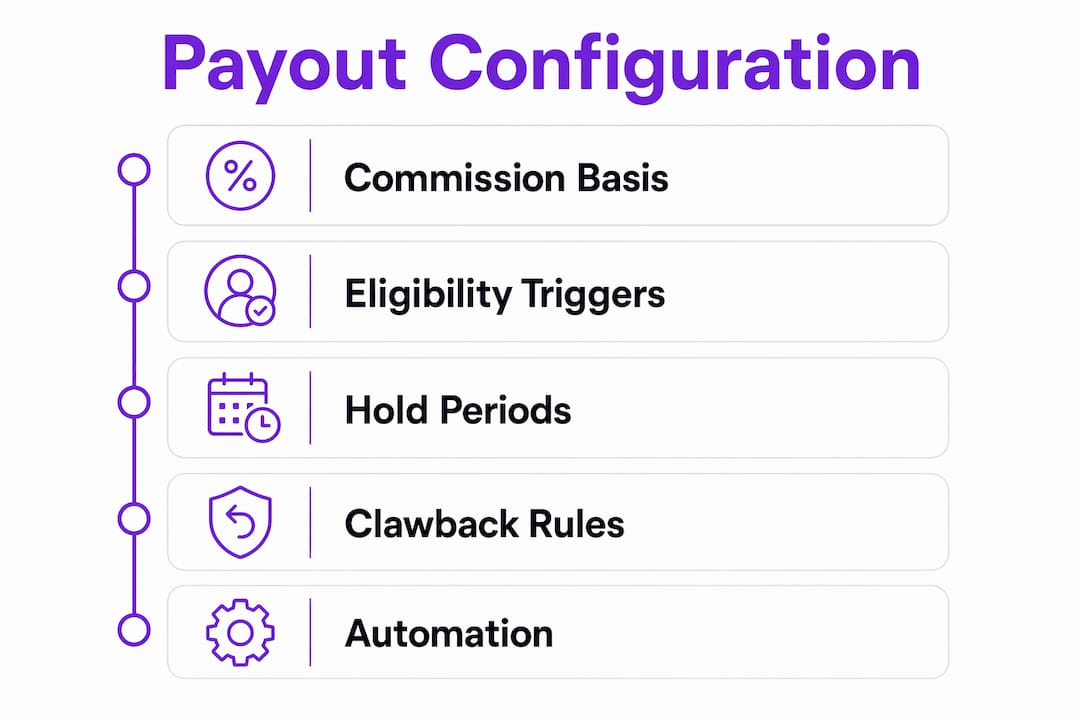
| Configuration dimension | Options | Practical example |
|---|---|---|
| Commission basis | Sales amount, net commission, profitability, custom field | 3% of gross sales price vs. 25% of net commission received |
| Measurement scope | Per transaction, per period total, per line item | Single closing vs. monthly volume bonus |
| Eligibility trigger | Billing, booking, collections | Payment releases on funding vs. on contract execution |
| Hold period | Immediate, delayed by days, delayed to milestone date | 30-day hold after close to cover rescission window |
| Recovery method | Hold and release, pay and deduct | Withhold until clawback window closes vs. pay now and recover later |
Eligibility triggers deserve special attention. NetSuite’s commission preferences detail “Commissions Paid By Default On” options that tie payout timing to transaction lifecycle events such as billing, booking, or collections. In real estate terms, this translates to releasing payment on contract execution, on funding, or on receipt of the co-op check from escrow. Each choice carries different cash flow and compliance implications.
Hold periods add another layer of control. Tern’s agency financial settings show commissions remaining “On Hold” until predefined milestone dates, a model directly applicable to real estate. A brokerage can log the commission as earned at closing but gate the actual payment until the rescission period expires or the co-op check clears.
Pro Tip: Treat commission earned and commission eligible for payout as two separate system states. Log the earning event immediately for accounting purposes, but do not release the payment until your eligibility conditions are fully met. This single design decision reduces clawback exposure and simplifies your audit trail.
What are best practices for clawbacks and reversals in transaction payouts?
Clawbacks are the mechanism that lets a brokerage recover a commission already paid when a transaction falls apart after funding. Clawbacks are implemented either by holding payments until the clawback window closes or by paying on close and deducting from future earnings. Both approaches work, but they carry very different operational costs.
The hold approach is simpler to administer. The brokerage withholds payment until the clawback window expires, then releases the full amount. The agent waits longer but faces no recovery action if the deal reverses. The pay-and-recover approach pays the agent immediately but requires tracking, notification, and deduction workflows if a reversal occurs. That complexity adds audit burden and can strain agent relationships.
A well-designed clawback policy defines four things:
- The trigger events. Define exactly which events activate a clawback: buyer cancellation, lender rescission, title defect, or fraud discovery. Vague triggers create disputes.
- The clawback window. Standard clawback windows range from 60 to 120 days, with provisions varying by relationship and industry norms. Set your window to match your transaction type and state law.
- The documentation requirements. Every clawback event must be logged with a date, a reason code, and a reference to the original transaction. This documentation protects the brokerage in any dispute.
- The exceptions policy. Define which agents or transaction types qualify for exceptions, such as senior agents with long track records or transactions above a certain value.
Pro Tip: Avoid immediate pay-on-close without a clawback safeguard. Settlement reversals happen more often than brokers expect, and recovering paid commissions without a documented policy creates both operational and compliance challenges that are far harder to resolve after the fact.
How can brokers automate transaction-based agent payout workflows?
Automation converts your commission schedule rules into a repeatable, auditable process that runs without manual intervention. The core workflow has three stages: session creation, authorization, and settlement. Automating transaction-based payouts involves creating financial sessions with limits, authorization, and asynchronous settlement to prevent overspending and keep workflows controlled.
The session creation stage defines the payout scope: which transaction, which agent, which commission schedule, and what dollar limit applies. Setting a monetary limit per session is not just a guardrail against errors. It is a compliance control that prevents any single payout from exceeding the documented fair market value for the services performed.
Authorization adds a human checkpoint before money moves. A designated broker or office manager reviews the calculated payout, confirms the eligibility conditions are met, and approves the release. This step creates the documented approval record that RESPA compliance requires. Asynchronous settlement then processes the actual payment transfer without blocking the authorization workflow, so approvals and disbursements can happen on different timelines.
Key automation features every broker should configure include:
- Payout session limits that cap each disbursement at the approved commission amount
- Eligibility gate checks that verify funding status, co-op receipt, and hold period expiration before releasing payment
- Automated audit logs that timestamp every state change from earned to eligible to paid
- Reversal workflows that automatically flag a paid commission for recovery when a transaction cancellation event is recorded
Brokerpay builds these controls directly into its commission payment platform, giving brokerages a compliant payout workflow without requiring a custom ERP build. Brokers who want to move away from manual processes can also review how to switch to automated payouts as a practical starting point.
Key Takeaways
A compliant transaction-based agent payout setup requires separating commission earned from commission eligible, documenting every service performed, and automating the approval and settlement workflow to create a permanent audit trail.
| Point | Details |
|---|---|
| RESPA defines the legal boundary | Every payout must tie to a documented service at fair market value, or it risks being a prohibited kickback. |
| Eligibility triggers control timing | Configure payouts to release on funding or co-op receipt, not on contract execution, to reduce reversal risk. |
| Clawback windows need written policy | Set a 60–120 day window with defined triggers, documentation requirements, and exception rules. |
| Separate earned from eligible | Log commission at closing but gate the payment until all eligibility conditions are satisfied. |
| Automation creates the audit trail | Session limits, authorization checkpoints, and async settlement prevent overpayments and satisfy compliance review. |
The configuration decision most brokers get wrong
The most common mistake I see in brokerage commission setups is treating “closed” and “paid” as the same event. They are not. A transaction closes when the deed records. A commission becomes eligible for payout when the co-op check clears, the hold period expires, and the eligibility conditions in your commission schedule are satisfied. Collapsing those two events into one is how brokerages end up chasing clawbacks from agents who have already spent the money.
The second mistake is building payout rules informally. A broker tells an agent “you get 70/30 on everything,” and that agreement lives in a text message. When the deal reverses, there is no documented policy to enforce. The agent disputes the recovery, and the brokerage has no written clawback trigger to point to. I have seen this scenario create more internal conflict than any other commission issue.
The fix is not complicated. Define your commission schedule in writing, separate the earned and eligible states in your system, set a clawback window that matches your transaction type, and run every payment through a platform that logs the full chain of events. Accurate commission tracking also prevents the tax reporting errors that compound compliance problems at year end. Brokers who invest in proper configuration upfront spend far less time resolving disputes and far more time closing deals.
— Wes
How Brokerpay handles compliant agent payout processing
Brokerpay is a commission payment platform built for real estate brokerages that need RESPA-compliant payout workflows without building a custom system. It tracks agent splits, referral fees, and co-op commissions in one place, documents every payment against the transaction that generated it, and eliminates the Venmo and Zelle workarounds that create federal liability.
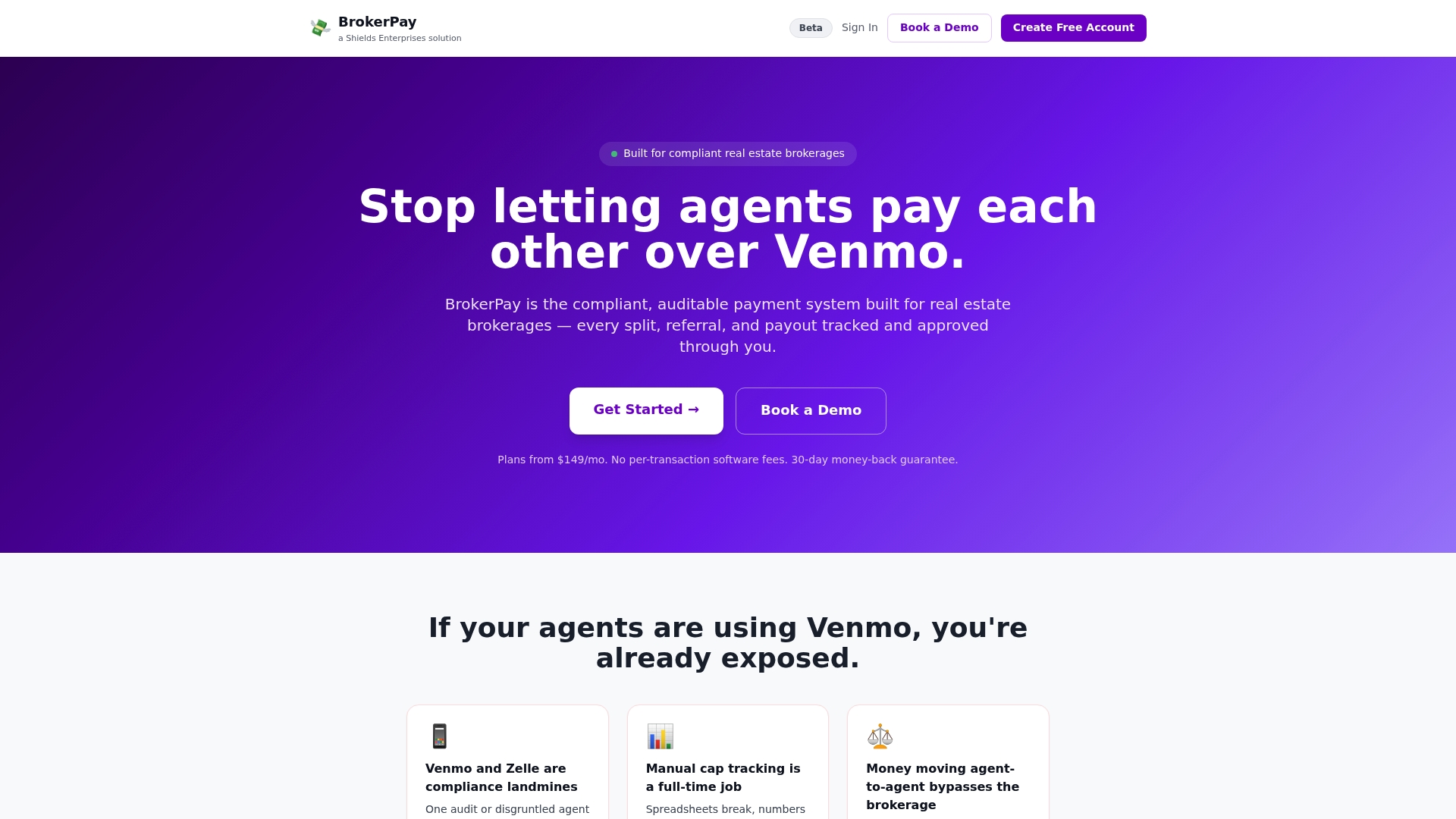
Brokerpay processes payout authorization and settlement with full audit logging, so every payment has a timestamped record of who approved it, what transaction it came from, and which commission schedule applied. Brokerages that process high transaction volumes or manage multi-agent splits benefit most from the platform’s eligibility controls and automated hold period management. Visit Brokerpay to see how the platform handles transaction-based commission processing for brokerages of every size.
FAQ
What is a transaction-based agent payout setup?
A transaction-based agent payout setup is a commission schedule that defines when, how much, and under what conditions an agent is paid based on specific transaction events such as funding or co-op receipt. It includes the calculation basis, eligibility triggers, hold periods, and clawback provisions.
Does RESPA restrict how brokers pay agent commissions?
RESPA Section 8(a) and 8(b) prohibit payments for referrals and fee splits that are not tied to services actually performed at fair market value. Every agent payout must be documented against a specific brokerage service to remain compliant.
What is the difference between commission earned and commission eligible?
Commission earned is recorded when the transaction closes. Commission eligible is the point at which all payout conditions, such as co-op receipt, hold period expiration, and eligibility trigger satisfaction, are met and the payment can be released. Treating these as separate states reduces clawback risk.
How long should a clawback window be for real estate commissions?
Standard clawback windows range from 60 to 120 days, depending on transaction type and brokerage policy. The window should be long enough to cover common reversal scenarios such as lender rescission or title defects.
Can brokers automate agent payout workflows without a custom ERP?
Platforms like Brokerpay provide built-in commission tracking, eligibility controls, and audit logging designed for real estate brokerages, removing the need for a custom ERP build to achieve compliant, automated payout processing.