Benefits of Electronic Commission Disbursement for Brokerages

Electronic commission disbursement is the automated process of calculating, splitting, and paying agent commissions through digital payment rails rather than manual checks or informal transfers. The benefits of electronic commission disbursement are measurable and immediate: brokerages that adopt it cut reconciliation time by up to 90%, reduce payout errors to under 1%, and compress payment cycles from 45 days to as few as 7. Platforms like Brokerpay are built specifically for real estate brokerages that need ROSPA-compliant workflows without the federal liability that comes from Venmo and Zelle workarounds. This article breaks down each core advantage so you can evaluate whether digital commission payouts fit your operation.
1. Benefits of electronic commission disbursement: time savings
The most immediate advantage of switching to electronic disbursement is the collapse in manual labor. Automated commission workflows reduce monthly reconciliation time from 20–40 hours down to just 2–4 hours. That is an 85–90% reduction in processing time, which frees your finance team for work that actually requires human judgment.
Manual commission processing depends on spreadsheets, email chains, and hand-keyed data. Each step introduces delay and creates a new opportunity for error. When you remove those steps, the entire payment cycle accelerates without adding headcount.
- Commission splits calculate automatically based on pre-set rules
- Referral fees and co-op payments route to the correct parties without manual intervention
- Finance staff shift from data entry to exception handling
Pro Tip: Before automating disbursement, document every split rule and fee structure your brokerage uses. Automation only works as well as the logic you feed it.
2. What accuracy improvements does electronic disbursement deliver?

Commission calculation errors are more common than most brokers realize. The industry average error rate for manually processed commissions runs between 3% and 8%. Automated commission tracking drops that rate to under 1%, which directly prevents overpayments, underpayments, and the legal exposure that follows both.
A 3% error rate sounds small until you apply it to a brokerage closing 200 transactions a year. Six errors per year, each potentially triggering a dispute, a corrected payment, or an agent complaint, adds up fast. Automation eliminates the arithmetic mistakes that cause most of those errors.
The accuracy gains extend beyond individual transactions:
- 1099 filings generate automatically from verified payment records
- Split logic applies consistently across every transaction, not just the ones someone double-checked
- Dispute rates drop because the math is transparent and traceable
Brokerages that centralize payout logic into a single system report a 90% reduction in commission disputes within the first quarter of implementation. That figure reflects what happens when agents can see exactly how their number was calculated, rather than receiving a check with no explanation.
3. How electronic disbursement improves agent satisfaction and retention
Agents do not leave brokerages only over commission splits. They leave over friction. Waiting 30–45 days for a commission check, then calling the office to ask where it is, creates exactly the kind of friction that pushes productive agents toward competitors.
Integrated disbursement platforms compress payment cycles from 30–45 days down to 7–14 days. That 50–75% reduction in cycle time has a direct effect on agent satisfaction and voluntary attrition. Faster money is better money, even when the dollar amount is identical.
“The visibility gap is more retention-critical than payout speed alone. When agents lack access to real-time earnings data, month-end inquiries spike and dissatisfaction compounds. Giving agents a self-service portal where they can see every pending and completed payment changes the relationship between the agent and the brokerage.”
Real-time dashboards and self-service portals address the visibility gap directly. Agents check their own status instead of calling your front desk. Your staff handles fewer interruptions. The agent feels respected and informed. That combination builds loyalty more reliably than a marginally better split.
Electronic disbursement via virtual cards and mobile wallets also removes traditional banking hurdles, giving agents instant access to funds the moment a transaction closes. For independent contractors managing their own cash flow, that speed is a genuine competitive differentiator when they are choosing which brokerage to join.
4. What compliance and audit benefits does electronic disbursement provide?
Manual commission workflows create compliance gaps that are invisible until an audit or a lawsuit makes them visible. Electronic disbursement platforms solve this by generating an immutable audit trail that covers every step: import, calculation, reconciliation, dispute, and resolution.
Automated audit trails reduce Errors and Omissions exposure because every payment decision is documented and timestamped. If a dispute goes to arbitration, you have a complete record. If a regulator requests documentation, you can produce it in minutes rather than days.
| Compliance area | Manual process risk | Electronic disbursement outcome |
|---|---|---|
| 1099 filing accuracy | Manual entry errors, missed recipients | Auto-generated from verified payment data |
| RESPA compliance | Informal transfers create federal liability | Documented, compliant payment rails |
| Audit readiness | Spreadsheets with no version control | Immutable, timestamped transaction records |
| Identity verification | Ad hoc, inconsistent | KYC modules embedded in the workflow |
Tax-reporting modules integrated with disbursement platforms automate 1099 filings and identity verification, removing two of the most common sources of year-end brokerage stress. Brokerpay builds these compliance layers directly into its platform so brokerages do not need to bolt on separate tools.
Pro Tip: Run a compliance audit of your current commission workflow before you migrate. Identify every informal payment method your team uses, including Venmo, Zelle, and personal checks, and document them. That list becomes your migration checklist.
5. How transparency and real-time data improve brokerage operations
Transparency is not just an agent benefit. It is an operational advantage for the brokerage. When every commission payment is tracked in real time, your management team gains visibility into settlement times, bottlenecks, and cost patterns that are invisible in a manual system.
Self-service portals reduce administrative inquiries significantly because agents no longer need to contact the office to confirm payment status. Finance teams shift their attention from answering “where is my check?” calls to analyzing which transaction types take longest to close and why.
The operational data that electronic disbursement generates is genuinely useful:
- Average days to payment by transaction type
- Dispute frequency by agent, transaction type, or split structure
- Referral fee routing accuracy rates
- Volume trends by month, quarter, or agent tier
That data supports better decisions on staffing, process design, and agent compensation structures. A brokerage running on manual systems has none of it.
Commission disputes largely stem from opaque manual systems. Automation builds trust by creating a single source of truth for every payout calculation. When agents can see the logic, disputes drop. When disputes drop, your team spends less time on conflict resolution and more time on growth.
6. What is the financial return on electronic commission disbursement?
The financial case for digital commission payouts is not theoretical. 78% of agencies that adopt automated commission tracking report positive ROI within 90 days, driven primarily by recovered commissions and labor savings. That payback period is faster than most technology investments brokerages make.
The ROI comes from three sources. First, error detection recovers commissions that would otherwise be lost to calculation mistakes. Second, labor savings reduce the hours your finance team spends on reconciliation. Third, dispute reduction cuts the administrative cost of resolving agent complaints.
Brokerages that have switched from manual to automated payouts also report a recruiting advantage. Agents who receive faster, more transparent payments talk about it. That word-of-mouth affects which brokerage a productive agent chooses when they are evaluating options.
The competitive advantage of electronic disbursement lies in transparency as a service. Real-time visibility eliminates manual inquiries and allows staff to focus on growth rather than administration. That shift in staff attention compounds over time in ways that are harder to quantify but equally real.
Key Takeaways
Electronic commission disbursement delivers measurable gains in speed, accuracy, compliance, and agent retention that manual systems cannot match.
| Point | Details |
|---|---|
| Dramatic time savings | Automated workflows cut monthly reconciliation from 40 hours to under 4 hours. |
| Near-zero error rates | Automation drops commission errors from up to 8% down to under 1%. |
| Faster agent payouts | Payment cycles compress from 45 days to as few as 7, reducing attrition. |
| Built-in compliance | Immutable audit trails and automated 1099 filing reduce regulatory exposure. |
| Rapid financial return | 78% of brokerages report positive ROI within 90 days of adoption. |
Why centralizing commission logic is the step most brokerages skip
Most brokerages focus on the payment rail when they evaluate electronic disbursement. They want faster checks, fewer calls, and cleaner records. Those are the right goals. But the brokerages that get the most out of automation are the ones that centralize their commission logic before they touch the disbursement layer.
I have seen brokerages automate their payment rails while still running split calculations in three different spreadsheets maintained by three different people. The result is faster delivery of the wrong number. That is worse than a slow manual system because it is harder to catch and harder to explain to an agent who is already frustrated.
The best practice is to treat commission logic as a product. Write down every rule: standard splits, tiered splits, referral fees, co-op structures, and any exceptions your top producers have negotiated. Get that logic into a single system before you automate the payout. Brokerpay is built for exactly this sequence. It tracks and documents the logic first, then processes the payment.
The recruiting angle is real, too. Agents talk to each other. A brokerage that pays accurately, on time, with full visibility, has a story to tell in recruiting conversations that a brokerage running on Venmo and spreadsheets simply cannot match. That is a competitive advantage that compounds every quarter.
— Wes
Brokerpay handles the commission workflow your team should not be doing manually
Real estate brokerages that still process agent splits through checks, Venmo, or Zelle are carrying federal liability they may not fully recognize. Brokerpay is a RESPA-compliant commission payment platform built to track, document, and process agent splits, referral fees, and co-op commissions without the workarounds that create legal exposure.
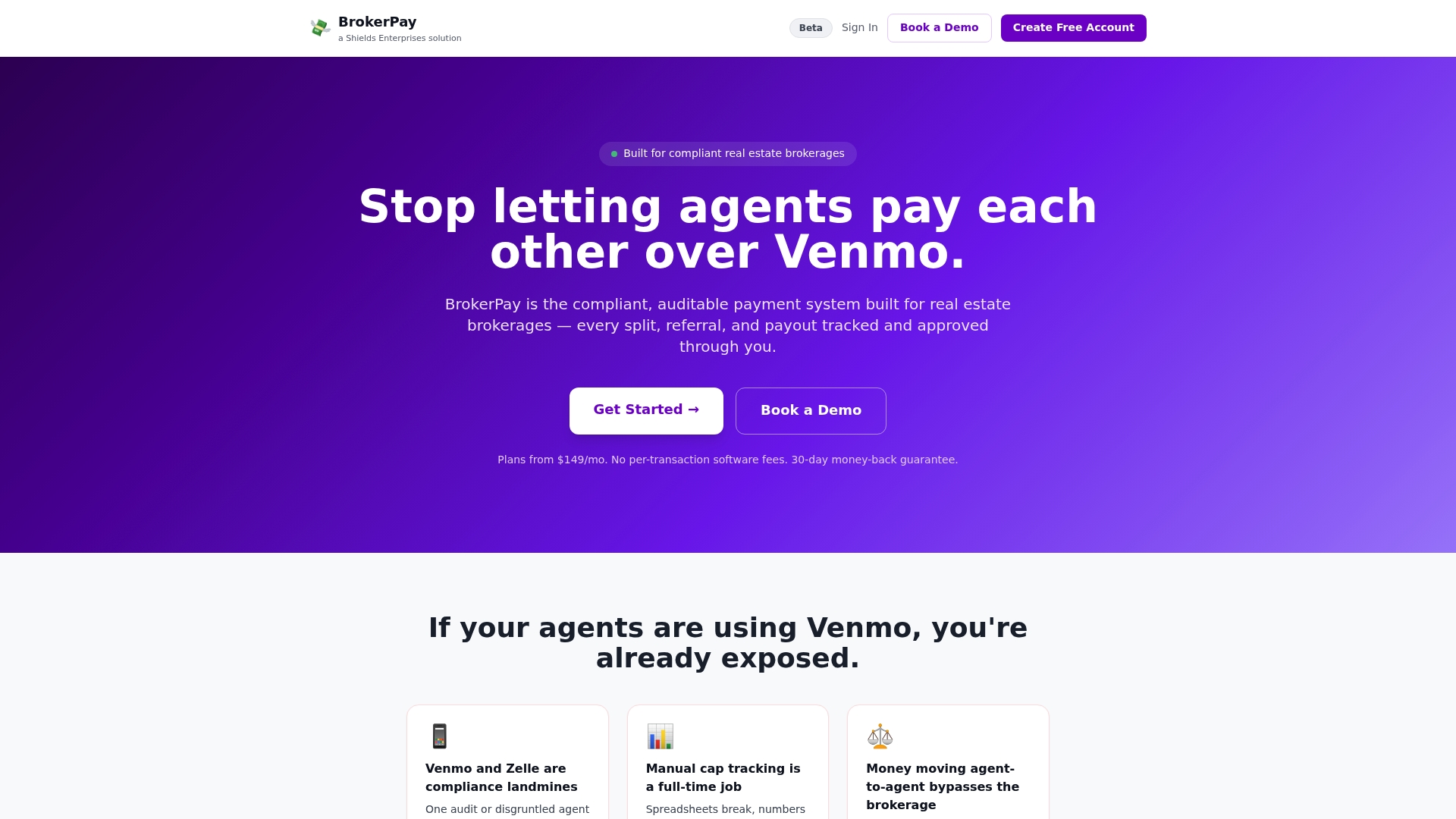
Brokerpay gives your agents real-time visibility into their earnings and gives your finance team a complete audit trail for every transaction. The platform handles commission tracking and tax compliance automatically, so your team is not scrambling at year-end. If your brokerage is ready to move past manual processes, Brokerpay is built for exactly that transition.
FAQ
What is electronic commission disbursement?
Electronic commission disbursement is the automated calculation and digital payment of agent commissions through compliant payment rails. It replaces manual checks, spreadsheets, and informal transfers like Venmo or Zelle.
How much time does electronic disbursement save?
Automated commission workflows reduce monthly reconciliation time from 20–40 hours down to 2–4 hours, an 85–90% reduction in processing labor.
Does electronic disbursement help with RESPA compliance?
Yes. Platforms like Brokerpay document every split, referral fee, and co-op payment with a timestamped audit trail, keeping brokerages compliant and eliminating the federal liability that informal payment methods create.
How quickly do brokerages see a return on investment?
78% of brokerages that adopt automated commission tracking report positive ROI within 90 days, primarily from recovered commissions and reduced labor costs.
What is a real estate payment gateway and how does it relate?
A real estate payment gateway is the secure infrastructure that routes commission payments between parties. Electronic disbursement platforms use payment gateways to process splits accurately and compliantly at the moment a transaction closes.