Title Agents and Commission Payments: A Pro’s Guide

Title agents are neutral fiduciaries responsible for disbursing real estate commissions from seller proceeds at closing, making their role in commission payments one of the most legally consequential functions in any transaction. Real estate professionals who treat title agents as mere paperwork processors miss the full picture. The role of title agents in commission payments spans fund management, regulatory compliance, and post-closing disbursement, all governed by signed contracts and lender instructions. Understanding how title agents operate, especially after the 2024 National Association of Realtors (NAR) settlement, gives brokerages and investors a real edge in avoiding delays and liability.
How do title agents manage the commission payment process?
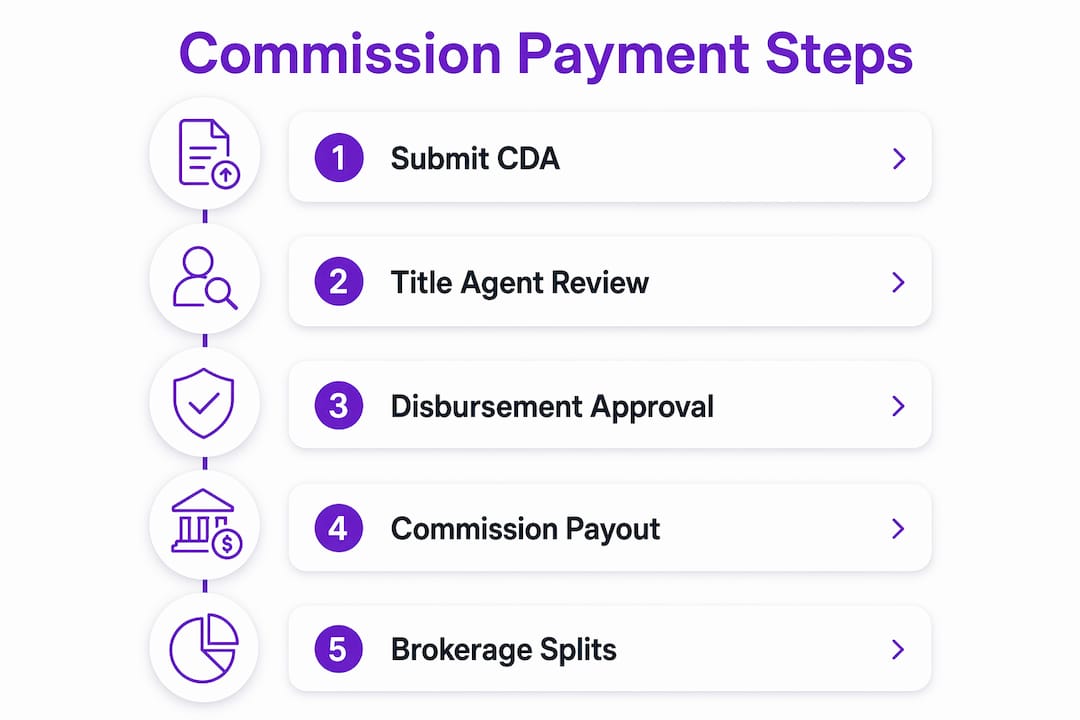
Title agents manage commission disbursements by holding all closing funds in escrow and releasing them only after every contractual condition is satisfied. The process follows a strict sequence, and each step has legal weight.
Here is how the disbursement lifecycle works in practice:
- Funds are collected into escrow. The title agent receives the buyer’s funds, including the down payment and loan proceeds, into a dedicated escrow account before closing begins.
- The seller’s ledger is zeroed out. The title agent deducts the mortgage payoff, property taxes, prorations, and closing costs from the seller’s gross proceeds. Commissions come out of this same pool before the seller receives anything.
- Gross commissions are disbursed to brokerages. Title agents pay gross commissions to the listing brokerage and the buyer’s brokerage, not to individual agents. This distinction matters legally and operationally.
- Lender instructions are confirmed. The title agent verifies that all lender conditions are met before releasing any funds. A single unresolved condition can freeze the entire disbursement.
- Remaining net proceeds go to the seller. Only after all deductions clear does the seller receive the balance.
The title agent acts as an impartial referee throughout this process. Title agents cannot favor any party, whether buyer, seller, or agent. Their obligation runs to the contract and the law, not to any individual’s preferences.
Pro Tip: Submit your Commission Disbursement Authorization (CDA) to the title agent at least 48 hours before closing. Late submissions are the single most common cause of same-day payout delays.

One detail professionals frequently overlook: title agents do not calculate or verify internal agent splits. That responsibility stays inside the brokerage. The title company’s job ends when the gross commission lands in the brokerage’s account.
What compliance and legal responsibilities do title agents carry?
Title agents carry significant legal obligations when managing commission payments. Errors in disbursement create direct legal liability, which is why compliance is the foundation of every title agent’s practice.
The core compliance duties include:
- Following the purchase agreement exactly. Title agents disburse funds according to the signed contract. They cannot deviate based on verbal instructions or last-minute requests from any party.
- Paying brokerages, not agents. Title companies cannot pay agents directly; all commission funds must flow through licensed brokerages. A CDA, executed by the brokerage, is the legal mechanism that allows the title company to pay an agent at closing without violating this rule.
- Coordinating with attorneys in attorney-closing states. About 12 U.S. states require attorney involvement in the closing process. In those states, the attorney manages fund disbursement while the title company handles title work. Title agents must coordinate with local counsel to stay compliant.
- Confirming lender instructions before releasing funds. Lenders issue closing instructions that the title agent must follow precisely. Any deviation can trigger a wire recall or loan cancellation.
Title agents are legally obligated to follow the purchase contract and lender instructions impartially. They cannot favor any party, and errors in disbursement expose them to direct legal liability. This neutrality is not a courtesy. It is a legal requirement.
The practical consequence for real estate professionals is clear: any ambiguity in your commission instructions creates risk for the title agent and delays for you. Written, specific instructions submitted early are the only reliable way to protect your payout.
How did the 2024 NAR settlement change title agents’ role?
The 2024 NAR settlement fundamentally changed how buyer agent compensation flows through a transaction, and title agents sit at the center of that change. Before the settlement, buyer agent commissions were typically bundled into the listing side and disbursed as a single co-op payment. That model is gone.
Under the new structure, buyer agent compensation is decoupled from the listing commission. Buyers are now contractually responsible for their agent’s fees by default, though sellers frequently offer concessions to cover those costs. The title agent must now read and execute disbursement instructions that reflect this new reality.
The practical changes for title agents include:
- Reading buyer-broker agreements. Title agents must now reference the buyer-broker agreement to confirm the agreed compensation amount before disbursing buyer-side commissions.
- Tracking multiple payment sources. Buyer agent fees may come from seller concessions, buyer funds, or a combination. The title agent must track each source accurately.
- Handling greater documentation volume. Each transaction now requires more explicit written authorization for buyer-side disbursements than was standard before 2024.
- Adapting to deal-by-deal variability. No two transactions look identical under the new rules. Title agents cannot rely on standard templates for buyer-side commission instructions.
Pro Tip: After the NAR settlement, always confirm with your title agent that your buyer-broker agreement is in their closing file before the scheduled closing date. A missing agreement can halt buyer-side disbursement entirely.
For brokerages managing compliant co-op payment workflows, the post-settlement environment demands tighter documentation at every stage. Title agents can only execute what the paperwork authorizes.
What practical steps help real estate professionals work with title agents?
Real estate professionals who treat title agent coordination as a closing-day task consistently run into payout delays. The professionals who get paid on time treat it as a pre-closing process that starts days earlier.
Communicate commission instructions in writing, early. Verbal agreements about commission splits or referral fees mean nothing to a title agent. Submit your CDA and any written commission instructions at least two business days before closing. This gives the title agent time to flag discrepancies before funds are on the table.
Understand the timing gap between closing and payout. Commission payouts often take 24–72 hours after closing due to deed recording and funds confirmation. This is normal and not a sign of error. Plan your cash flow accordingly, and do not promise agents same-day payment unless a CDA is already in place and confirmed.
Know the difference between title company payouts and brokerage splits. The title company pays the gross commission to your brokerage. Your brokerage then handles the internal split with the agent. These are two separate transactions with separate timelines. Agents who expect the title company to pay them directly are operating on a misunderstanding of how the commission payment process actually works.
Use CDAs to speed up agent payouts. A Commission Disbursement Authorization is a legal document executed by the brokerage that instructs the title company to pay the agent directly at closing. CDAs are the fastest legal path to same-day agent payment. Not every state or title company accepts them, so confirm availability before closing.
| Action | Timing | Purpose |
|---|---|---|
| Submit CDA to title agent | 48+ hours before closing | Authorizes direct agent payment at closing |
| Confirm buyer-broker agreement is in file | 3+ days before closing | Prevents buyer-side disbursement delays |
| Verify lender instructions are cleared | Day before closing | Avoids last-minute fund freezes |
| Confirm deed recording timeline | Day of closing | Sets accurate payout expectations for agents |
Pro Tip: Ask your title agent which specific documents they need for commission disbursement at the time you open escrow, not the week of closing. Every title company has slightly different requirements, and early clarity prevents last-minute scrambles.
Commission tracking for tax compliance starts the moment the title company disburses funds. Brokerages that document each disbursement in real time avoid the accounting headaches that compound at year-end.
Title agents are more than closing coordinators
The industry tends to treat title agents as administrative support. That framing undersells what they actually do and creates real problems for brokerages that do not engage them proactively.
I have seen transactions stall at the finish line because a brokerage submitted commission instructions on the morning of closing, assuming the title agent would sort it out. Title agents are not problem-solvers for last-minute paperwork. They are legal fiduciaries executing a predetermined script. If your instructions are not in the file, the script does not include your payment.
The 2024 NAR settlement made this dynamic more pronounced. Title agents now carry more documentation responsibility per transaction than they did two years ago. The professionals who adapt to that reality, by submitting cleaner files earlier, are the ones who close without drama.
The future of this relationship is moving toward automation. Platforms that connect brokerage commission management directly with title company disbursement workflows will reduce the manual handoff errors that cause most payout delays today. Real-time payment facilitation is not a distant concept. It is already being built into the closing process at forward-thinking brokerages.
The uncomfortable truth is that most commission payment disputes are not caused by bad actors. They are caused by professionals who assume the title agent knows what they want without being told explicitly. Write it down. Submit it early. Follow up.
— Wes
How Brokerpay fits into your commission payment workflow
Title agents disburse gross commissions to brokerages, but what happens next is entirely the brokerage’s responsibility. That internal split, the referral fee, the co-op payment, the agent’s net check, all of it falls outside the title agent’s scope.
Brokerpay is built for exactly that gap. It tracks, documents, and processes agent splits and referral fees in a RESPA-compliant workflow, eliminating the Venmo and Zelle workarounds that create federal liability. When the title company’s wire hits your brokerage account, Brokerpay takes over, distributing funds to agents with a full audit trail. Real estate professionals who use Brokerpay stop chasing agents for payment confirmations and start closing with confidence.
FAQ
What does a title agent actually pay at closing?
Title agents disburse gross commissions to licensed brokerages, along with mortgage payoffs, taxes, and other closing costs, directly from seller proceeds. They do not pay individual agents or calculate internal brokerage splits.
Can a title company pay a real estate agent directly?
Title companies cannot pay agents directly without a Commission Disbursement Authorization executed by the brokerage. The CDA is the legal instrument that allows direct agent payment at closing while keeping the brokerage in the chain of authorization.
How long does it take to receive a commission after closing?
Commission payouts typically take 24–72 hours after closing, depending on deed recording timelines and funds confirmation. A CDA can accelerate this to same-day payment in many cases.
Did the 2024 NAR settlement change how title agents disburse buyer agent commissions?
Yes. Buyer agent compensation is now decoupled from listing commissions, requiring title agents to reference buyer-broker agreements and track multiple payment sources for each transaction.
Do all states use title companies to manage commission disbursements?
Not all states follow the same process. Approximately 12 U.S. states require attorney involvement in closings, where attorneys manage fund disbursement and title companies handle title work separately.
Key takeaways
Title agents disburse gross commissions to brokerages as neutral fiduciaries, and brokerages are solely responsible for all internal agent splits after that point.
| Point | Details |
|---|---|
| Title agents pay brokerages, not agents | All gross commissions flow to licensed brokerages; agents receive splits from their brokerage, not the title company. |
| CDAs speed up agent payouts legally | A Commission Disbursement Authorization lets title companies pay agents directly at closing with brokerage authorization. |
| Post-NAR settlement adds documentation | Title agents now require buyer-broker agreements to disburse buyer-side commissions on every transaction. |
| Payout timing is 24–72 hours post-closing | Deed recording and funds confirmation cause this standard delay; plan agent cash flow expectations accordingly. |
| Early written instructions prevent delays | Submit commission instructions and CDAs at least 48 hours before closing to avoid last-minute disbursement holds. |