How Digital Disbursements Improve Compliance in Real Estate

Digital disbursements are electronic payment methods that improve compliance by automating verification, reducing fraud, and creating auditable records from payment initiation through settlement. For real estate professionals and compliance officers, this matters because manual commission payments create federal liability under RESPA, expose brokerages to AML violations, and generate audit trails that fall apart under scrutiny. Platforms built around PCI DSS standards and NACHA rules replace paper checks and informal transfers with documented, traceable workflows. The result is faster payments, fewer errors, and a compliance posture that holds up when regulators ask questions.
How do digital disbursements improve compliance in financial operations?
Digital disbursements reduce compliance risk by cutting the number of people who touch a transaction. Digitizing payment processes can reduce transaction handlers from eight to two. Fewer handlers mean fewer opportunities for data entry errors, unauthorized access, and fraud.
Speed compounds the benefit. The Bureau of the Fiscal Service reported payouts processed in under 5 seconds using modern digital payment tools. That speed eliminates the processing gaps where manual systems accumulate errors and compliance exposures.
The compliance advantages of digital disbursements fall into three categories:
- Automated KYC and AML screening runs at the point of payment initiation, not after the fact
- Real-time sanctions screening flags restricted payees before funds move, not during a quarterly audit
- Immutable transaction records capture every step from payment request to settlement confirmation
Non-compliance with PCI DSS carries fines ranging from $5,000 to $100,000 per month. That range reflects how quickly unmanaged payment processes become expensive regulatory problems.
Pro Tip: Clean payee data before you automate. Practitioners report that automating payouts without fixing data hygiene issues, like mismatched payee names, creates more manual rework, not less. Garbage in, compliance friction out.
How do digital disbursements accelerate audit readiness?
Audit readiness is not a quarterly event. It is a daily operational state, and digital disbursement platforms make that state achievable without dedicated audit staff.
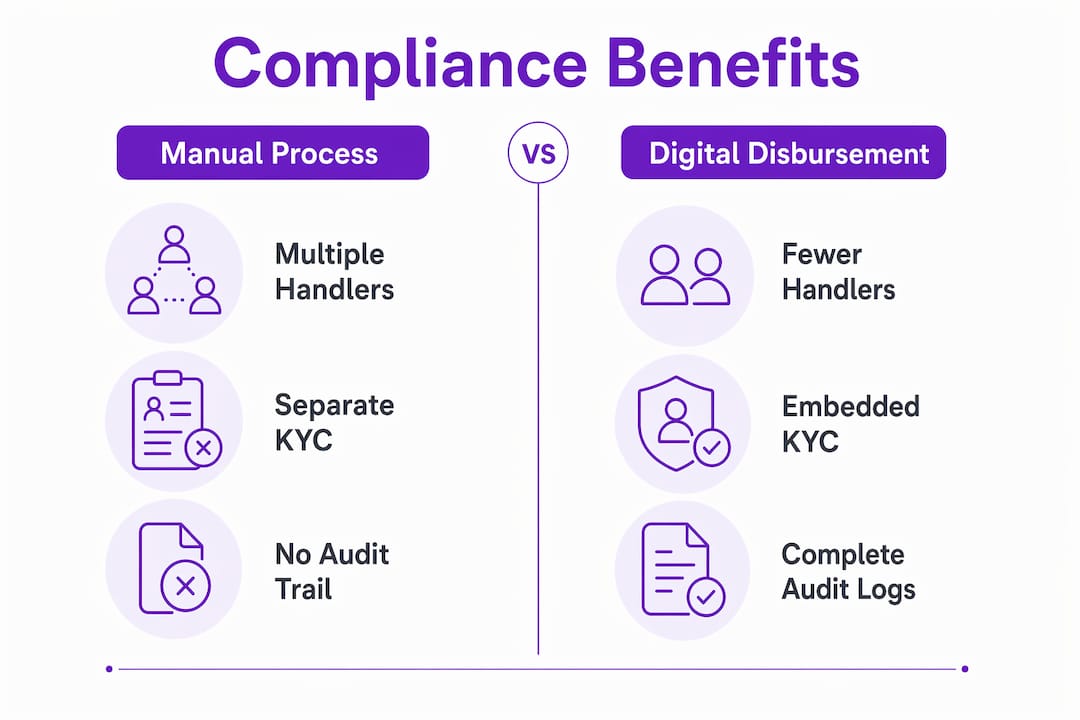
The core mechanism is the audit log. Real-time audit logs must connect every payment’s initial request through to recipient validation to satisfy auditors and regulators. A log that exists but cannot be queried is not a compliance asset. It is a liability.
Digital platforms deliver audit readiness through several structural features:
- API-accessible transaction records that compliance teams can pull on demand, not just during scheduled reviews
- Payee validation links that tie each disbursement to a verified identity, tax ID, or license number
- Exportable data formats that satisfy retention mandates under AML regulations and IRS reporting requirements
- Reconciliation automation that matches payments to contracts without manual spreadsheet work
Legacy systems create measurable dissatisfaction. 31% of recipients in legacy disbursement systems report dissatisfaction, with 60% citing slow settlement speed as the primary cause. Slow settlement is not just a customer experience problem. It signals batch processing architectures that cannot support real-time compliance controls.
The EU Instant Payments Regulation now requires settlements within seconds, eliminating batch processing and mandating automated sanctions screening in real time. That regulatory direction reflects where compliance expectations are heading globally, including in U.S. real estate payment workflows.
Pro Tip: Connect your disbursement platform to your compliance management system via API. Automated data handoffs between payment records and compliance workflows cut reporting time and reduce the risk of transcription errors that create audit findings.
What compliance challenges do digital disbursements solve in real estate?
Real estate commission payments carry specific regulatory weight. RESPA governs how brokerages split commissions and pay referral fees. AML regulations require documentation of payment sources and recipients. IRS Form 1099 rules demand accurate payee records for every agent paid more than $600 in a calendar year. Manual processes fail all three requirements at scale.

The risks of manual payment workflows are concrete. A brokerage using Venmo or Zelle to pay agent splits has no embedded KYC check, no AML screening, and no audit trail that connects the payment to a specific transaction file. That is not a theoretical risk. It is the kind of paper trail that triggers federal liability.
Digital disbursement platforms address these challenges by embedding KYC and AML screening directly into the payout flow. Compliance controls run automatically at the moment of payment, not as a separate manual step.
The operational difference between manual and digital compliance workflows is significant:
| Compliance area | Manual process | Digital disbursement |
|---|---|---|
| KYC verification | Collected separately, often incomplete | Embedded at payee onboarding |
| AML screening | Periodic, batch review | Real-time, per transaction |
| Audit trail | Paper files, spreadsheets | Queryable digital logs |
| 1099 documentation | Manual data entry, error-prone | Auto-generated from payment records |
| Multi-party payments | Tracked manually across deals | Automated splits with full traceability |
Multi-party real estate transactions amplify every compliance gap. A single closing can involve a listing agent, buyer’s agent, referral partner, and co-op brokerage. Each payment leg requires its own documentation. Compliant co-op payment workflows require traceability at every split, not just at the top-level commission disbursement.
How do digital disbursement platforms integrate with compliance systems?
Integration is where digital disbursement benefits either compound or collapse. A platform that processes payments quickly but cannot connect to your compliance management system creates a new data silo instead of solving an old one.
API-driven architecture is the foundation. Platforms built on open APIs allow compliance teams to pull transaction data into case management tools, export records to auditors, and trigger automated alerts when a payment hits a risk threshold. Onboarding compliance documentation automation reduces integration delays and keeps payment workflows audit-ready from day one.
Scalable compliance requires embedding KYC, AML, and sanctions screening within the disbursement flow rather than running them as separate processes. Embedding compliance controls within digital disbursement flows reduces manual overhead while enabling regulatory adherence at volume. That matters for brokerages processing dozens of closings per month across multiple agents and markets.
Cross-border and multi-currency disbursements add another compliance layer. Each jurisdiction carries its own AML thresholds, tax documentation requirements, and sanctions lists. Platforms that handle currency conversion within a compliant framework eliminate the need for separate foreign exchange processes that create documentation gaps.
Risk-based routing is the most underused integration feature in real estate payment operations. A risk-based routing approach directs low-risk payees to instant payment rails automatically while holding high-risk transactions for manual review. This prevents the compliance failure mode where automated approvals process transactions that should have been flagged.
Pro Tip: When evaluating disbursement platforms, ask specifically about risk-based routing logic. Platforms that apply the same verification rules to a $500 referral fee and a $50,000 co-op commission are not built for real estate compliance workflows.
Brokerpay is built specifically for this integration challenge. It tracks agent splits, referral fees, and co-op commissions within a RESPA-compliant framework, with automated payouts for brokers replacing the manual processes that create federal liability.
Key Takeaways
Digital disbursements improve compliance by replacing manual, error-prone payment processes with automated, auditable workflows that embed KYC, AML, and sanctions screening at the point of payment.
| Point | Details |
|---|---|
| Fewer handlers, less fraud | Reducing transaction handlers from eight to two directly lowers fraud risk and audit exposure. |
| Real-time audit logs | Queryable logs that connect payment requests to payee validation satisfy auditor and regulator demands. |
| Embedded compliance controls | KYC and AML screening built into the payout flow eliminates manual compliance steps and reduces overhead. |
| Data hygiene is non-negotiable | Automating payouts without clean payee data creates more compliance friction, not less. |
| Risk-based routing | Directing high-risk transactions to manual review prevents automated approvals of flagged payments. |
Why compliance officers should stop treating digital disbursements as an IT project
The most common mistake I see compliance officers make is handing digital disbursement implementation entirely to the technology team. The result is a platform that processes payments faster but does not actually reduce compliance risk, because the compliance requirements were never built into the workflow design.
Compliance in digital payments is not a feature you add after the platform is live. It is an architecture decision made before the first transaction runs. The brokerages that get this right treat their disbursement platform selection the same way they treat their compliance program design: with specific regulatory requirements, documented controls, and clear ownership.
The data hygiene point deserves more attention than it gets. I have seen brokerages invest in digital disbursement platforms and then spend more time on manual rework than before, because payee records were inconsistent, agent license numbers were missing, and tax IDs did not match IRS records. The platform was not the problem. The underlying data was.
Regulatory frameworks are also moving faster than most compliance programs. The EU Instant Payments Regulation is one example of how quickly “best practice” becomes “legal requirement.” U.S. real estate professionals should watch NACHA rule updates and FinCEN guidance with the same attention. Platforms that embed compliance controls as configurable rules, rather than hardcoded logic, adapt to regulatory changes without requiring a full system rebuild.
The brokerages that treat compliance as an operational advantage, not a cost center, are the ones that close deals faster, attract better agents, and avoid the federal liability that comes from informal payment workarounds.
— Was
Brokerpay: built for compliant real estate disbursements
Real estate brokerages that still rely on informal payment methods to split commissions carry federal liability they may not fully recognize. Brokerpay eliminates that exposure.
Brokerpay tracks, documents, and processes agent splits, referral fees, and co-op commissions within a RESPA-compliant framework. Every payment generates a queryable audit log. KYC and AML controls run automatically at the point of disbursement. Tax documentation populates from payment records, not manual data entry. For compliance officers who need commission tracking that prevents tax issues and audit exposure, Brokerpay replaces the Venmo and Zelle workarounds that create the problems. See how Brokerpay works and what a compliant real estate payment workflow actually looks like.
FAQ
What are digital disbursements in real estate?
Digital disbursements are electronic payments that transfer commission splits, referral fees, and co-op payments directly between parties with automated documentation. They replace paper checks and informal transfers with traceable, compliant payment records.
How do digital payments enhance compliance for brokerages?
Digital payment platforms embed KYC verification, AML screening, and audit logging directly into each transaction, eliminating the manual compliance steps that create errors and regulatory exposure.
What is the risk of using Venmo or Zelle for agent payments?
Informal payment apps have no embedded KYC or AML controls and generate no audit trail connected to a transaction file, creating direct RESPA and FinCEN liability for the brokerage.
How do audit logs in digital disbursements satisfy regulators?
Queryable audit logs that connect payment requests to payee validation give auditors a complete, verifiable record from initiation to settlement, which is the standard regulators require.
What is risk-based routing in a disbursement platform?
Risk-based routing automatically sends low-risk payees through instant payment rails while flagging high-risk transactions for manual review, preventing automated approvals of payments that should be scrutinized.