Real Estate Back-Office Payment Automation Guide

Real estate back-office payment automation is the use of API-first software to process, track, and reconcile property-related payments without manual intervention. Brokers and office managers who handle agent commissions, investor distributions, contractor invoices, and rent collections face a volume problem that spreadsheets and bank portals cannot solve. The industry term for this discipline is accounts payable and disbursement automation, though “back-office payment automation” captures the full scope of what modern brokerages need. This guide covers the tools required, the setup process, the common failure points, and the operational gains you can expect.
What is real estate back-office payment automation?
Real estate back-office payment automation replaces manual payment tasks with software-driven workflows that validate, batch, schedule, and reconcile payments across every transaction type a brokerage handles. The three most common payment categories are agent commission splits, investor distributions, and contractor or vendor invoices. Each carries different urgency, compliance requirements, and error risks.
API-first mass payment systems scale real estate disbursements to over 10,000 monthly payments while automating validation, batching, and reconciliation. That scale matters because a mid-size brokerage closing 200 transactions per month can generate thousands of individual payment lines once splits, referral fees, and co-op commissions are factored in. No finance team can process that volume accurately by hand.

The compliance dimension is equally significant. RESPA regulations govern how real estate fees are split and documented. Using consumer apps like Venmo or Zelle to pay agents creates federal liability because those platforms produce no compliant audit trail. Brokerpay is built specifically to eliminate that risk by tracking, documenting, and processing every split within a RESPA-compliant framework.
What tools and prerequisites do you need to get started?
Automation requires the right infrastructure before any workflow runs. Three categories of tools form the foundation: an API-first payment platform, an accounting or property management system, and a compliance workflow for tax form collection.
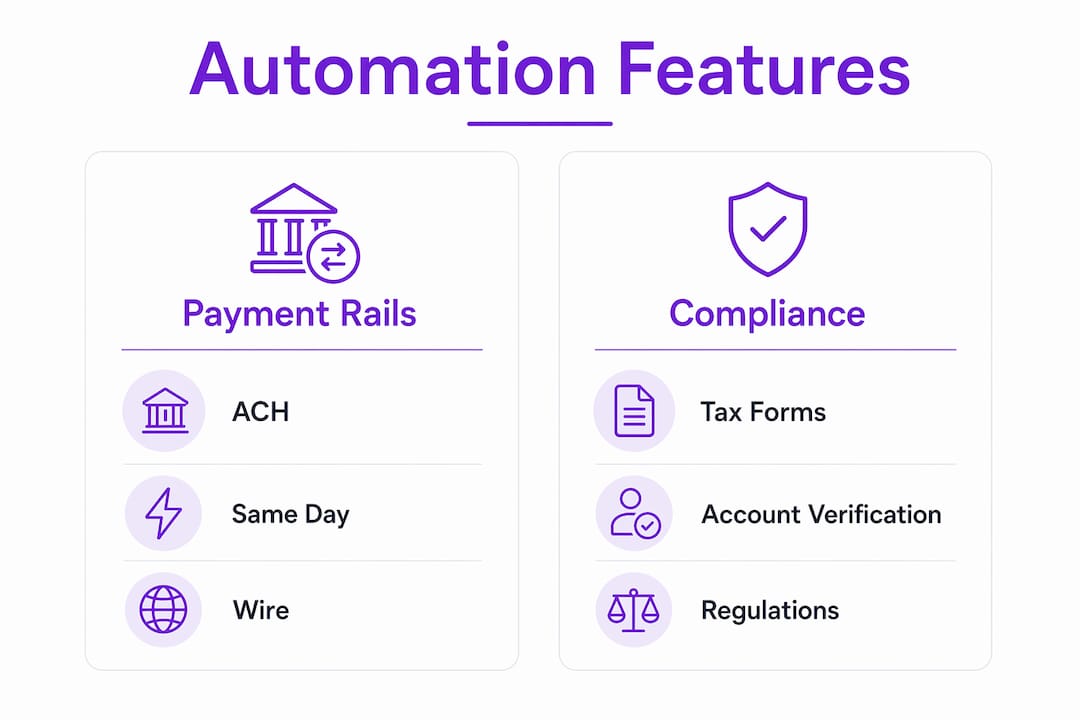
API-first payment platforms connect directly to your bank and to payee accounts via ACH, Same Day ACH, RTP/FedNow, Wire, or check. They expose endpoints that your property management or accounting software can call to trigger payments automatically. Platforms that lack an API force you back into manual portal entry, which defeats the purpose.
Accounting and property management integration is the second requirement. Automated AP solutions consolidate multi-entity property financials, standardizing data and improving reporting accuracy across portfolios. Without that normalization, a firm managing 50 properties across multiple LLCs will produce inconsistent financial records that make reconciliation painful.
Tax compliance infrastructure rounds out the prerequisites. Automated W-9 and W-8 collection, combined with 1099 filing, must be built into the platform from day one. Adding it later creates a compliance gap that surfaces at year-end when you least have time to fix it.
The table below maps the feature categories you should evaluate before selecting any platform.
| Feature category | What to look for |
|---|---|
| Payment rail support | ACH, Same Day ACH, RTP/FedNow, Wire, and check in one platform |
| Tax form automation | W-9/W-8 collection and 1099 filing built in, not bolted on |
| Multi-entity support | Separate ledgers per LLC or property with consolidated reporting |
| Account verification | Bank account ownership verification before first payment |
| Accounting integration | Native connectors to major real estate accounting software |
| Approval workflows | Role-based authorization with audit log for every payment |
Pro Tip: Before you sign any platform contract, ask the vendor to demonstrate a live API call that triggers a payment from your accounting system. If they cannot show it in a demo, the integration is not production-ready.
How do you set up automated payment workflows for commissions, rent, and vendors?
Setup follows a predictable sequence regardless of which platform you choose. Skipping steps early creates errors that are expensive to reverse later.
-
Onboard payees with identity and tax form verification. Collect legal name, address, tax ID, and bank account details for every agent, investor, and vendor. Run bank account ownership verification before storing any routing or account number. Misdirected large payments such as a $40,000 commission take days to reverse and risk significant capital loss. Verification eliminates that risk at the source.
-
Configure payment batches by payment type. Group agent commission splits into one batch, investor distributions into another, and vendor invoices into a third. Each group has different approval requirements and urgency levels. Keeping them separate makes reconciliation cleaner and approval routing simpler.
-
Select payment rails based on urgency and cost. Same Day ACH and RTP/FedNow meet agent commission and investor distribution urgency requirements without excess cost. Standard ACH works for recurring vendor payments where a two-day delay is acceptable. Wire is appropriate only for large, time-critical transactions where the fee is justified.
-
Build approval and authorization workflows. Every payment batch should require sign-off from a designated approver before funds move. Role-based permissions prevent junior staff from releasing payments without review. The approval log also serves as your audit trail for RESPA compliance purposes.
-
Schedule recurring payments. Rent collection and recurring vendor invoices should run on a fixed schedule without manual triggering. Landlords using automated rental platforms report a 99% on-time rent payment rate with recurring auto-pay features. That consistency reduces late fees, tenant friction, and the administrative time spent chasing payments.
-
Test with a small batch before full deployment. Run five to ten payments through the full workflow before opening it to your entire payee list. Confirm that reconciliation entries post correctly in your accounting system and that payees receive payment notifications.
Pro Tip: Map every payment type to a specific payment rail and approval tier in a written policy before you configure anything in the platform. That document becomes your runbook when staff turns over or when an auditor asks how your payment controls work.
What are the common challenges in back-office payment automation?
Most implementation problems fall into four categories: multi-entity complexity, misdirected payments, tax compliance gaps, and poor visibility into payment status.
Multi-entity complexity is the most underestimated challenge. Managing accounts payable across hundreds of properties requires automated normalization of diverse file types into standardized financial records. A firm with 30 LLCs receiving invoices in different formats from different vendors cannot reconcile accurately without a platform that normalizes those inputs automatically.
Misdirected payments are the most expensive failure mode. Manual bank portals and spreadsheets lack account ownership verification, causing costly payment errors and reversal delays. A single wrong routing number on a $40,000 commission payment can freeze capital for days while the bank processes a reversal.
Tax compliance gaps create year-end scrambles. Automated collection and filing of W-8/W-9 and 1099 tax forms is the only reliable way to prevent compliance bottlenecks at scale. Firms that collect tax forms manually in a spreadsheet inevitably discover missing or outdated forms in december when there is no time to chase them down.
Poor payment status visibility breaks reconciliation. When your accounting team cannot see whether a payment cleared, failed, or is pending, they make assumptions that produce errors in your books.
The biggest hidden cost of manual payment processes is not the labor hours. It is the capital tied up in payment errors, reversals, and compliance penalties that never appear on a single line item but accumulate across hundreds of transactions each year.
Pro Tip: Set automated alerts for failed payments, returned ACH transactions, and payments that have been pending for more than 48 hours. Catching a failure the same day it occurs costs minutes to fix. Catching it at month-end costs hours.
How does payment automation improve financial visibility and operational efficiency?
The operational gains from automation compound across three dimensions: speed, accuracy, and scale.
Automating accounts payable workflows completes approvals 5 times faster than manual processes across property portfolios. That speed translates directly into faster vendor payments, which improves your negotiating position and reduces the risk of service interruptions from unpaid contractors.
Centralized reporting is the second major gain. Centralizing payments in integrated property operations improves cash flow predictability, reporting accuracy, and tenant satisfaction. When every payment flows through one system, your finance team can pull a real-time view of outstanding payables, cleared transactions, and projected cash needs without assembling data from multiple sources.
Scale is the third dimension. The ability to process over 10,000 payments monthly without adding finance headcount is the defining advantage of API-first platforms. A brokerage that grows from 50 to 200 agents does not need to hire two additional accounting staff if its payment infrastructure scales through configuration rather than headcount.
The practical benefits for brokers and office managers include:
- Faster agent commission disbursements that improve agent retention and satisfaction
- Automated investor distribution reports that reduce investor relations overhead
- Real-time payment status visibility that eliminates “did my check clear?” calls from vendors
- Automatic reconciliation entries that reduce month-end close time
- Compliant co-op payment workflows that document every split for RESPA audit purposes
API-first billing platforms also enable firms to adapt pricing and operational complexity through configuration rather than costly replatforming. That flexibility matters in real estate, where deal structures, commission arrangements, and entity configurations change frequently.
Key Takeaways
Real estate back-office payment automation requires API-first infrastructure, built-in tax compliance, and account verification to process thousands of payments accurately without adding finance headcount.
| Point | Details |
|---|---|
| Start with verification | Verify bank account ownership before the first payment to prevent costly misdirected disbursements. |
| Separate payment batches | Group commissions, rent, and vendor payments into distinct batches for cleaner reconciliation and approval routing. |
| Match rails to urgency | Use Same Day ACH or RTP/FedNow for commissions and standard ACH for recurring vendor invoices to balance speed and cost. |
| Automate tax compliance | Collect W-9/W-8 forms and file 1099s through the platform from day one to avoid year-end compliance gaps. |
| Centralize for visibility | Consolidating all payments in one system gives finance teams real-time cash flow data without manual data assembly. |
What I have learned from watching brokerages automate their back office
The brokerages that implement payment automation successfully share one habit: they treat the payment platform as infrastructure, not software. They configure it the way they would configure a phone system or an accounting chart of accounts. They write policies, assign roles, and test before going live. The ones that struggle treat it like a bank portal they log into when they need to send money.
The second pattern I have noticed is that compliance features are almost always undervalued during vendor selection. Brokers focus on speed and cost per transaction, which are real concerns. But the firm that saves $0.30 per ACH transaction and then pays $15,000 in penalties for missing 1099 filings made a bad trade. Tax form automation and RESPA-compliant audit trails are not nice-to-have features. They are the reason you automate in the first place.
My honest recommendation is to start with commission payment automation before tackling rent collection or vendor payments. Commissions are the highest-risk, highest-urgency payment type in any brokerage. Getting that workflow right builds the operational muscle and the institutional confidence to expand automation across the rest of your back office.
The industry is also moving faster than most brokers realize. Agents increasingly expect same-day commission payments after closing. Investors expect distribution statements that reconcile automatically with their own accounting systems. The brokerages that meet those expectations will retain better agents and attract more capital. The ones still cutting checks by hand will not.
— Wes
How Brokerpay handles real estate payment automation for brokerages
Brokerpay is built for exactly the compliance and disbursement challenges this article describes. It tracks, documents, and processes agent splits, referral fees, and co-op commissions within a RESPA-compliant framework, eliminating the Venmo and Zelle workarounds that create federal liability for brokerages.

Brokerpay automates tax form collection and 1099 filing so your year-end close does not turn into a compliance scramble. It handles multi-agent splits, referral fees, and co-op payments with a full audit trail on every transaction. Brokerages that need to move from manual to automated payouts can get started without adding finance headcount. Visit Brokerpay to see how the platform handles your specific commission and compliance workflows.
FAQ
What is real estate back-office payment automation?
Real estate back-office payment automation uses API-first software to process, validate, and reconcile property payments including commissions, rent, and vendor invoices without manual intervention. It replaces spreadsheets and bank portals with automated workflows that scale to thousands of monthly transactions.
How do I automate real estate commission payments?
Onboard each agent with verified bank account details and a completed W-9, then configure a payment batch that triggers automatically when a transaction closes. Platforms like Brokerpay handle the split calculation, compliance documentation, and disbursement in one workflow.
What payment rails work best for agent commissions?
Same Day ACH and RTP/FedNow are the best options for agent commissions because they deliver funds within hours at a lower cost than wire transfers. Standard ACH is appropriate for recurring vendor payments where a two-day settlement window is acceptable.
How does automation handle 1099 tax reporting?
Automated platforms collect W-9 and W-8 forms during payee onboarding and generate 1099 filings at year-end based on payment records. This eliminates the manual overhead of chasing tax forms in december and reduces the risk of filing errors.
What is the biggest risk of not automating real estate payments?
The biggest risk is misdirected payments. Without account ownership verification, a single wrong routing number on a large commission payment can freeze capital for days during the reversal process, disrupting cash flow and damaging agent trust.