Why Brokerage Payment Systems Replace Spreadsheets

Brokerage payment systems are defined as centralized platforms that automate commission tracking, payment processing, and compliance documentation across every agent transaction. The core reason why brokerage payment systems replace spreadsheets is simple: spreadsheets break under the weight of real brokerage operations. Brokerages that switch from manual spreadsheets to centralized payment workflows see a 98% reduction in billing inaccuracies and 75% less audit time. That is not a marginal improvement. It is a structural shift in how a brokerage operates. Platforms like Brokerpay represent this shift for real estate, handling agent splits, referral fees, and co-op commissions in a RESPA-compliant environment that no spreadsheet can replicate.
Why do spreadsheets fail for brokerage payments and commissions?
Spreadsheets fail brokers because they are static tools applied to dynamic problems. Every commission split involves multiple variables: agent tier, transaction date, referral source, and co-op splits. A spreadsheet requires someone to manually enter, check, and update each one. That process creates errors at every step.
The operational damage from spreadsheet reliance is concrete:
- Manual math errors accumulate across transactions, causing financial leakage that brokers rarely catch until an audit.
- Reconciliation delays force office managers to spend hours cross-referencing bank records against hand-entered commission logs.
- Fragmented data silos mean your CRM, your accounting software, and your commission tracker never talk to each other.
- Withdrawal delays and failed deposits become more likely when disconnected middleware handles routing between systems.
- Audit vulnerabilities grow when records live in multiple files with no version control or access log.
The timing problem makes this worse. Spreadsheet-based systems fail to detect anomalies in real time, causing 8–12 hour delays in identifying issues. In a brokerage processing dozens of closings per month, that lag means problems compound before anyone notices.
Pro Tip: Run a single month of commission records through a manual reconciliation exercise. Count every correction you make. That number is your baseline error rate, and it is the clearest argument for switching to an automated system.
The cost of maintaining multiple disconnected tools adds up fast. Unified systems reduce vendor sprawl and annual software run rates compared to patching together separate tools for accounting, commission tracking, and payment processing. Mid-size brokerages regularly consolidate thousands of dollars in software subscriptions by moving to a single platform.
How do payment systems unify commission tracking and workflows?
Unified brokerage payment systems replace the patchwork of spreadsheets and disconnected apps with a single operational layer. The shift is not just about convenience. It is about replacing ad hoc data links with shared lifecycle logic that ties commission calculations directly to live transaction data.
Here is how that unification works in practice:
- Direct platform synchronization. Payment systems connect directly to your trading platform and CRM, pulling transaction data automatically. No manual entry means no manual errors.
- Live commission split dashboards. Every agent sees their current earnings in real time. Office managers see the full picture across all agents without opening a single spreadsheet.
- Automated tiered calculations. Multi-tier commission structures, graduated splits, and referral fees calculate automatically when a transaction closes. Automated commission computation eliminates the math errors that cost brokerages money.
- Integrated audit trails. Every payment, approval, and adjustment generates a timestamped record. Regulators and auditors get clean documentation without anyone compiling it manually.
- Role-based approvals. Instead of email chains and spreadsheet logs, approval workflows route through the system. The right person approves the right payment, and the record is automatic.
Pro Tip: When evaluating platforms, ask specifically whether commission rules update automatically when an agent changes tiers mid-year. Systems that require manual rule updates still carry spreadsheet-level risk in that one area.
Brokerpay applies this model to real estate specifically, handling the co-op commissions, referral fees, and agent splits that define brokerage operations. The platform keeps every transaction RESPA-compliant by design, which removes the compliance burden from your office manager’s plate entirely.
What operational and financial benefits do brokers gain by switching?
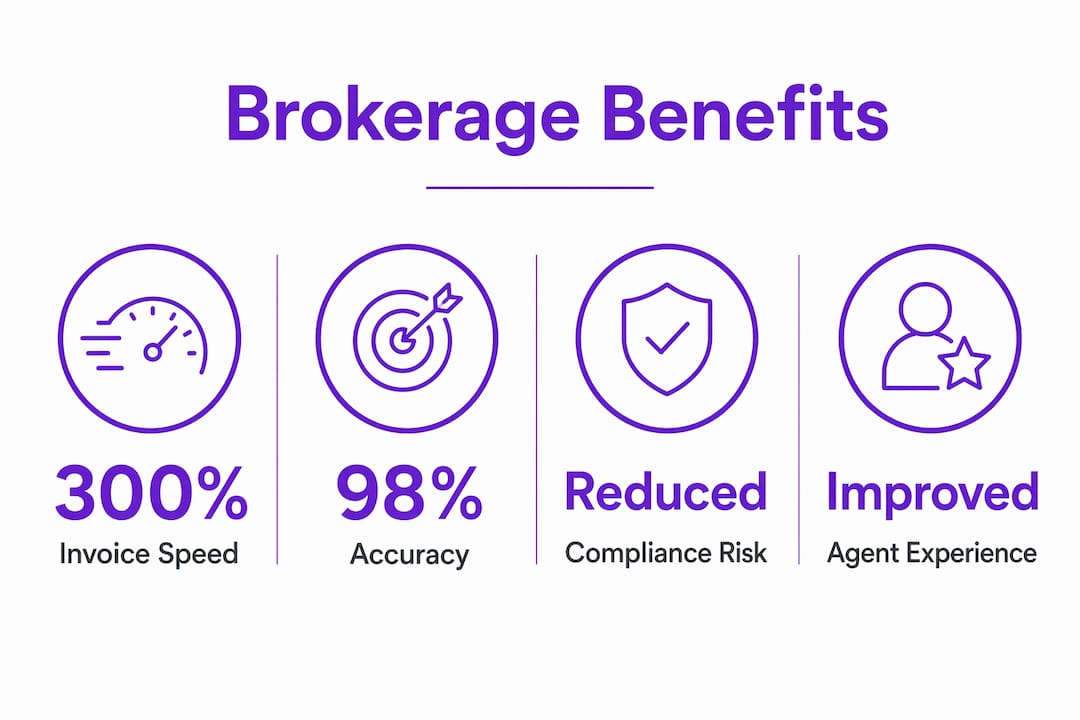
The benefits of payment systems over spreadsheets show up in three areas: speed, accuracy, and compliance. Each one has a direct dollar value for your brokerage.
On speed, brokerages that move to centralized platforms see a 300–500% increase in invoice processing speed by eliminating manual data entry bottlenecks. Faster invoice processing means faster payouts to agents. Faster payouts build agent trust and reduce the friction that drives top producers to other brokerages.

On accuracy, the 98% reduction in billing inaccuracies is the headline number. The underlying mechanism matters more: automated systems generate clean, auditable records for every transaction, and tokenization with PCI DSS compliance protects sensitive payment data. That combination reduces both human error and fraud risk simultaneously.
On compliance, the stakes are highest. Regulatory bodies like the FCA and CySEC expect documented, traceable payment records. Spreadsheets cannot produce those records reliably. A unified system does it automatically.
“Modern payment infrastructure is critical for investor trust, with instant, error-free transaction processing being a competitive advantage.” — Citi, Serving the Always-On Investor: A Payments Playbook for Broker-Dealers
The agent experience improvement is often underestimated. Instant payment adoption enhances liquidity, reduces settlement delays, and builds trust. Agents who receive accurate, on-time payments do not question their splits or call the office to verify numbers. That alone saves office managers hours every week.
| Benefit | Impact |
|---|---|
| Billing accuracy | 98% reduction in inaccuracies vs. manual tracking |
| Audit preparation | 75% less time spent on audit documentation |
| Invoice processing | 300–500% faster than manual data entry workflows |
| Compliance readiness | Automated audit trails satisfy FCA and CySEC documentation standards |
| Agent trust | Real-time payment visibility reduces split disputes and office inquiries |
How can independent brokers implement a payment system without disrupting operations?
The biggest reason brokers delay switching is fear of disruption. That fear is legitimate but manageable. Proactive change early in the fiscal year minimizes friction because transaction volume is typically lower in Q1 and the team has time to learn the system before peak activity.
A practical implementation approach follows these priorities:
- Start with integration mapping. Identify every tool your brokerage currently uses: your CRM, your accounting software, your transaction management system. Choose a payment platform that connects to all of them natively.
- Centralize accounts payable and receivable first. Getting all money movement into one system is the highest-value first step. Commission calculations can follow once the payment layer is stable.
- Run parallel tracking for 30 days. Keep your spreadsheets active alongside the new system for one month. Compare outputs daily. This builds team confidence and catches any configuration errors before they affect real payouts.
- Establish real-time sync as a non-negotiable requirement. Any platform that requires manual data imports still carries spreadsheet-level risk. Unified systems remove the need for disconnected middleware entirely.
- Train on role-based approvals before go-live. The approval workflow is where most teams struggle initially. Walk every manager through the approval chain before the first live transaction.
The switch from manual to automated payouts does not require a full technology overhaul. Most brokerages implement incrementally, starting with commission tracking and adding payment processing once the team is comfortable. That phased approach keeps operations stable while the brokerage builds toward full automation.
Timing your upgrade to Q1 also optimizes audit readiness. A full year of clean, system-generated records is far more valuable to an auditor than ten months of automated data preceded by two months of spreadsheets.
What future trends are shaping brokerage payment systems?
The next generation of brokerage payment infrastructure moves beyond replacing spreadsheets. It builds systems that anticipate problems before they occur.
Real-time and instant payment adoption is accelerating. Digital wallet payouts reached 83 million in the past year, and Gen Z investors expect real-time transactions as a baseline. Brokerages that cannot process instant payouts will face agent and client attrition as this expectation becomes standard.
API-first architectures are replacing monolithic back-office systems. A platform built on open APIs connects to new tools as they emerge, without requiring a full system replacement. That flexibility protects your technology investment over time.
AI-driven analytics are entering commission management. These tools flag anomalies in payment patterns, forecast cash flow based on pipeline data, and identify agents whose commission structures may be misaligned with brokerage profitability. The real-time anomaly detection that unified systems already provide is the foundation for this next layer of intelligence.
Mobile-first interfaces are also becoming a requirement, not a feature. Agents who close deals on the road expect to check their commission status from a phone. Office managers need approval workflows that function on mobile without degrading the audit trail.
The spreadsheet problem is a trust problem
Wes here. I have watched brokers defend their spreadsheets the way people defend old cars. They know every quirk, they have workarounds for every problem, and they genuinely believe the system works because it has not catastrophically failed yet.
The issue is that spreadsheets fail quietly. A formula error in one cell propagates through twenty calculations before anyone notices. An agent gets underpaid by $400 on a closing, does not say anything, and starts looking at other brokerages. The broker never connects those two events.
What I have seen after brokerages implement a unified system like Brokerpay is not just fewer errors. It is a change in the quality of conversations. Office managers stop spending their mornings reconciling numbers and start spending them on things that actually grow the business. Agents stop questioning their splits because the math is visible and automatic. The commission tracking that prevents tax issues becomes a byproduct of normal operations rather than a separate project every quarter.
The resistance to change is real, and I respect it. But the brokers who wait until a compliance audit or an agent dispute forces the switch pay a much higher price than those who move proactively. The technology is not complicated. The decision is.
— Wes
Brokerpay handles what spreadsheets cannot
Brokerpay is built specifically for real estate brokerages that need compliant, documented commission payments without the manual overhead.

The platform tracks agent splits, referral fees, and co-op commissions in a single system, keeping every transaction RESPA-compliant and eliminating the Venmo and Zelle workarounds that create federal liability. Every payout generates a clean audit trail automatically. Office managers get real-time visibility into every commission calculation without opening a spreadsheet. Agents get accurate, on-time payments with full transparency into their splits. If your brokerage is still managing commissions manually, see how Brokerpay works and what a compliant, automated payment workflow looks like in practice.
FAQ
Why do brokerage payment systems replace spreadsheets?
Brokerage payment systems replace spreadsheets because they automate commission calculations, generate audit-ready records, and eliminate the manual math errors that cause financial leakage. Brokerages switching to centralized platforms see a 98% reduction in billing inaccuracies and 75% less audit time.
What are the biggest risks of using spreadsheets for commission tracking?
The biggest risks are manual math errors, reconciliation delays, and the inability to detect payment anomalies in real time. Spreadsheet-based systems cause 8–12 hour delays in identifying issues, which allows errors to compound across multiple transactions before anyone catches them.
How does RESPA compliance relate to commission payment systems?
RESPA requires that referral fees and co-op commissions follow specific documentation and payment rules. Platforms like Brokerpay track and document every transaction automatically, keeping brokerages compliant and eliminating informal payment methods like Venmo or Zelle that create federal liability.
When is the best time to switch from spreadsheets to a payment system?
Q1 is the best time to upgrade brokerage payment systems. Lower transaction volume in early Q1 gives your team time to learn the platform before peak market activity, and a full year of clean records maximizes audit readiness.
What should brokers look for in a brokerage payment platform?
Brokers should prioritize direct integration with their CRM and transaction management system, automated tiered commission calculations, role-based approval workflows, and real-time audit trails. Platforms that require manual data imports still carry spreadsheet-level risk in those import steps.
Key Takeaways
Brokerage payment systems replace spreadsheets because they deliver automated accuracy, real-time visibility, and built-in compliance that no manual process can match.
| Point | Details |
|---|---|
| Accuracy improvement | Centralized systems reduce billing inaccuracies by 98% compared to manual spreadsheet tracking. |
| Speed gains | Invoice processing runs 300–500% faster when manual data entry bottlenecks are removed. |
| Compliance readiness | Automated audit trails satisfy FCA, CySEC, and RESPA documentation requirements without extra manual work. |
| Implementation timing | Starting in Q1 minimizes operational friction and builds a full year of clean financial records. |
| Agent trust | Real-time commission visibility reduces split disputes and keeps top producers from looking elsewhere. |