Flat Fee Brokerage Model Explained for Agents and Sellers

A flat fee brokerage model is a real estate compensation structure where brokers or agents charge a fixed dollar amount for defined services, regardless of the home’s final sale price. This stands in direct contrast to the traditional commission model, where sellers pay 5–6% of the sale price to cover both listing and buyer agent fees. The flat fee approach, also called a flat fee MLS or fixed fee listing, gives sellers cost predictability from day one. For agents, a related variation called the 100% commission model replaces percentage splits with fixed monthly and per-transaction fees. Understanding what is a flat fee brokerage model matters now more than ever, as sellers on higher-priced homes stand to save tens of thousands of dollars.
What is a flat fee brokerage model and how does it work?
A flat fee brokerage model charges sellers a set price for a defined package of services, not a cut of the sale. Listing packages in 2026 typically range from $795 to $2,495, plus MLS fees of $210 to $280. The seller pays upfront or at closing, and the brokerage delivers exactly what the package specifies.

Service tiers vary widely. A basic package usually covers MLS listing, a lockbox, and document storage. Mid-tier packages add contract review and pricing guidance. Premium packages may include professional photography, open house coordination, and negotiation support. The key point is that service scope, not quality, defines what “limited” means in flat fee real estate. A seller who buys a premium package can receive full-service support at a fraction of the traditional commission cost.
The agent side of flat fee brokerage works differently. Under a 100% commission structure, agents keep their entire commission but pay the brokerage directly. Monthly fees run $50–$500, and per-transaction fees range from $250 to $995. This replaces the traditional 20–50% split agents give up under conventional brokerage arrangements. Agents who close enough deals each month reach a break-even point where the fixed cost model outperforms any percentage split.
- Basic tier: MLS listing, digital documents, lockbox access
- Mid tier: Pricing consultation, contract support, showing coordination
- Premium tier: Photography, staging advice, negotiation, open house management
- Agent model: 100% commission retained, fixed monthly and per-transaction fees paid to brokerage
Pro Tip: If you are a seller evaluating packages, calculate your savings against a 2.5% listing commission on your expected sale price. On a $500,000 home, a $1,500 flat fee saves you $11,000 on the listing side alone.
What are the benefits of the flat fee brokerage model?
Cost savings are the most visible benefit, and the numbers are hard to argue with. A luxury home sale at $10.2 million paid a $7,995 flat fee instead of a 2.5% listing commission that would have cost $255,000. That is a real, documented example of how the model performs at the high end of the market.
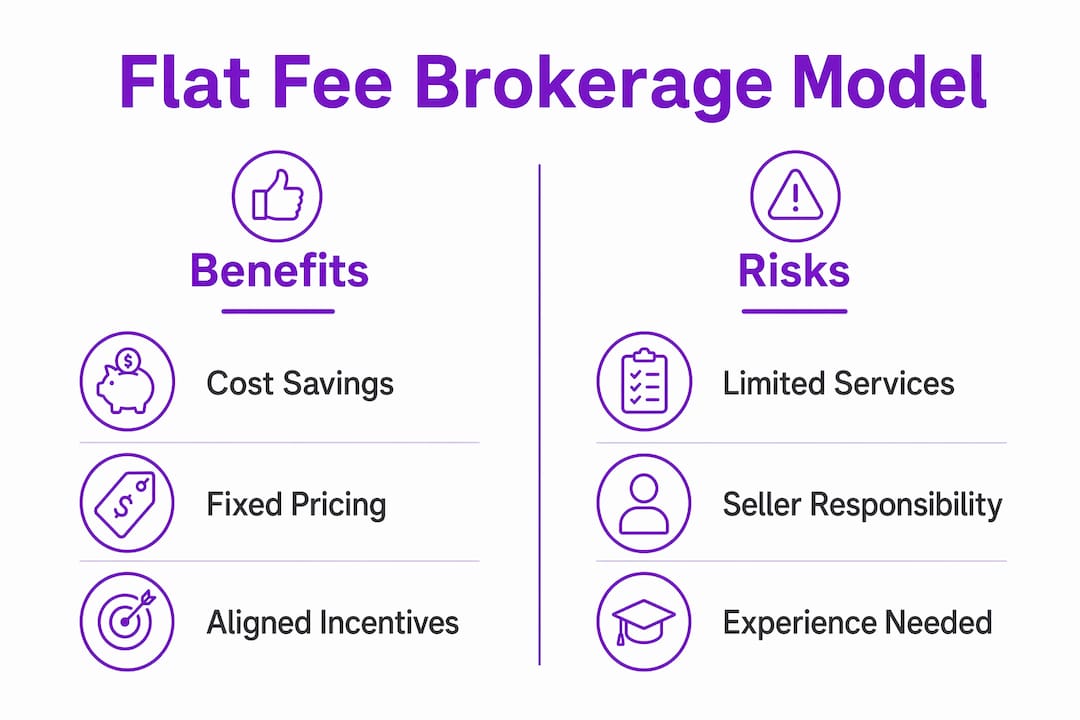
Predictability matters just as much as savings. Sellers know their cost before the home goes on the market. There are no surprises tied to a bidding war that pushes the sale price up. The fee stays fixed whether the home sells for $400,000 or $600,000. That transparency changes how sellers plan their net proceeds.
For agents, the flat fee model encourages financial independence. Flat fee models foster agent entrepreneurship by removing the brokerage’s claim on a percentage of every deal. An agent who closes 20 transactions a year and pays $500 per transaction keeps far more than an agent splitting 30% with a traditional brokerage on the same volume.
“The goal is to put the power back with buyers and sellers. People have felt trapped by traditional commissions for a long time.” — Rob Luecke, as quoted by NPR
The flat fee model also removes the conflict of interest that exists when an agent’s income rises with the sale price. A fixed fee agent has no financial incentive to push for a higher price or a faster close. That alignment with the seller’s actual goals is a structural advantage, not just a marketing claim.
What are the risks and downsides of a flat fee brokerage?
The flat fee model shifts responsibility from the brokerage to the seller. Basic packages typically exclude intensive marketing, open houses, and negotiation support unless the seller upgrades. Sellers who are not prepared to handle showings, field offers, and coordinate inspections will find the experience stressful without a full-service agent.
The buyer’s agent commission remains a separate cost. Buyer agent fees typically run 2.5–3%, and sellers who offer a low co-op commission risk fewer showings. Buyer agents have no obligation to show homes where the compensation does not justify their time. Skimping on the buyer side commission to maximize savings can backfire by reducing buyer traffic.
Agents operating under a 100% commission flat fee model face their own financial risks. Hidden operational costs including errors and omissions insurance, technology subscriptions, and marketing expenses come entirely out of the agent’s pocket. Profitability depends on closing enough transactions each month to offset those fixed costs. An agent with a slow quarter can lose money even while keeping 100% of each commission.
- Seller risks: Less hand-holding, more self-management required
- Buyer agent risk: Low co-op commissions reduce showing interest
- Agent risks: Out-of-pocket operational costs, volume dependency
- Service gaps: Open houses and staging often excluded from basic tiers
Pro Tip: Agents switching to a 100% commission flat fee model should run a break-even analysis before signing up. Divide your total monthly fixed costs by your average commission per deal to find the minimum number of closings you need each month to stay profitable. Use Brokerpay’s commission tracking tools to keep those numbers accurate.
How does the flat fee model compare to traditional and hybrid models?
All three brokerage models operate under the same state licensing and RESPA requirements. The model a brokerage uses does not change its legal obligations. What changes is the cost structure, the service scope, and who carries the operational burden.
| Feature | Traditional model | Flat fee model | Hybrid model |
|---|---|---|---|
| Listing cost | 2.5–3% of sale price | $795–$2,495 fixed | Reduced % plus flat fee |
| Service scope | Full service included | Tiered, à la carte | Partial service included |
| Seller responsibility | Low | Moderate to high | Moderate |
| Agent split | 20–50% to brokerage | Fixed monthly/transaction fee | Varies by agreement |
| Cost predictability | Low | High | Medium |
| Best for | First-time sellers | Experienced sellers | Sellers wanting balance |
Traditional brokerages bundle all services into the commission and absorb operational costs on the agent side. Flat fee brokerages unbundle those services and price them separately. Hybrid models sit in between, offering a reduced percentage commission with some services included and others available as add-ons.
The practical difference shows up most clearly on expensive homes. A $1 million sale at a 2.5% listing commission costs $25,000. The same sale with a $1,995 flat fee listing saves $23,005 on the listing side. That math is straightforward. The trade-off is that the seller takes on more responsibility for marketing and negotiation unless they pay for a premium package.
Key Takeaways
A flat fee brokerage model saves sellers the most money on higher-priced homes, but requires sellers to take on more responsibility for the transaction process.
| Point | Details |
|---|---|
| Fixed cost structure | Listing packages range from $795 to $2,495 in 2026, regardless of sale price. |
| Service tiers matter | Basic packages cover MLS access; premium tiers add negotiation and marketing support. |
| Buyer agent fees remain | Sellers still pay 2.5–3% to the buyer’s agent; low co-op commissions reduce showings. |
| Agent break-even is critical | Agents on 100% commission models must close enough deals to cover fixed monthly costs. |
| Regulation stays constant | All brokerage models require state licensing and RESPA compliance regardless of fee structure. |
Why the flat fee model is misunderstood more than it is misused
The most common mistake I see agents and sellers make is treating flat fee as a binary choice between “cheap and limited” and “expensive and full-service.” That framing is wrong. The flat fee model is a pricing structure, not a service quality rating. A premium flat fee package from a well-run brokerage can deliver everything a traditional agent offers, just at a predictable price.
Where the model genuinely struggles is with sellers who underestimate their own workload. Flat fee real estate works best for sellers who have sold before, understand the contract process, and are comfortable negotiating directly or coordinating with a real estate attorney. First-time sellers who buy a basic package and then feel lost at the inspection stage are not victims of a bad model. They bought the wrong tier for their experience level.
For agents, the flat fee or 100% commission model is not automatically better. It rewards volume and self-discipline. An agent who closes 15 or more transactions a year and manages their own marketing will likely come out ahead. An agent who closes 5 deals a year and relies on brokerage referrals may not. The math has to work before the model does.
The trend is moving toward flat fee structures across the industry, and that shift is real. But the agents and sellers who benefit most are the ones who go in with clear expectations, not just the promise of savings.
— Wes
How Brokerpay supports flat fee and 100% commission brokerages
Flat fee and 100% commission brokerages process more individual transactions per agent than traditional brokerages, which means more payment events to track, document, and distribute correctly.

Brokerpay automates the entire commission payment process for brokerages operating under any fee structure. The platform tracks agent splits, referral fees, and co-op commission payments with full RESPA compliance, eliminating the Venmo and Zelle workarounds that create federal liability. For flat fee brokerages where agents pay fixed monthly and per-transaction fees, Brokerpay documents every payment automatically. Visit Brokerpay to see how the platform handles commission management for flat fee and 100% commission models.
FAQ
What is a flat fee brokerage model in simple terms?
A flat fee brokerage model charges sellers a fixed dollar amount for real estate services instead of a percentage of the sale price. Listing packages in 2026 typically range from $795 to $2,495.
How does flat fee real estate differ from a traditional commission?
Traditional commissions cost 5–6% of the sale price and include full-service support. Flat fee listings charge a set price for a defined service tier, with sellers handling more of the transaction themselves.
Do sellers still pay the buyer’s agent under a flat fee model?
Yes. The buyer’s agent commission of 2.5–3% remains a separate cost that sellers negotiate independently from the flat fee listing price.
Is the flat fee model right for every seller?
The flat fee model works best for experienced sellers comfortable managing showings, negotiations, and paperwork. First-time sellers may need a premium package or a traditional agent for adequate support.
Are flat fee brokerages required to follow the same rules as traditional brokerages?
Yes. All brokerages, regardless of fee structure, must hold valid state licenses and comply with RESPA and other applicable regulations.