Common Referral Fee Processing Errors Real Estate Agents Make

Common errors in referral fee processing are the leading cause of compliance violations, payment disputes, and IRS penalties for real estate agents and brokerage staff. Referral fee processing, the formal term for tracking, documenting, and disbursing fees paid for client introductions, requires strict alignment with IRS rules, RESPA regulations, and state licensing board requirements. A single documentation gap or missed tax form can expose a brokerage to federal liability. The errors covered here are the ones that show up most often in real estate offices, and each one is preventable.
1. What are the most common documentation errors in referral fee agreements?
Referral fee disputes originate from unclear definitions and missing payment mechanics far more often than from disagreements about the fee rate itself. When an agreement does not define what counts as a “qualified referral,” agents argue over whether a lead that went cold still triggers payment. That ambiguity costs brokerages real money and real relationships.
The most damaging documentation mistakes include:
- No written agreement at all. Handshake deals and email threads are not enforceable referral agreements. A signed, written contract is the minimum standard.
- Vague qualification language. Terms like “qualified lead” or “warm introduction” mean different things to different people. Agreements must define exactly what actions or outcomes trigger a fee.
- Missing payment triggers. The agreement must state when payment is due, whether that is at contract signing, at closing, or after funds clear.
- No rejection window. Without a defined window for rejecting duplicate or unqualified referrals, you have no basis to dispute a fee claim.
- Missing state disclosure language. Several state licensing boards require specific disclosure language in referral agreements. Omitting it creates a licensing complaint risk.
Pro Tip: Draft every referral agreement with a checklist that covers qualification criteria, payment trigger, rejection window, and disclosure language. Review it with your broker before signing.
Informal agreements feel faster in the moment. They create months of disputes later.

2. How do tax reporting mistakes affect referral fee processing in 2026?
Tax reporting is where referral fee mistakes get expensive fast. The IRS updated its rules for 2026, and many agents are not aware of the change.
The 1099-NEC reporting threshold increased from $600 to $2,000 in 2026. Any payment of $2,000 or more to a non-corporate payee now requires a Form 1099-NEC, issued by January 31 of the following year. That threshold change does not reduce your obligation. It shifts which payments require the form.
The most frequent tax reporting errors in referral fee processing are:
- Netting fees before reporting. Netting referral fees against commission income before reporting causes IRS mismatches with payment platform filings and triggers audits. Referral fee income is gross revenue and must appear as such on Schedule C.
- Missing 1099-NEC filings. Payers who skip the form because a payment feels small or informal still face IRS penalties if the amount crosses the threshold.
- Skipping W-9 collection. Collecting W-9 forms before the first payment determines whether the recipient is corporate or non-corporate, which controls your 1099 filing requirement. Skipping this step creates information gaps that are difficult to fix after the fact.
- Misclassifying corporate payees. Payments to corporations generally do not require a 1099-NEC. Misclassifying a sole proprietor as a corporation means you skip a required filing.
- Incorrect Schedule C reporting. Agents who receive referral fees must report them as self-employment income. Agents who pay referral fees may deduct them on Schedule C Line 10 as commissions and fees, but only when properly documented.
Referral fee income reported on Schedule C must reflect gross amounts received, not amounts net of fees paid out. The IRS cross-references 1099-NEC filings from payers against recipient returns. A mismatch is an automatic audit flag.
Commission tracking that connects to tax documentation is the clearest way to prevent tax reporting problems before they reach the IRS.
3. What operational and tracking errors disrupt referral fee payments?
Operational errors are the day-to-day breakdowns that cause delayed payments, clawbacks, and ledger disputes. They are less dramatic than a RESPA violation but far more common.
The most disruptive operational mistakes include:
- Paying at contract signature instead of closing. Paying referral fees before a deal closes creates clawback problems when transactions fall through. Best practice is to pay only after funds clear or the deal officially closes.
- No lead rejection process. Without a documented rejection window and process, agents cannot push back on duplicate or unqualified referrals. Every referral becomes a potential fee obligation.
- Manual spreadsheets as the only tracking system. Manual spreadsheets and informal communication cause errors in lead qualification and payment timing. They also produce no audit trail.
- Mismatched payout timing. Paying a referral fee before the brokerage receives the commission creates a cash flow problem and a reconciliation headache.
- No refund or chargeback policy. When a transaction reverses, the referral fee policy must address whether the fee is returned, credited, or forfeited.
| Operational Error | Root Cause | Recommended Fix |
|---|---|---|
| Clawback disputes | Payment at contract signature | Pay only after closing and funds receipt |
| Duplicate referral claims | No rejection window defined | Set a 5-business-day rejection window in the agreement |
| Ledger mismatches | Manual tracking only | Use an automated system with audit trail |
| Delayed payouts | Payout before commission receipt | Tie payout timing to commission receipt date |
| Unresolved refunds | No refund policy in agreement | Add a refund clause covering transaction reversals |
Pro Tip: Automated tracking systems reduce disputes by providing clear, auditable referral attribution and payout histories. Switching from manual to automated payouts removes the human error that causes most ledger disputes.
4. How do regulatory compliance failures affect referral fee processing?
RESPA and state licensing rules create hard legal requirements for referral fee processing. Violations do not just result in fines. They can trigger license complaints and federal investigations.
The most common regulatory compliance failures are:
- Missing RESPA affiliated business arrangement disclosures. RESPA requires written disclosure of ownership relationships at the time of referral. The disclosure must explain the financial relationship and estimated charges, and it must be delivered separately to the client, not buried in a closing packet.
- Paying fees directly between agents. Referral fees must flow through the brokerage, not directly between individual agents. Direct agent-to-agent payments violate state licensing rules in most states and create unauthorized payment records.
- Hidden financial relationships. Undisclosed referral arrangements between affiliated businesses are a RESPA violation. The rule exists to protect consumers from inflated charges tied to undisclosed financial interests.
- Inadequate record retention. Keeping referral fee disclosure documents on file for at least five years is required to satisfy regulatory audits. Brokerages that cannot produce disclosure records during a RESPA inquiry face serious penalties.
- Paying unlicensed referrers. Most states prohibit paying referral fees to unlicensed individuals. Verify licensure before any fee agreement is signed.
Real estate referral disclosures give consumers the information they need to evaluate financial conflicts of interest. That transparency protects agents and brokerages as much as it protects clients.
Compliant payment workflows, including proper documentation and brokerage-level disbursement, are the clearest defense against licensing complaints. Reviewing co-op payment workflow examples from real brokerages shows how these processes work in practice.
Key Takeaways
The most effective defense against referral fee processing errors is a combination of written agreements, proper tax documentation, automated tracking, and RESPA-compliant disclosure practices.
| Point | Details |
|---|---|
| Written agreements are non-negotiable | Every referral fee arrangement needs a signed contract with clear qualification and payment trigger terms. |
| 2026 IRS threshold changed | The 1099-NEC filing threshold is now $2,000 for non-corporate payees; collect W-9s before the first payment. |
| Pay after closing, not at signing | Tying payouts to closed transactions and funds receipt prevents clawback disputes and reconciliation problems. |
| RESPA disclosures must be timely | Written affiliated business arrangement disclosures must reach clients at the time of referral, not at closing. |
| Keep records for five years | Disclosure documents and payment records must be retained for at least five years to satisfy regulatory audits. |
What I’ve Learned After Years of Watching Referral Fee Disputes Play Out
The pattern I see most often is not a brokerage that ignored the rules. It is a brokerage that assumed a handshake was good enough. The referral fee agreement felt like a formality, so nobody wrote one. Then the deal closed, the referring agent expected 25%, and the receiving agent remembered agreeing to 20%. Now you have a dispute, a potential licensing complaint, and two agents who will never work together again.
The second pattern is the tax surprise. An agent receives several referral fees throughout the year, treats them as informal income, and then discovers in february that the payer filed 1099-NECs. The agent’s Schedule C does not match. That mismatch is not a small correction. It is an audit trigger.
What actually works is treating referral fee processing the same way you treat a purchase contract. You would not close a transaction on a verbal agreement. You should not pay or receive a referral fee on one either. The agreement needs qualification criteria, a payment trigger tied to closing, a rejection window, and the correct disclosure language for your state.
The 2026 IRS threshold change from $600 to $2,000 is already causing confusion. Some agents assume payments below $2,000 are now invisible to the IRS. They are not. The threshold controls when you must issue a 1099-NEC, not whether the income is taxable. Every dollar of referral fee income is taxable, regardless of whether a form was filed.
Build the system before you need it. An audit trail created after the fact is not an audit trail.
— Wes
How Brokerpay handles referral fee compliance for real estate brokerages
Referral fee errors are largely a systems problem. When the tools are manual, the errors are inevitable.
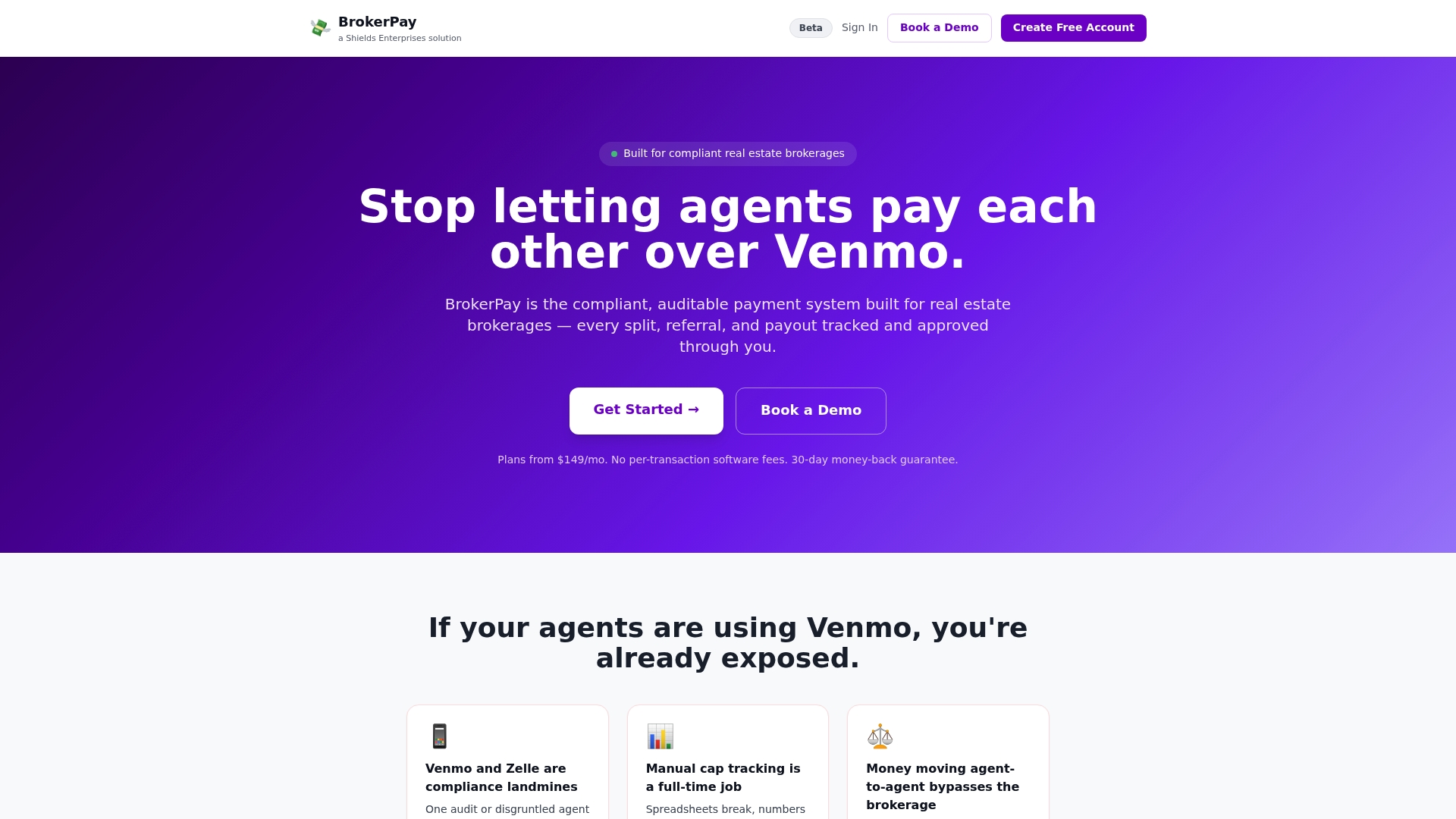
Brokerpay is a compliant commission payment platform built specifically for real estate brokerages. It tracks, documents, and processes agent splits, referral fees, and co-op commissions in one place. The platform supports 1099-NEC reporting, W-9 collection, and audit trail creation, so brokerages are not piecing together records from email threads and spreadsheets when a compliance inquiry arrives. Brokerpay also eliminates the Venmo and Zelle workarounds that create federal liability by routing all payments through the brokerage correctly. If your office is still processing referral fees manually, stop paying agents over Venmo and replace that risk with a documented, compliant workflow.
FAQ
What is the 1099-NEC threshold for referral fees in 2026?
The IRS raised the 1099-NEC filing threshold to $2,000 in 2026. Any referral fee payment of $2,000 or more to a non-corporate payee requires a Form 1099-NEC issued by January 31 of the following year.
Can agents pay referral fees directly to each other?
No. Referral fees must flow through the brokerage in most states. Direct agent-to-agent payments violate state licensing rules and create unauthorized payment records that expose both agents to disciplinary action.
What happens if a referral fee agreement is not in writing?
Without a written agreement, there is no enforceable definition of what triggers the fee, when it is due, or how disputes are resolved. Verbal and email-based agreements are the leading source of referral fee disputes in real estate.
How long must brokerages keep referral fee disclosure documents?
RESPA and most state licensing boards require brokerages to retain referral fee disclosure documents for at least five years. These records are the primary defense during a regulatory audit or licensing inquiry.
Does referral fee income need to be reported on Schedule C?
Yes. Referral fee income is taxable self-employment income and must be reported as gross revenue on Schedule C, not netted against commissions received. Netting creates IRS mismatches with 1099-NEC filings from payers.