What Is a Variable Commission Structure? A Clear Guide

A variable commission structure is a pay model where a salesperson’s earnings shift based on their actual performance. Instead of collecting the same paycheck regardless of results, a rep earns more when they close more and less when they fall short. Variable compensation is any portion of pay that fluctuates based on performance rather than a fixed amount, and in sales, it almost always takes the form of commission tied to revenue, quota attainment, or deal profitability.
The core components of any variable commission plan include:
- Commission rate: The percentage of revenue paid per deal closed
- Pay mix: The ratio of fixed base salary to variable pay, such as a majority base salary and a lesser variable portion
- Quota: The revenue target a rep must hit to earn full commission
- Accelerators: Higher commission rates that kick in once a rep exceeds quota
- Decelerators: Reduced rates that apply when performance falls below a threshold
Variable commission plans contrast sharply with fixed pay, where a salesperson earns the same amount regardless of output. The appeal of variable pay is alignment: when a rep’s income rises and falls with company revenue, their daily priorities tend to mirror the company’s. These plans appear across industries, from B2B software sales and real estate to insurance and financial services.
Table of Contents
- How variable commission structures work in practice
- Benefits and drawbacks of variable commission structures
- How variable, fixed, and hybrid commission models compare
- What contractual and governance considerations matter most
- Key Takeaways
How variable commission structures work in practice
The math behind a variable commission plan can range from a single flat rate to a multi-tiered formula with accelerators. Understanding the mechanics helps both managers designing plans and reps evaluating offers.
Flat-rate commission is the simplest model. A rep earns a fixed percentage on every dollar of revenue, regardless of volume. If the rate is 8% and the rep closes $50,000 in a month, they earn $4,000.
Tiered commission adds layers. A rep might earn 8% on the first $50,000 of monthly revenue, then 11% on everything above that. The jump in rate rewards volume and encourages reps to push past their baseline rather than coast once they hit a comfortable number.

Accelerators and decelerators are the most powerful behavioral levers in a variable plan. Accelerators increase commission rates after a rep reaches a preset quota, strongly rewarding over-achievement. Decelerators reduce rates below certain thresholds to discourage underperformance. A rep at 120% of quota might earn a 1.5x multiplier on their base rate, while a rep at 70% of quota earns a reduced rate.
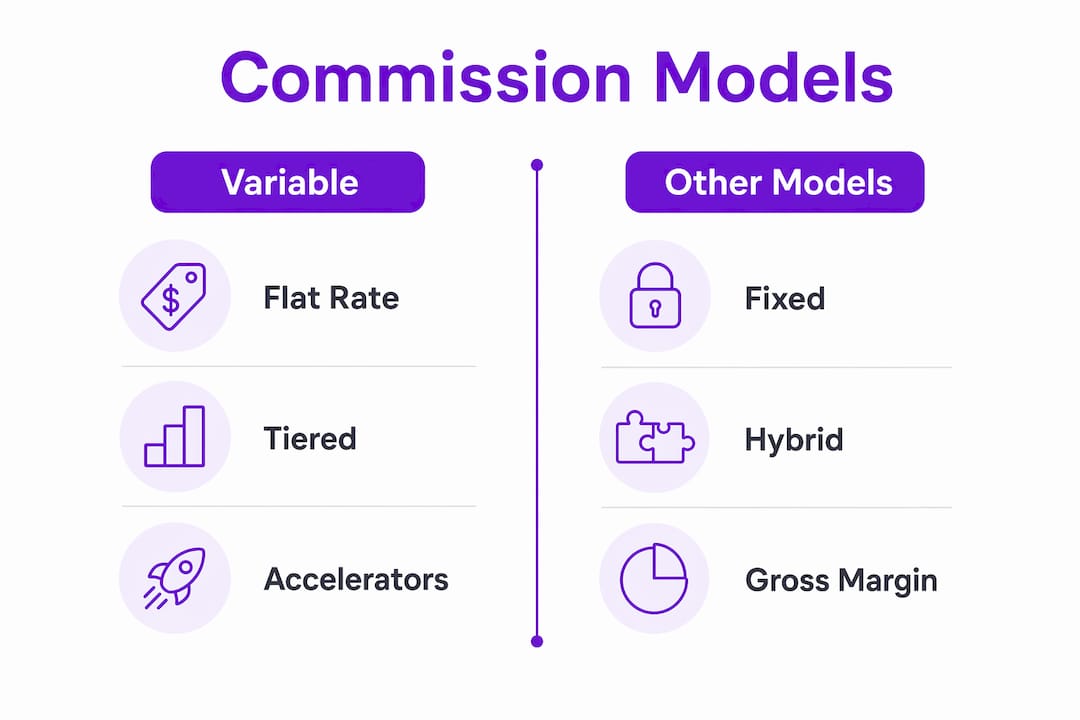
Gross margin commission pays on profit rather than revenue. A $10,000 deal with a 50% margin earns commission on $5,000, not the full $10,000. This structure discourages reps from discounting aggressively to close deals.
| Formula Type | How It Works | Example |
|---|---|---|
| Flat rate | Fixed % on all revenue | 8% on $50,000 = $4,000 |
| Tiered | Rate increases at volume thresholds | 8% to $50K, then 11% above |
| Accelerator | Rate multiplies above quota | 1.5x rate at 120% quota attainment |
| Gross margin | % paid on profit, not revenue | 10% on $5,000 margin |
| Multiplier (quota-based) | Commission scales with quota % | 0.7x at 80% quota, 1.2x at 120% |
Payout timing varies by company. Monthly cycles are common in high-velocity sales environments. Quarterly payouts suit longer sales cycles, like enterprise software or commercial real estate. Annual plans are rare for commissions but appear in bonus-heavy structures.
Benefits and drawbacks of variable commission structures
Variable commission plans are a direct motivational tool. When a rep can see exactly how a closed deal translates into personal income, the link between effort and reward is immediate. Linking effort to reward increases accountability and aligns individual behavior with business goals in ways that fixed salaries rarely achieve.
The main advantages:
- Reps are self-motivated to perform because their income depends on it
- Companies pay more only when revenue comes in, keeping compensation costs tied to results
- Top performers can earn well above their target, which helps with retention
- Plans can be adjusted by role, territory, or product line to reflect different business priorities
- Variable sales compensation plans are systemic and scalable, not one-off bonuses, so they evolve with the business
The main drawbacks:
- Income unpredictability creates stress, especially for reps in long sales cycles
- Complex tiered plans can confuse reps, reducing the motivational effect
- Administrative burden grows with plan complexity, particularly when tracking multiple metrics
- Poorly designed plans can push reps toward short-term behavior, like discounting to close, rather than building long-term customer value
Pro Tip: Transparency in commission structures is critical. If reps cannot calculate their own expected payout from a deal, the motivational value of the plan collapses. Keep formulas simple enough that a rep can run the math in their head before picking up the phone.
The right balance depends on the role. A hunter role focused on new business can tolerate more income variability than a customer success manager whose job is retention. Matching the plan’s risk level to the role’s risk tolerance is one of the most overlooked decisions in compensation design.
How variable, fixed, and hybrid commission models compare
Fixed and hybrid models each solve a different problem, and understanding where variable commission fits helps clarify when each model makes sense.
Fixed commission pays a constant percentage or flat amount regardless of sales volume. It offers income stability and is easy to administer, but it provides no extra incentive to push beyond a baseline. Fixed structures provide income stability but less performance leverage, making them better suited to roles where sales volume is largely outside the rep’s control.
Hybrid models blend a fixed base salary with variable commission. A typical split means most on-target earnings (OTE) come from base salary with a smaller variable pay portion. This is the most common structure in B2B sales, where reps need income predictability during long deal cycles but still have meaningful upside for strong performance. Commission-only plans carry no base salary and suit certain high-volume or channel roles, but they create real income instability for most reps.

| Dimension | Variable (commission-only) | Fixed | Hybrid (base + commission) |
|---|---|---|---|
| Definition | All pay tied to performance | Guaranteed pay, no performance link | Fixed base plus performance-based commission |
| Mechanics | Commission rate on revenue or quota | Set salary or flat fee per deal | Base salary plus tiered or flat commission |
| Benefits | High motivation, cost tied to results | Predictable income, easy to administer | Balances stability with performance incentive |
| Drawbacks | Income instability, risk of burnout | No incentive to exceed baseline | More complex to design and track |
| Best fit | High-volume, transactional sales | Support roles, low-autonomy sales | B2B account executives, enterprise sales |
| Contractual note | Requires clear clawback and draw terms | Simple, low-dispute structure | Needs documented quota and accelerator rules |
Pay mix varies meaningfully by role. A roughly equal base-to-variable split is common for B2B account executives, while roles with longer sales cycles or more service components often carry a higher base salary proportion. Adjusting the mix is one of the fastest ways to attract a different talent profile, since reps who are confident in their ability to close will favor higher variable upside.
Real estate offers a clear illustration of how these models play out. Agents typically work on a pure commission basis, with splits between the agent and brokerage governed by documented agreements. Protecting a brokerage from buyer-side commission compression requires a well-designed variable structure that accounts for shifting market conditions.
What contractual and governance considerations matter most
A variable commission plan is only as good as the documentation behind it. Disputes over commission calculations are among the most common sources of friction between sales reps and employers, and most of them stem from ambiguity in the original plan document.
Effective governance requires documented rules covering eligibility, payout formulas, dispute resolution, clawbacks, and change management. Without these, even a well-designed plan becomes a liability.
Governance best practices:
- Write eligibility rules clearly: who qualifies, when they qualify, and what disqualifies a payout
- Define every metric used in the payout formula, including what counts as a closed deal and when revenue is recognized
- Document clawback terms: if a deal cancels or a customer churns within 90 days, does the rep return the commission?
- Establish a formal dispute process with a named decision-maker and a response timeline
- Require written sign-off from reps when the plan is introduced or changed mid-year
“A variable compensation plan is not the same as a discretionary year-end bonus or a one-off spot award. It is a documented program specifying who is eligible, what performance is rewarded, how payouts are calculated, when payments occur, and how the plan connects to the organization’s overall pay philosophy and business goals. Effective variable pay requires structure, predictability, and transparency — qualities that isolated incentives rarely provide.” — SalaryCube
Mid-year plan changes are particularly damaging. Reps who accepted an offer based on a specific commission structure and then see it altered after they have already built a pipeline lose trust quickly, and that trust is hard to rebuild. When changes are necessary, give reps advance notice, explain the business reason, and grandfather existing pipeline under the old terms where possible.
Legal and tax implications add another layer of complexity. Structured commission tracking prevents compliance issues and unexpected liabilities, particularly in regulated industries like real estate, where RESPA governs how fees are paid and documented. Automated platforms reduce administrative burden and create an audit trail that protects both the brokerage and the agent.
Pro Tip: Quotas set too high backfire. A well-designed plan typically targets a majority of reps hitting their quota to keep goals attainable and motivation high. If fewer than half your team is hitting quota consistently, the plan is demotivating rather than driving performance.
For real estate brokerages specifically, commission tracking and tax compliance are tightly linked. Every split, referral fee, and co-op payment needs a paper trail, not just for motivation but for federal compliance.
Brokerpay is built for exactly this problem. Real estate brokerages that still process agent splits over Venmo or Zelle are creating federal liability with every transaction. Brokerpay tracks, documents, and processes agent splits, referral fees, and co-op commissions in a RESPA-compliant workflow, replacing informal payment workarounds with a system that holds up to scrutiny.

Stop using Venmo for splits and give your brokerage the documentation it needs to stay compliant.
Key Takeaways
A variable commission structure only works when the payout formula is transparent, the quotas are realistic, and the governance rules are documented before the first deal closes.
| Point | Details |
|---|---|
| Core definition | Variable commission ties pay directly to performance outcomes like revenue or quota attainment. |
| Quota design matters | Plans work best when 60–70% of reps hit their targets, keeping goals attainable and trust intact. |
| Accelerators drive top performance | Higher commission rates above quota strongly reward over-achievement and retain top earners. |
| Governance prevents disputes | Documented eligibility, clawback, and dispute rules protect both employer and rep. |
| Hybrid models balance risk | A base-plus-commission structure suits most B2B roles by pairing income stability with performance upside. |