Commission Disbursement Methods Comparison for Brokers

The fastest way to cut commission errors and speed up payouts is to standardize your CDA timing and run it through a unified workflow that ties split calculations directly to compliant payment rails. Everything else is a workaround.
- Best option: Automated, compliant payout platform with the CDA submitted at least 24 hours before closing. Ideal for any brokerage processing more than a handful of transactions per month.
- Fallback: Title-company disbursement with explicit wire or ACH instructions attached to the CDA. Works for low-volume offices or one-off complex deals where a platform isn’t yet in place.
- Compliant automation example: Brokerpay handles CDA ingestion, agent splits, referral fees, and tax form collection in one workflow, keeping brokerages RESPA-compliant without Venmo or Zelle workarounds.
Use the automated platform path for any deal where speed, agent visibility, or 1099 accuracy matters. Fall back to title-company disbursement when you’re dealing with unusual escrow holds or a one-time transaction that doesn’t justify platform onboarding.
Table of Contents
- What is a Commission Disbursement Authorization and how does money move at closing?
- How do common commission disbursement methods compare?
- How do you prepare and submit a CDA before closing?
- What features should you look for in a commission-disbursement platform?
- How should brokerages roll out a new disbursement workflow?
- What compliance risks should brokerages watch for?
- How does a compliant platform like Brokerpay solve these problems in practice?
- Key Takeaways
- Why automation beats manual disbursement when the CDA discipline is there
- Brokerpay keeps your commission payouts compliant and on time
- Useful sources and further reading
What is a Commission Disbursement Authorization and how does money move at closing?
A Commission Disbursement Authorization (CDA) is the written instruction a brokerage submits to the title company or closing attorney that tells them exactly how to split and distribute the commission from a real estate transaction. It’s not a suggestion. The settlement agent treats it as the binding directive for who gets paid, how much, and where the funds go.
The money flow is straightforward but unforgiving. Seller proceeds arrive at the settlement agent, who holds them in escrow. Once the CDA is received and verified, the agent disburses according to its instructions: listing broker, cooperating broker, referral recipients, and any office fees come off the top before agents see a dollar. Commission disbursement is the process of distributing those earned commissions to the appropriate parties, and the CDA is the document that makes it happen.
Who fills it out varies by brokerage. Usually the listing broker or a transaction coordinator drafts it, the broker of record signs it, and the cooperating broker may countersign depending on state practice. Errors cluster in three places: split math that doesn’t add up to 100%, missing or mismatched W-9 information, and referral fee instructions that weren’t communicated to the title company in advance.
The operational handoff looks like this: Brokerage drafts CDA with verified payee names, tax IDs, and split percentages → broker of record signs → CDA submitted to title company before their cutoff → title confirms receipt and flags discrepancies → funds disbursed at or shortly after closing. Missing any step in that chain is what delays checks, not the payment rail itself.
How do common commission disbursement methods compare?
Here’s how the main commission payout systems stack up on the dimensions that actually matter to a brokerage: speed, cost, compliance exposure, and fit.
| Method | Typical speed | Typical cost per payout | Compliance/tax risk | Best use case |
|---|---|---|---|---|
| Title/escrow disbursement | Same day as closing | Included in closing costs | Low if CDA is complete | Standard residential closings |
| Wire transfer | Same day (if submitted before cutoff) | Typically involves a fee per wire transfer | Low, but requires exact account details | High-value deals, urgent payouts |
| ACH | Usually a few business days | Generally low-cost per transaction | Low with proper documentation | Recurring agent splits, office fees |
| Paper check | Several business days (mail) | Involves a per-check fee | Moderate (lost checks, stale dates) | Backup or agent preference |
| Card push (Visa Direct, Mastercard Send) | Near-instant to debit card | Varies by platform | Low with onboarding controls | Agents needing immediate access |
| Payout platform (automated) | 1–2 business days (ACH) or near-instant (card push) | Platform fee + per-transaction | Lowest overall with built-in tax collection | High-volume brokerages, multi-rail needs |
A few things the table can’t fully capture. Reconciliation effort is where paper checks and manual wires quietly cost the most. Every check that gets lost or returned requires manual follow-up, a stop-payment, and a reissue. ACH is cheap per transaction but offers agents no real-time visibility, which generates a steady stream of “when do I get paid?” calls to your admin team. Automated payout management platforms close that gap by connecting commission engines to banking rails and giving agents dashboard access to their own payout status.
For cross-border payments or referral fees going to out-of-state or international agents, wire is often the only reliable option, but at $15–$50 per transfer it adds up fast. Small-amount commissions, say a $200 referral split, can get eaten alive by per-payout fees if the platform or method isn’t chosen with minimums in mind.
How do you prepare and submit a CDA before closing?
Getting the CDA right before closing day is the single highest-leverage operational move a brokerage can make. Delayed payouts are most commonly caused by missing paperwork or late approvals, not by the payment method itself.
Essential CDA fields to verify before submission:
- Exact legal name of each payee (must match W-9 exactly)
- Tax ID or EIN for each payee (W-9 on file and current)
- Split percentages that sum to 100% of the commission
- Referral fee amounts and the payee receiving them
- Office fees or franchise fees deducted before agent splits
- Wire or ACH routing and account numbers for each payee
- Special remittance instructions (e.g., “hold check for agent pickup”)
- Signature block for broker of record (and cooperating broker if required)
CDA templates are widely available and show exactly which fields title companies expect. Using a consistent template reduces entry errors significantly.
Timeline checkpoints. Draft the CDA as soon as the transaction is under contract and all parties are identified. Confirm split percentages with the cooperating broker no later than one week before closing. Submit the completed CDA to the title company at least 24 hours before the scheduled closing time. Most title companies have a hard cutoff, often noon the day before, after which they cannot guarantee same-day disbursement.

Pro Tip: Call the title company on the morning of closing to confirm they received the CDA, that all signatures are in place, and that their disbursement cutoff hasn’t shifted. A two-minute call eliminates the most common reason agents don’t get paid on closing day.
What features should you look for in a commission-disbursement platform?
The best commission disbursement options in platform form do more than move money. They close the gap between commission calculation and compliant payment execution. Platforms that combine onboarding, tax collection, and payout execution reduce reconciliation headaches compared with separate point solutions.
Feature checklist for platform evaluation:
- Automated split calculation tied to transaction data
- CDA generation or ingestion (can it read a CDA and auto-populate payees?)
- W-9 and W-8BEN collection at agent onboarding
- Multi-rail payout support: ACH, wire, and card push
- Real-time payout status tracking for agents
- Reporting and reconciliation exports (CSV, accounting system integration)
- Role-based approval workflows (broker of record must approve before funds move)
- Audit logs with transaction references tied to CDA identifiers
- 1099 production and filing support
Questions to ask during vendor demos:
- Does the platform integrate with your MLS or transaction management system?
- What are the cutoff times for same-day ACH and wire submissions?
- How does agent onboarding work, and how long does it take to collect W-9s?
- What is the minimum payout threshold, and can it be configured per agent?
- How are 1099s generated, and does the platform file them or just produce the forms?
- What security controls govern who can approve and release a payout?
- What happens if a payout fails? Is retry logic automated or manual?
Pro Tip: Payout minimums deserve more attention than most brokerages give them. A high minimum saves on transaction fees but can leave low-volume agents waiting months for a first payment, which kills motivation and participation. The better approach: price minimums as a percentage plus a fixed fee so small payouts remain viable without destroying your per-transaction economics.
How should brokerages roll out a new disbursement workflow?
Implementation is where good intentions meet operational reality. A phased rollout with clear ownership at each step prevents the chaos of a hard cutover.
Implementation checklist:
- Align stakeholders: broker of record, accounting, operations lead, and your primary title company contact all need to agree on the new workflow before go-live
- Define approval SLAs: who approves a CDA, within what timeframe, and what happens if they’re unavailable
- Map input sources: identify where transaction data lives (transaction management system, commission engine, spreadsheet) and how it feeds the payout platform
- Collect W-9s from all active agents before the first live payout run
- Set reconciliation cadence: daily exception review, weekly payout reconciliation, monthly ledger close
Reconciliation cadence should match brokerage size. A solo broker or small team can get away with weekly reconciliation. A mid-size office with 20–50 agents needs daily exception monitoring and a weekly close. Enterprise brokerages with multiple offices should run automated daily reconciliation with exception alerts and a formal monthly audit.
The most common rollout mistake isn’t technical. It’s skipping agent communication. Agents who don’t understand the new system will call your admin team constantly, or worse, start using Venmo to settle splits themselves. Send a short explainer before go-live, walk through the payout dashboard in a team meeting, and designate one person as the first point of contact for payout questions during the first 30 days.
Automated platforms provide dashboards and status tracking that lower admin burden compared with manual ACH or wire processes. That benefit only materializes if agents actually use the dashboard, which requires a brief onboarding moment at hire.
Pro Tip: Collect W-9s and payout preferences during the agent onboarding paperwork, not after the first deal closes. Chasing tax forms at 1099 season is a solved problem if you treat documentation as a condition of the first payout.

What compliance risks should brokerages watch for?
The compliance exposure in commission disbursement is real and specific. These are the red flags that create the most liability.
Red flags to act on immediately:
- Using Venmo, Zelle, or other consumer rails for commercial commission payouts. Consumer payment rails can trigger account freezes and are not built for high-volume commercial transactions. They also create a documentation gap that’s nearly impossible to close at 1099 time.
- Missing W-9 or W-8BEN forms for any payee. Paying without a tax ID on file means you may be required to withhold backup withholding at the IRS rate.
- Unsigned or late CDAs. A CDA submitted after the title company’s cutoff is effectively no CDA at all for that closing.
- Mismatched payee legal names between the CDA and the W-9 on file.
- Referral fee arrangements without a written referral agreement. RESPA Section 8 prohibits fee-splitting arrangements that aren’t properly documented.
- Unusual split arrangements that don’t match the purchase agreement or listing agreement.
On the tax side, the brokerage is responsible for issuing 1099-MISC or 1099-NEC forms to agents and referral recipients who receive $600 or more in a calendar year. The deadline is January 31 of the following year. Collecting W-9s at agent onboarding and tying those documents to payout records eliminates most tax-reporting exceptions before they become a problem.
RESPA considerations at closing are narrower but worth knowing. RESPA Section 8 governs kickbacks and unearned fees in settlement services. A properly documented co-op commission or referral fee paid through the CDA is compliant. An undocumented side payment is not. When a transaction involves complex referral splits, escrow holds, or international payees, get confirmation from your title company and, for anything structurally unusual, a real estate attorney.
This article is general information, not legal or tax advice. Confirm current RESPA rules and 1099 requirements with a qualified attorney or CPA for your specific situation.
How does a compliant platform like Brokerpay solve these problems in practice?
Brokerpay is built specifically for U.S. real estate brokerages and addresses the operational and compliance gaps that manual disbursement leaves open.
Functional fit at a glance:
- Ingests or generates CDAs and auto-populates payee records from transaction data
- Applies split logic tied directly to the selected payment rail (ACH, wire, or card push)
- Collects W-9s and W-8BENs during agent onboarding and links them to payout recipient records
- Produces audit logs with transaction references that map to CDA identifiers, which simplifies dispute resolution
- Supports role-based approvals so the broker of record controls when funds move
- Generates 1099-ready data at year-end without a manual reconciliation sprint
A realistic implementation timeline:
- Week 0: Platform setup, admin configuration, and agent onboarding invitations sent
- Week 1: Open transactions imported, CDA templates configured, W-9 collection underway
- Week 4: First live payout run processed through the platform with full audit trail
That’s a realistic four-week path from decision to live payouts for a mid-size brokerage. Larger offices with complex split structures or multiple MLS feeds may need additional configuration time.
For brokerages that have run a pilot, the operational outcomes tend to cluster around three improvements: fewer payout exceptions requiring manual intervention, faster agent visibility into payout status (which reduces admin inquiries), and a cleaner 1099 season because tax forms were collected before the first payout rather than chased in January. For specific case study data, compliant co-op payment workflows illustrates how these workflows play out across different transaction types.
Key Takeaways
Standardizing CDA timing and using a unified payout platform that ties split calculations to compliant payment rails is the most effective way for U.S. brokerages to reduce commission errors and accelerate agent payouts.
| Point | Details |
|---|---|
| CDA timing is the real bottleneck | Submit the CDA at least 24 hours before closing; late documentation causes more delays than any payment method. |
| Match the rail to the deal | ACH suits recurring splits; wire handles high-value or urgent payouts; card push delivers near-instant funds for agents who need immediate access. |
| Tax forms belong at onboarding | Collecting W-9s when agents join eliminates most 1099 exceptions before they become a year-end crisis. |
| Avoid consumer rails entirely | Venmo and Zelle create account-freeze risk and documentation gaps that no retroactive fix can fully close. |
| Brokerpay unifies the workflow | Brokerpay handles CDA ingestion, split logic, tax form collection, and audit logs in one compliant platform built for U.S. brokerages. |
Why automation beats manual disbursement when the CDA discipline is there
The brokerages that get the most out of automated payout platforms are not the ones with the fanciest tech stack. They’re the ones that got their CDA process right first and then let automation handle the repetitive execution.
Manual disbursement isn’t just slow. It’s a system that scales linearly with transaction volume, which means every new agent and every new deal adds proportional admin work. Automation breaks that relationship. Once the split logic and tax forms are configured, adding a new agent or a new transaction type costs almost nothing operationally.
Two things that consistently improve when brokerages make the switch:
- Fewer disputes. When every payout has an audit trail tied to a CDA identifier, agents can see exactly what they were paid and why. That transparency cuts “I think my split is wrong” conversations by a wide margin.
- Lower admin cost per payout. The manual work of chasing W-9s, confirming wire details, and reconciling exceptions is the hidden cost of staying manual. Platforms that handle those steps at onboarding make each subsequent payout cheaper to process.
The caveat worth stating plainly: automation amplifies whatever your CDA process already is. If your split math is inconsistent or your W-9 collection is ad hoc, a platform will execute those errors faster and at greater scale. Fix the documentation discipline first. Then automate.
Brokerpay keeps your commission payouts compliant and on time
Real estate brokerages processing commissions through Venmo, Zelle, or manual wire instructions are carrying federal liability they don’t need to carry. Brokerpay eliminates that exposure by handling the entire commission payment workflow in one place: CDA processing, agent split calculations, referral fees, co-op commissions, W-9 collection, and 1099-ready reporting.
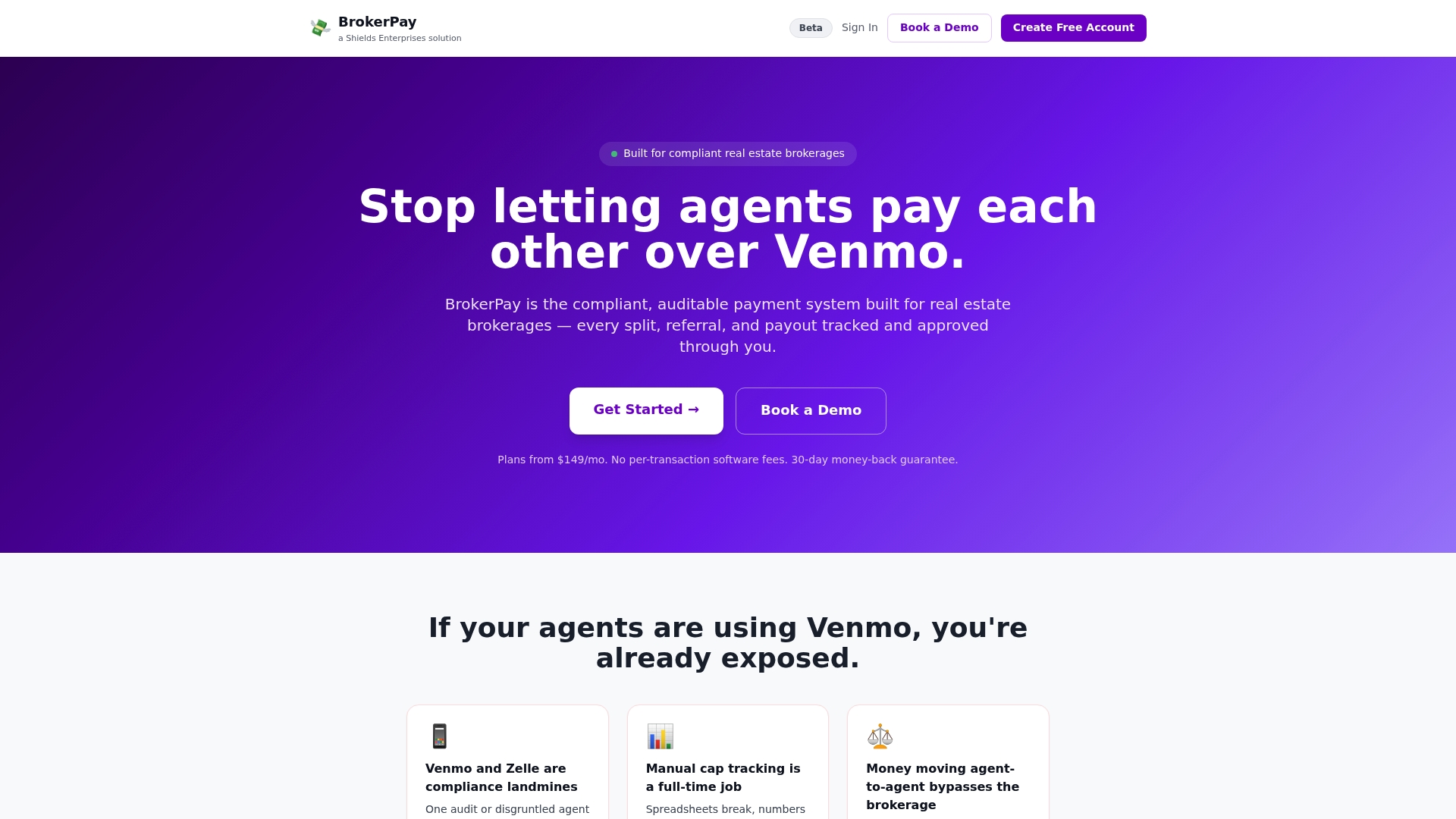
Agents get real-time visibility into their payout status. Brokers get a full audit trail for every transaction. And your accounting team stops spending January chasing tax forms that should have been collected at hire. Brokerpay is built specifically for U.S. brokerages that need a compliant commission payment workflow without the manual overhead.
Request a demo at brokerpay.io and see how the platform handles your specific split structures and CDA workflow.
Useful sources and further reading
These resources are worth bookmarking if you’re building or auditing a commission disbursement process.
- Jotform CDA template: A practical starting point for standardizing your CDA fields. Use it to audit whether your current form captures all required payee and tax information.
- Montsky Real Estate — CDA guide: Solid operational overview of how CDAs work and why timing matters more than payment method choice.
- Brokerpay — switch from manual to automated payouts: Step-by-step guide for brokerages planning a payout workflow rollout, including pilot planning and agent communication templates.
- How real estate commission structure works: Useful background on split structures and how compensation arrangements affect disbursement complexity.
- Payout management selection guide: Vendor-neutral framework for evaluating payout orchestration platforms, including feature checklists and integration considerations.
For state-specific CDA practices, your title company’s closing team is the right first call. Requirements vary by state, and title officers deal with these forms daily. For complex 1099 questions, particularly around referral fees paid to entities or international payees, consult a CPA familiar with real estate transaction reporting.