Compliance First Escrow Approvals for U.S. Brokers With BrokerPay

A compliant escrow disbursement approval has to clear three checkpoints before a dollar moves: written authorization from the Principal Broker, confirmed “good funds” credited to the trust account, and a documented paper trail that satisfies RESPA and state auditors. Skip any one of the three and the brokerage is exposed, regardless of how routine the payment looks.
TL;DR:
- Disbursement approval requires a signed Commission Disbursement Authorization, proof of good funds, a detailed closing statement, service invoices if applicable, and verified tax IDs before payment.
- Deposits must be credited and available in the trust account before funds are disbursed, with reconciliation performed monthly to ensure trust ledger, bank, and sub-ledger balances match.
- Peer-to-peer payment apps like Venmo or Zelle are unsafe for disbursements because they lack proper documentation and audit trails required by RESPA and state law.
- Disputed funds can only be released with written agreement or through legal interpleader procedures, never unilaterally or informally.
- Automated workflows that log all approval steps and attach supporting documents help prevent errors, reduce compliance risks, and simplify audits.
Table of Contents
- What Documents Does an Escrow Disbursement Approval Require?
- How Do You Approve an Escrow Disbursement Step by Step?
- What Trust Account Controls Keep Disbursements Compliant?
- When Do Referral Payments Cross the RESPA Line?
- How BrokerPay Supports Compliant Disbursement Approvals
- What Laws Govern Escrow Disbursements Besides RESPA?
- What Happens When a Disbursement Approval Goes Wrong?
- Who’s Actually Responsible for Approving a Disbursement?
- What Role Do Escrow Disbursement Approvals Play in a Real Estate Transaction?
- What Are the Best Practices for Accurate Disbursement Approvals?
- What Is the Complete Escrow Disbursement Approval Process?
- Three Mistakes That Trigger Audits
- Ready to Evaluate BrokerPay for Your Brokerage?
- Primary Sources for Escrow Disbursement Rules
- Sources
- FAQ
What Documents Does an Escrow Disbursement Approval Require?
Every approval packet needs the same backbone, whether the payment is a full commission, a referral split, or a co-op fee to another brokerage. Missing even one document turns a routine disbursement into an audit liability.
- Commission Disbursement Authorization (CDA): This is the formal, signed instruction that tells the closing agent how to split and release gross commission. It needs the transaction address, sale price, gross commission, each payee’s license number, the split percentage, and the Principal Broker’s certifying signature. No signature, no release.
- Bank deposit or wire receipt: Proof the funds are actually sitting in the trust account, not just promised. This is the “good funds” step, and skipping it is how brokerages end up disbursing against a check that later bounces.
- Closing or settlement statement: Ties the commission dollar-for-dollar to a specific closed transaction. Auditors match this against the CDA line by line.
- Invoices or a written scope of services: Required for any referral fee or marketing services agreement (MSA) payment, because RESPA requires proof the fee reflects actual work, not a disguised kickback.
- Tax identifiers and vendor setup records: TINs, W-9s, and 1099 flags for every agent or referral partner receiving payment, collected before the first dollar goes out, not after.
Treat this packet as non-negotiable paperwork, not a formality. A commission tracking system built around 1099 accuracy catches missing tax IDs before they become a January scramble.
How Do You Approve an Escrow Disbursement Step by Step?
The workflow below is the sequence most compliant brokerages already run informally. Formalizing it into five fixed steps is what turns it into something an auditor can actually verify.
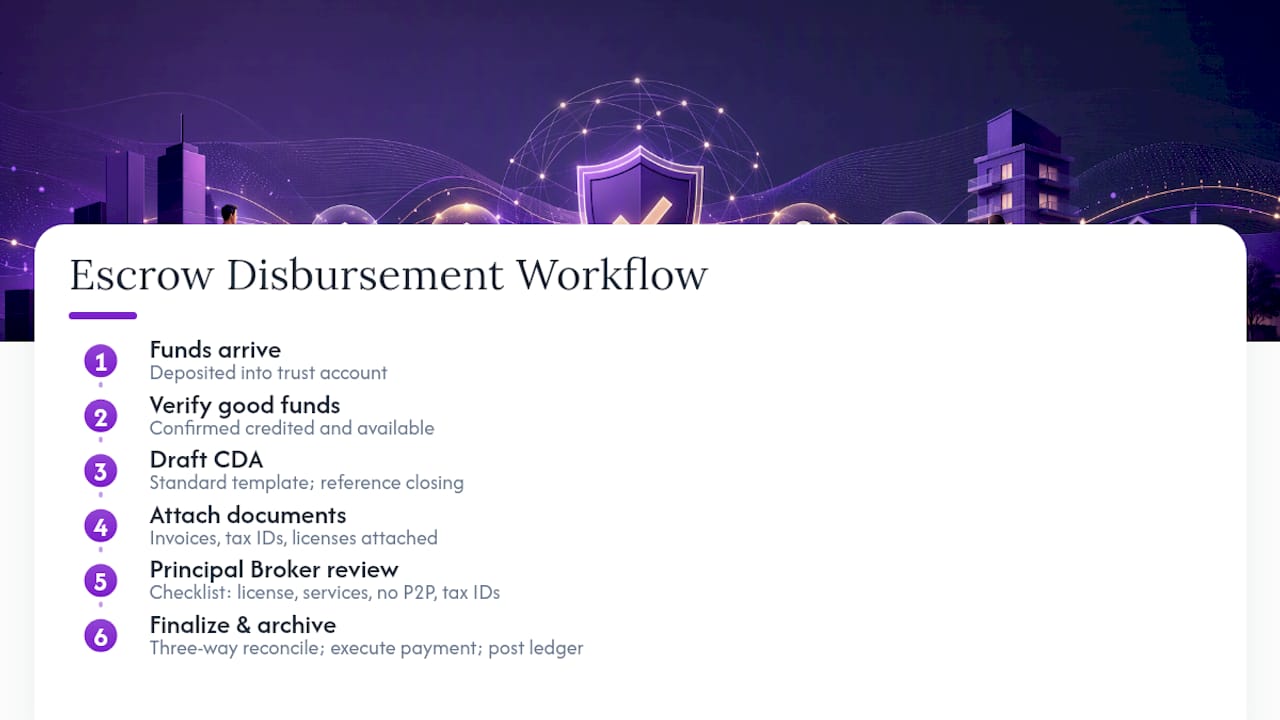
- Receive, log, and deposit funds. Confirm the check or wire, log it into the trust ledger immediately, and deposit it within your state’s required window (often next business day, sometimes up to three business days depending on the jurisdiction). Verify the deposit meets the ALTA Model Good Funds Law standard: deposited, credited, and available before you touch it.
- Prepare the CDA. Pull the closing statement reference, list every payee, and calculate splits before routing anything for signature. Standardized templates cut errors here more than any other single change.
- Run the Principal Broker review checklist. Confirm every payee’s license is active, confirm services performed match any referral or MSA invoice, and confirm tax IDs are on file. This is the compliance chokepoint, and it should never be skipped for a “trusted” agent.
- Reconcile in accounting. Run the three-way match (bank statement, trust ledger, client sub-ledger) before any funds move, and confirm sweep timing for the brokerage’s earned share.
- Execute payment and archive the packet. Send the ACH or wire, post the ledger entries, and file the complete audit packet, CDA, receipts, closing statement, invoices, together in one place.
Pro Tip: Attach a one-page standardized approval checklist directly to every CDA before it goes to the Principal Broker. Reviewers move faster when they’re checking boxes against a fixed list instead of re-deriving what “complete” means each time.
Wire fraud adds a real wrinkle to step one. Before crediting any incoming wire, brokerages should confirm the sending party through a verified callback, not the number on the wire instruction itself, since wire fraud has cost real estate participants over $275 million in reported losses.
What Trust Account Controls Keep Disbursements Compliant?
Three-way reconciliation is the monthly discipline that catches problems before an examiner does. It requires matching three numbers exactly: the bank statement balance, the trust ledger balance, and the sum of every client sub-ledger. If those three don’t tie out, funds moved somewhere they shouldn’t have, or a deposit or disbursement never got posted correctly.
The recurring audit finding: Missing or unsigned reconciliation worksheets are one of the most common issues examiners flag in broker trust-account reviews, not the underlying math errors themselves.
A few operational rules keep this clean:
- Deposit windows vary by state, from next-business-day to three-business-day requirements, so confirm your own state’s statute rather than assuming a national standard.
- If a deposit is disputed, hold the funds, seek written agreement between the parties, or use your state’s interpleader or escrow disbursement order procedure. Never release funds unilaterally to resolve a dispute.
- Trust funds cannot cover bank fees, payroll, or any operating expense, and only a small state-permitted cushion (if any) may sit in the account beyond client funds.
- Segregation of duties matters: the person preparing the reconciliation worksheet should not be the same person signing off on it, and the Principal Broker’s signature belongs on the final worksheet every month.
- Keep reconciliation worksheets, CDAs, and supporting documents for the retention period your state licensing law sets, typically several years, since that’s the window auditors pull records from.
Colorado’s real estate division treats every dollar in these accounts as fiduciary money the broker holds for someone else, not brokerage cash, and that framing should drive every control decision.
When Do Referral Payments Cross the RESPA Line?
RESPA Section 8(a) bars kickbacks for referrals of settlement business, and 8(b) bars splitting fees except for services actually rendered. The safe harbor under Section 8©(2) protects payments for bona fide, market-value services, which is exactly what an MSA needs to document to survive scrutiny.
The CFPB’s own guidance is blunt about MSAs: they’re lawful only when the services were genuinely performed and the payment reasonably tracks fair market value, not when they’re a wrapper around a disguised referral fee.
Watch for these red flags in any approval packet:
- Split payments with no invoice or service description attached
- Any escrow disbursement routed through Venmo, Zelle, or another peer-to-peer app
- Affiliate or joint-venture arrangements without a written disclosure to the consumer
- MSA fees that don’t scale with the actual work performed
A one-page checklist works well here: CDA signed, services documented, tax ID on file, funds confirmed as good funds, no P2P transfer anywhere in the chain.
How BrokerPay Supports Compliant Disbursement Approvals
Manual approval chains built on email threads and spreadsheets are exactly where CDAs go missing and reconciliations fall behind. BrokerPay automates the approval workflow itself: CDA templates, routing to the Principal Broker for signature, and a logged audit packet for every disbursement action, timestamped and exportable.
- Replaces Venmo and Zelle workarounds with a documented ACH or wire process, removing a recurring federal liability point
- Stores CDA templates and supporting documents together, so nothing gets separated from the transaction it belongs to
- Logs every approval step automatically, building the audit trail as the work happens instead of after the fact
A practical pilot: pick one office, onboard the Principal Broker and head of accounting, run it against 10 closed transactions, then export the audit packet and compare it to what your current process produces.
What Laws Govern Escrow Disbursements Besides RESPA?
RESPA gets the attention, but it’s state law that governs the day-to-day mechanics of holding and releasing escrowed funds. Every state real estate commission maintains its own trust-account statute, and these statutes set the deposit deadlines, recordkeeping rules, and reconciliation requirements brokerages actually operate under day to day.
Iowa’s trust account statute is a representative example: it spells out deposit timing, required ledger detail, and notification duties to the state commission when discrepancies surface. Most states follow a similar pattern, though the specific deadlines and penalty structures differ, so confirming your own state’s exact language matters more than relying on a national rule of thumb.
Beyond state trust-account law, brokerages should account for:
- State real estate license law, which typically gives the licensing board direct authority to suspend or revoke a broker’s license for trust-account violations, independent of any federal RESPA action.
- Contract law, since the purchase agreement or listing agreement often specifies exactly when and how earnest money gets released, and deviating from that language without written consent from both parties creates breach exposure.
- Interpleader procedures, the legal mechanism a broker uses to deposit disputed funds with a court and let a judge decide who’s entitled to them, rather than guessing wrong and facing liability from both sides.
- Anti-money-laundering considerations, which increasingly touch real estate closings and can require additional documentation on large or unusual fund movements.
None of these frameworks operate in isolation. A single improper disbursement can trigger a state licensing complaint, a civil breach-of-contract claim, and a RESPA inquiry simultaneously, which is why the documentation habits described earlier do triple duty.
What Happens When a Disbursement Approval Goes Wrong?
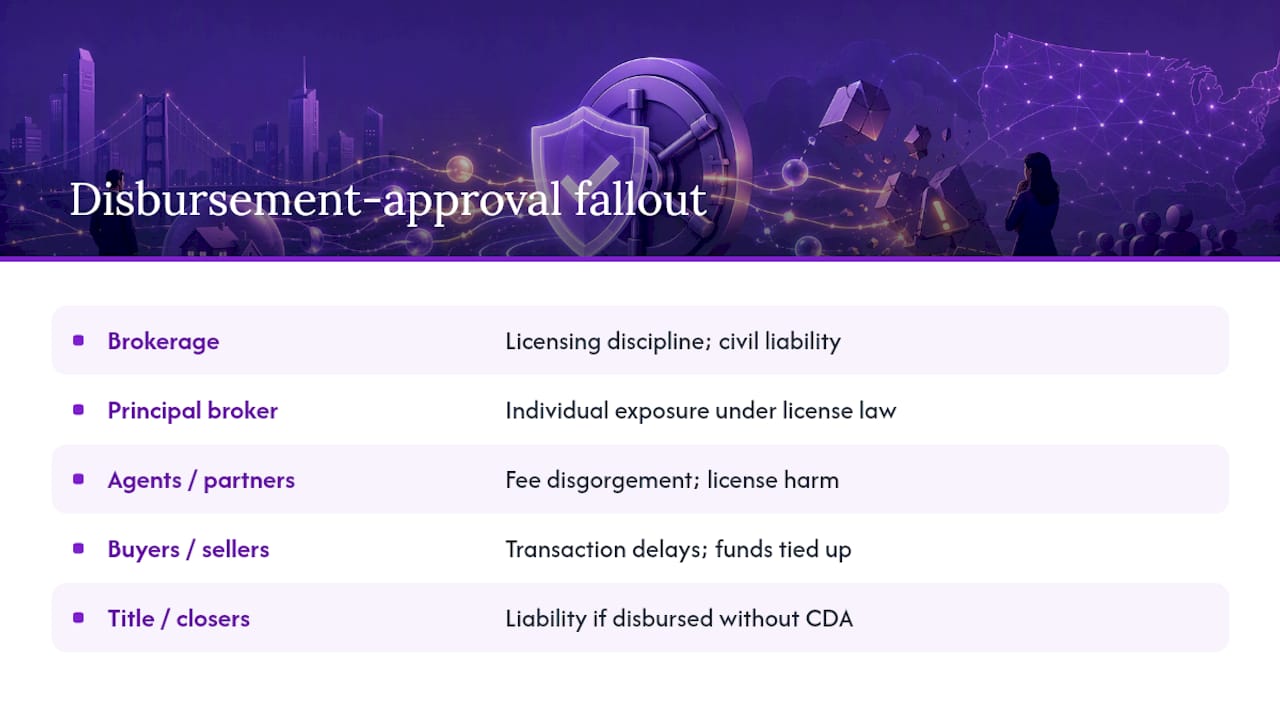
The fallout from an improper disbursement rarely stays contained to one party. It’s the failure mode that makes compliance worth the friction it adds to closing day.
For the brokerage, consequences range from state licensing discipline (fines, suspension, or revocation of the broker’s license) to civil liability if the wrong party gets paid or a deposit gets released without authorization. A pattern of undocumented split payments is also exactly what draws CFPB attention under RESPA Section 8.
For the Principal Broker personally, signing a CDA without verifying the underlying documentation creates individual exposure, since license law in most states places the certification duty directly on that individual, not just the brokerage entity.
For agents and referral partners, receiving a payment that later gets characterized as an undocumented kickback can mean disgorgement of the fee, damage to their own license standing, and potential inclusion in a broader enforcement action even if they didn’t structure the payment themselves.
For buyers and sellers, a mishandled earnest money dispute can delay their transaction, tie up funds in interpleader litigation, or in the worst cases, cost them money they were legally entitled to receive back.
For title companies and closing agents, releasing funds against an incomplete or unsigned CDA exposes them to liability too, which is exactly why most won’t disburse without one. That mutual accountability is part of why the CDA carries the weight it does across the transaction: it protects everyone in the chain who has to sign off on the release.
Who’s Actually Responsible for Approving a Disbursement?
Four parties typically touch an escrow disbursement, and each one carries a distinct piece of the compliance burden.
The Principal Broker holds ultimate signing authority. Their signature on the CDA certifies that licensing is current, services were performed, and the split matches what was agreed. This responsibility can’t be fully delegated, even in larger brokerages with dedicated operations staff.
The accounting or bookkeeping function runs the reconciliation math, confirms good funds status, and maintains the trust ledger. In smaller brokerages this might be the Principal Broker wearing a second hat; in larger ones, it’s a dedicated controller who reports findings to the broker for sign-off.
The closing agent or title company holding the escrowed funds won’t release anything without a properly executed CDA in hand. They’re the last checkpoint before money actually moves, and they have their own liability if they disburse against incomplete paperwork.
The agents and referral partners receiving payment are responsible for supplying documentation, invoices, service descriptions, W-9s, on their end promptly, since delays here stall the entire approval chain. A compliant co-op payment workflow usually breaks down at this exact handoff, when a referral partner doesn’t provide documentation until after the Principal Broker has already asked for it twice.
What Role Do Escrow Disbursement Approvals Play in a Real Estate Transaction?
An escrow disbursement approval is the gate that sits between money held in trust and money actually landing in someone’s account. Every dollar a brokerage collects during a transaction, earnest money, commission proceeds, referral fees, has to pass through this gate before it changes hands.
The role it plays goes beyond bookkeeping. It’s the mechanism that keeps a brokerage’s fiduciary duty intact: the broker is holding someone else’s money, and the approval process is proof that release only happened when it was properly authorized, fully funded, and correctly documented. Remove the approval step and you’re left with a broker moving client funds on trust alone, which is precisely the scenario state trust-account law exists to prevent.
It also functions as the brokerage’s institutional memory. Six months or two years after a closing, when a question comes up about who got paid what and why, the approval packet is the record that answers it, not someone’s recollection of how the deal went.
What Are the Best Practices for Accurate Disbursement Approvals?
Accuracy here isn’t about catching every possible fraud scenario. It’s about building habits that make errors visible before they become disbursements.
Standardize your CDA template and tie every field directly to the closing statement reference number. This single habit reduces mismatched figures more than any manual double-check ever will, since it forces the numbers to trace back to a single source document instead of being retyped from memory.
Separate the person preparing a reconciliation from the person approving it. One prepares, another reviews and signs. This isn’t bureaucratic overhead; it’s the control that catches a transposed number or a skipped entry before it compounds into next month’s mismatch.
Require documentation before payment, never after. If a referral fee invoice or service description isn’t in hand, the CDA doesn’t get signed, full stop. Chasing paperwork after money has already moved is how brokerages end up with disbursement records they can’t defend.
Run reconciliations on a fixed monthly schedule, not “when there’s time.” Auditors care less about whether your books are perfect and more about whether your controls, the signed worksheets, the consistent timing, the segregation of duties, were actually followed every month.
Eliminate P2P payment apps entirely from any workflow touching escrowed funds. There’s no version of Venmo or Zelle that produces the documentation trail RESPA or state trust law requires, no matter how convenient it feels on a Friday afternoon closing.
What Is the Complete Escrow Disbursement Approval Process?
Pulled together, the full process runs from the moment funds arrive to the moment the file gets archived, and it should look the same on every transaction regardless of how well the brokerage knows the agent involved.
Funds arrive and get deposited into the trust account within the state’s required window. The deposit is verified as good funds, meaning it’s actually credited and available, not just received. A CDA gets drafted using the standardized template, referencing the closing statement directly. Supporting documentation, service invoices, tax IDs, license verification, gets attached before the packet moves anywhere.
The Principal Broker reviews the full packet against the checklist: correct license status, services documented, no P2P transfer anywhere in the chain, tax IDs on file. Once signed, accounting runs the three-way reconciliation to confirm the trust ledger, bank statement, and sub-ledgers all agree. Payment executes via ACH or wire, ledger entries post, and the complete packet, CDA, receipts, invoices, reconciliation worksheet, gets archived together.
That last archiving step is where a lot of brokerages quietly fail. The disbursement happens correctly, but the documentation ends up scattered across email, a shared drive, and someone’s desk drawer. When an audit request comes in eighteen months later, reassembling that trail from scratch is far harder than storing it as one packet from day one. A payment gateway built for real estate closes that gap by keeping the packet intact automatically.
Three Mistakes That Trigger Audits
Commingling trust and operating funds is the fastest way to draw scrutiny, and the fix is a hard rule: trust funds pay only trust obligations, period. Unsigned reconciliation worksheets are the second most common gap; require the Principal Broker’s signature every month, no exceptions. Undocumented referral payments round out the list; no invoice, no service description, no payment, ever.
— Wes
Ready to Evaluate BrokerPay for Your Brokerage?
Manual CDA routing and P2P payment workarounds are the two weakest points in most brokerage approval chains, and they’re exactly what BrokerPay was built to replace. Instead of chasing signatures over email or trusting an agent’s Venmo receipt as your audit trail, A documented ACH and wire workflow can provide every CDA, approval, and reconciliation note logged automatically as it happens.
A demo typically walks through the CDA templates, the approval logging system, and how to export a full audit packet on demand, along with what implementation looks like for your specific office setup. Bring your Principal Broker and your head of accounting to that conversation, since they’re the two people who’ll actually sign off on adopting it. From there, the natural next step is switching from manual payouts to an automated workflow in a single office first, before rolling it out brokerage-wide. Visit BrokerPay to get started.
Primary Sources for Escrow Disbursement Rules
- CFPB RESPA Section 8 guidance
- ALTA Model Good Funds Law FAQs
- Your state’s trust-account statute and licensing board regulations
This article is general information, not a substitute for advice from a qualified financial advisor. Consult a qualified financial professional about your own circumstances before acting on anything here.
Sources
- 12 CFR 1024.14 — RESPA Section 8 (Regulation X)
- What is commission disbursement authorization in CA real estate?
- ALTA Model Good Funds Law FAQs
- Real-estate broker trust-account three-way reconciliation guide
FAQ
What Is a CDA in Escrow Disbursement Approvals?
A Commission Disbursement Authorization is the signed document that instructs a closing agent on how to split and release commission funds, and it requires Principal Broker review and signature before any release happens.
Why Are Venmo and Zelle Unsafe for Escrow Disbursements?
Peer-to-peer apps create no audit trail tied to services performed or licensing status, which leaves brokerages exposed under RESPA Section 8 and unable to produce documentation an auditor would require.
How Often Should Brokerages Run Trust Account Reconciliation?
Monthly, matching the bank statement, trust ledger, and client sub-ledgers in a three-way reconciliation, with a signed worksheet each cycle.
Can a Broker Release Disputed Earnest Money Without Consent?
No. The broker must hold the funds until both parties agree in writing, or use the state’s interpleader or escrow disbursement order procedure.
How Does BrokerPay Reduce RESPA Risk in Disbursement Approvals?
A documented ACH and wire workflow that logs CDA approvals and generates an exportable audit packet for every transaction can help reduce RESPA risk in disbursement approvals.