Avoid Venmo and Zelle Risk: Earnest Money Tracking for U.S. Brokerages

Earnest money tracking is the system a brokerage uses to receive, hold, document, and release good-faith deposits with a verifiable paper trail from first payment to final disbursement. The immediate fix for most offices: stop accepting deposits through Venmo or Zelle and move to a segregated trust account with logged approvals, because RESPA and Regulation X leave little room for informal handling. Platforms exist specifically to close that gap.
TL;DR:
- Moving to a trust account platform is essential to ensure proper logging, approvals, and compliance with RESPA and state trust-account rules.
- Deposits must be accepted via bank-verified channels and posted immediately with unique transaction IDs to prevent audit triggers.
- Trust account reconciliation should be daily, with disbursements authorized by signed releases tied to original transactions, avoiding informal transfers.
- Brokers need to enforce deposit timing deadlines based on the strictest state requirements and standardize record-keeping for all escrow transactions.
- Using purpose-built compliance platforms like Brokerpay ensures audit-proof tracking with immutable logs, role-based permissions, and easy exportability for regulators.
Table of Contents
- What Do RESPA and State Trust Account Rules Require for Earnest Money?
- How Do You Track Earnest Money From Receipt to Disbursement?
- What Should Brokerages Look for in Earnest Money Tracking Tools?
- Implementation Checklist: Reducing Liability in 2026
- Why Earnest Money Discipline Separates Serious Brokerages From the Rest
- How Brokerpay Handles the Earnest Money Checklist
- Sources
- FAQ
What Do RESPA and State Trust Account Rules Require for Earnest Money?
Federal law sets the outer boundary. RESPA prohibits kickbacks and requires that any payment tied to a federally related mortgage loan reflect services actually performed at fair value, not a disguised referral fee. That rule matters for earnest money because sloppy deposit handling, especially informal transfers between agents or unlogged “favors,” can look exactly like the arrangements RESPA Section 8 was written to catch. The controlling federal text sits in Regulation X, codified at 12 CFR 1024, which auditors and regulators cite directly when reviewing brokerage settlement conduct.
State trust-account rules add another layer, and they vary. California’s Department of Real Estate, for example, requires columnar records and detailed beneficiary ledgers for every trust fund transaction, a format many other states mirror with their own specific ledger requirements. Deposit timing windows differ too. Some states require funds in trust within one business day of an accepted offer; others allow three. A brokerage operating in multiple states cannot run one generic policy and assume it clears every jurisdiction.
What auditors actually pull when they show up:
- A timestamped receipt showing exactly when the deposit arrived
- The trust-account posting entry, matched to a unique transaction identifier
- A beneficiary ledger entry naming the buyer, property, and agent of record
- Signed authorization documents for any disbursement or transfer
- Retention records held for the state-mandated period, often three to five years
Missing even one of these on a single file is enough to trigger a broader trust-account audit. Regulators don’t sample gently.
How Do You Track Earnest Money From Receipt to Disbursement?
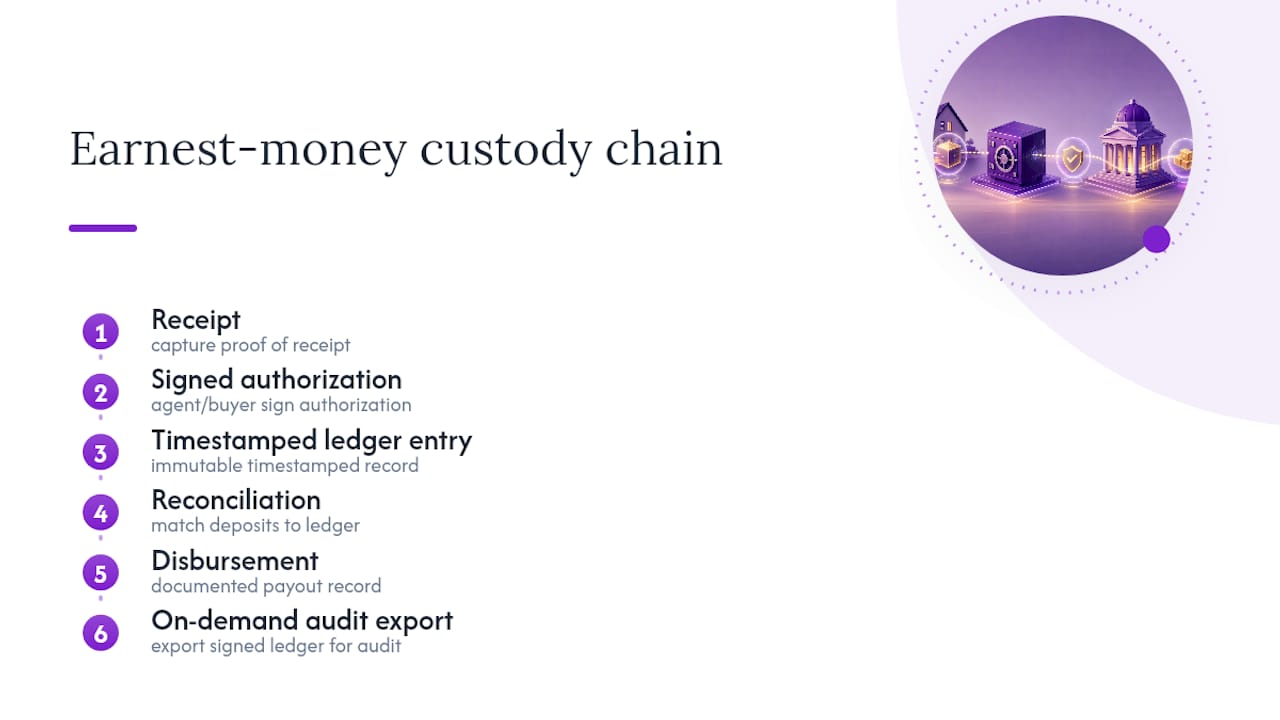
The lifecycle has five checkpoints, and skipping any one of them is where brokerages get burned during an audit.
- Accept funds through a verified channel. Bank-verified ACH transfers or authenticated payment portals confirm that money actually moved, not just that a request was sent. A Venmo “payment complete” screen is not proof of settlement.
- Post to the ledger immediately. Every deposit gets a unique transaction ID the moment it’s confirmed, with automatic notification to the agent, transaction coordinator, and compliance officer.
- Route to the trust account within the state window. Some states give brokers one business day, others give three. Build your internal deadline around the tightest jurisdiction you operate in, not the loosest.
- Reconcile daily. Automated bank sync should match every ledger entry against the actual account balance, flagging mismatches the same day rather than at month end.
- Authorize disbursement with a signed release. No fund leaves the account without a documented, signed authorization tied back to the original transaction ID.
Disputes and returned deposits need their own paper trail: who requested the return, what the purchase agreement says about contingencies, and who signed off on releasing the funds. Store that alongside the original transaction record, not in a separate email thread that disappears when an agent leaves the brokerage.
Pro Tip: Set your internal deposit deadline to the tightest state requirement across all your offices, even if only one branch operates there. It’s easier to enforce one rule than to remember five.
What Should Brokerages Look for in Earnest Money Tracking Tools?
Feature checklists matter more than brand names here, because the wrong platform can look compliant while missing the one thing that actually protects you in an audit: proof of settlement.
Require these capabilities before signing anything:
- A trust ledger with sub-ledger support for each active transaction, not a single shared spreadsheet
- Bank integration that confirms settlement, not just transfer initiation
- E-signature capture and document storage tied directly to each transaction ID
- Immutable audit logs that can’t be edited after the fact, even by an administrator
- State-rule configuration so deposit-timing deadlines adjust automatically by office location
- Role-based permissions separating who can approve a deposit from who can authorize a release
- One-click exportable reports formatted for regulator or auditor review
The technical reason consumer P2P apps fail this test comes down to settlement finality. A Zelle confirmation shows a request was sent, not that funds landed and cleared into a segregated account. Industry commentary on delivery-style earnest-money platforms has flagged the same phantom-confirmation problem: a screen that says “sent” is not evidence a regulator will accept. Proper payment infrastructure preserves fund segregation, atomic ledger posting, and audit logs by design, which is the entire point of choosing a purpose-built platform over ad hoc transfers.
Implementation Checklist: Reducing Liability in 2026
Getting from “we mostly handle this fine” to genuinely audit-ready takes a short, specific list of policy changes, not a full department overhaul.
- Ban peer-to-peer apps for earnest money outright, in writing, in your agent handbook, with no exceptions for “just this once.”
- Mandate deposit timing that matches your strictest state requirement, with automated reminders before the deadline.
- Require dual approval on every disbursement, splitting the person who verifies funds from the person who releases them.
- Standardize transaction folders so every file contains the receipt, ledger entry, authorization, and correspondence in one place.
- Set a retention schedule matching your state’s minimum, then keep it one year longer as a buffer.
- Run quarterly audit drills on a handful of random files before a real regulator does it for you.
Train agents with a simple script: any buyer asking to send earnest money through an app gets redirected to the brokerage’s verified payment channel, no exceptions, no judgment calls left to a new agent on a Sunday afternoon.
Pro Tip: Ask your reconciliation software to generate a one-click audit export before you need one. If it can’t produce a clean report on demand, you’ll find out during an actual audit, which is the worst possible time.
Why Earnest Money Discipline Separates Serious Brokerages From the Rest
Every compliance officer has a story about an agent who thought Venmo was faster and easier, right up until a deal fell through and nobody could prove where the deposit actually went. That gap between “we’re pretty sure it’s fine” and “here’s the signed authorization and the timestamped ledger entry” is where brokerages get exposed, and it’s rarely the agent who pays for it. It’s the broker of record.
The offices that treat earnest money tracking as a real operational discipline, not an afterthought bolted onto a spreadsheet, are the ones that walk into a state audit without dread. That’s not a small distinction when licenses are on the line.
How Brokerpay Handles the Earnest Money Checklist
Some commission payment platforms are built around the exact checklist above: a trust ledger that posts transactions immediately, approval workflows that separate verification from disbursement, and segregated account architecture that keeps client funds where regulators expect them. Every deposit gets a documented, timestamped audit trail, and every disbursement requires a signed authorization tied to its transaction ID, so when an auditor asks for proof, you export it instead of reconstructing it from memory.
If your brokerage is still leaning on informal transfers to move earnest money between agents or offices, that’s the exact liability Brokerpay was built to remove, alongside the same discipline it brings to switching from manual to automated payouts for commission splits and co-op fees. Compliance officers managing multi-office trust accounting get one consistent workflow instead of five branch-specific habits. Brokerpay offers Starter, Growth, and Enterprise plans, and you can review which fits your office size directly on the Brokerpay site. Request a walkthrough of the audit-export feature before your next state review, not after.
This article is general information, not a substitute for advice from a qualified financial advisor. Consult a qualified financial professional about your own circumstances before acting on anything here.
Sources
- HUD archive: Real Estate Settlement Procedures Act guidance
- CFPB: Real Estate Settlement Procedures Act (RESPA) FAQs
- Payments and escrow in real estate platforms: architecture, compliance, and fraud prevention — GTC Software
- Forbes: Banks start designing the next layer of financial infrastructure — settlement finality concerns
FAQ
What Counts as Earnest Money Tracking for a Brokerage?
It’s the documented process of recording a deposit’s receipt, its posting to a segregated trust account, and every step through reconciliation and disbursement. A compliant system produces a timestamped, auditable trail for each transaction, not just a bank balance.
Is It Legal to Accept Earnest Money Through Venmo or Zelle?
Nothing in RESPA explicitly bans P2P apps by name, but they create real problems for trust-account compliance because they don’t confirm actual settlement. Most state trust-account rules effectively rule them out since they can’t produce the beneficiary ledger records auditors require.
How Fast Must Earnest Money Go Into a Trust Account?
Deposit timing windows vary by state, with some requiring funds in trust within one business day of an accepted offer and others allowing longer. Brokerages operating across multiple states should build internal deadlines around the strictest requirement they face.
What Does a compliant commission payment platform Cost for a Multi-Office Brokerage?
Brokerpay offers Starter, Growth, and Enterprise plans, with pricing available directly through the Brokerpay site. Plan selection typically depends on agent count and the number of offices needing trust-ledger and approval-workflow features.
What Records Do Auditors Ask for First?
Auditors typically start with the timestamped receipt, the trust-account posting entry, and the signed disbursement authorization for a given transaction. Missing documentation on any single file often triggers a broader review of the brokerage’s entire trust-account system.