Protect Rep Pay: Commission Clawback Policy for Sales Ops & Finance

A commission clawback policy is appropriate for customer non-payment, cancellations inside a defined window, and downward corrections to booking value, but only when three guardrails hold: a written agreement signed before the commission is earned, objective and auditable triggers rather than manager discretion, and a paycheck deduction cap that never pushes pay below minimum wage. Skip any one of those three and the policy becomes a liability, not a control.
TL;DR:
- Clawbacks should only be triggered by objective, verifiable events like non-payment, refund windows, or downward booking corrections, all signed off before commissions are earned.
- Use proportional or stepped-tier recovery models to balance fairness and morale, with caps at 25 to 50 percent of a paycheck and a clear dispute process.
- Ensure policies are in writing, signed prior to earning, specify triggers and windows, and never reduce pay below minimum wage to stay enforceable legally.
- Automate tracking with systems that detect, calculate, and communicate deductions in advance, and always test in shadow mode using historical data.
- Communicate the policy transparently via face-to-face meetings with real examples, and review it annually to maintain trust and compliance.
Table of Contents
- What Triggers a Commission Clawback Policy?
- Types of Commission Clawbacks and When to Use Each
- How Do You Calculate a Commission Clawback?
- Is a Commission Clawback Policy Legally Enforceable?
- What Should Go in a Commission Clawback Policy?
- How Do You Automate Commission Clawback Tracking?
- How Do Commission Clawbacks Affect Accounting and Reporting?
- Common Mistakes in Commission Clawback Policies
- How Do You Roll Out a Clawback Policy Without Breaking Trust?
- How Do You Communicate a Clawback Policy to Sales Teams?
- How Should Disputed Clawbacks Be Handled?
- Do Commission Clawbacks Hurt Morale and Retention?
- Author Perspective: Balancing Protection and Rep Morale
- A Compliant Way to Track and Document Commission Adjustments
- Where to Go for Legal and Accounting Guidance
- Sources
- FAQ
What Triggers a Commission Clawback Policy?
The strongest clawback policies rely on a short list of objective, verifiable triggers rather than a catch-all clause. The three most defensible triggers are customer non-payment, cancellation or refund inside a defined window, and a downward correction of the booking’s actual value against what was originally recorded. Anything relying on vague language like “management discretion” tends to be legally fragile and creates the appearance of arbitrary enforcement, which is exactly what state wage regulators and plaintiffs’ attorneys look for.
Attribution matters as much as the trigger itself. A clawback should apply only when the seller’s conduct plausibly contributed to the loss, not when an outside event caused it. If a rep closed a deal at a fair, deal-desk-approved discount and the customer later fails to pay because of a business failure unrelated to the sale, that’s a collections problem, not a commission problem.
Common exclusions protect the policy’s fairness and its enforceability:
- Customer bankruptcy or insolvency unrelated to the terms the rep negotiated.
- Product implementation failures caused by the customer success or delivery team, not the sale itself.
- Deal-desk-approved discounts or terms that were sanctioned before the deal closed.
- Downgrades driven by roadmap gaps rather than misrepresentation at the point of sale.
Excluding these categories does more than protect reps. It keeps the finance and sales operations teams from spending hours defending recoveries that never should have been triggered in the first place.
Types of Commission Clawbacks and When to Use Each
Not every clawback scenario calls for the same mechanism. Matching the type to the business model keeps commission recovery policy proportional instead of punitive.
- Refund clawbacks apply when a customer returns a product or cancels within a short post-sale window, typically 30 to 90 days. Use these for transactional, one-time-sale businesses where a refund fully undoes the revenue event.
- Churn or cancellation clawbacks apply in subscription models when a customer cancels before a minimum retention period, often 90 days to 12 months. These carry more legal and morale risk than refund clawbacks because the rep did the work; the customer simply didn’t stay. Prefer a graduated recovery tied to how early the churn happened over a full-cliff recovery.
- Non-payment clawbacks apply when invoiced revenue never actually collects. These are the easiest to defend because no real money changed hands, which sidesteps most “already earned” wage arguments.
- Termination clawbacks apply to unvested or unpaid commission balances when a rep departs before a deal fully closes or funds. These need the clearest contract language of the four, since courts scrutinize forfeiture-on-termination clauses closely.
The practical decision rule: reach for a clawback when early churn or non-payment materially exceeds your acceptable threshold and attribution to the rep is clear. When attribution is murky or the dollar amounts are small, a holdback, a quota debit, or ratable commission pay is usually the better tool.
How Do You Calculate a Commission Clawback?
Three calculation models cover almost every commission recovery policy in practice, and each has a different risk profile for the rep’s paycheck.
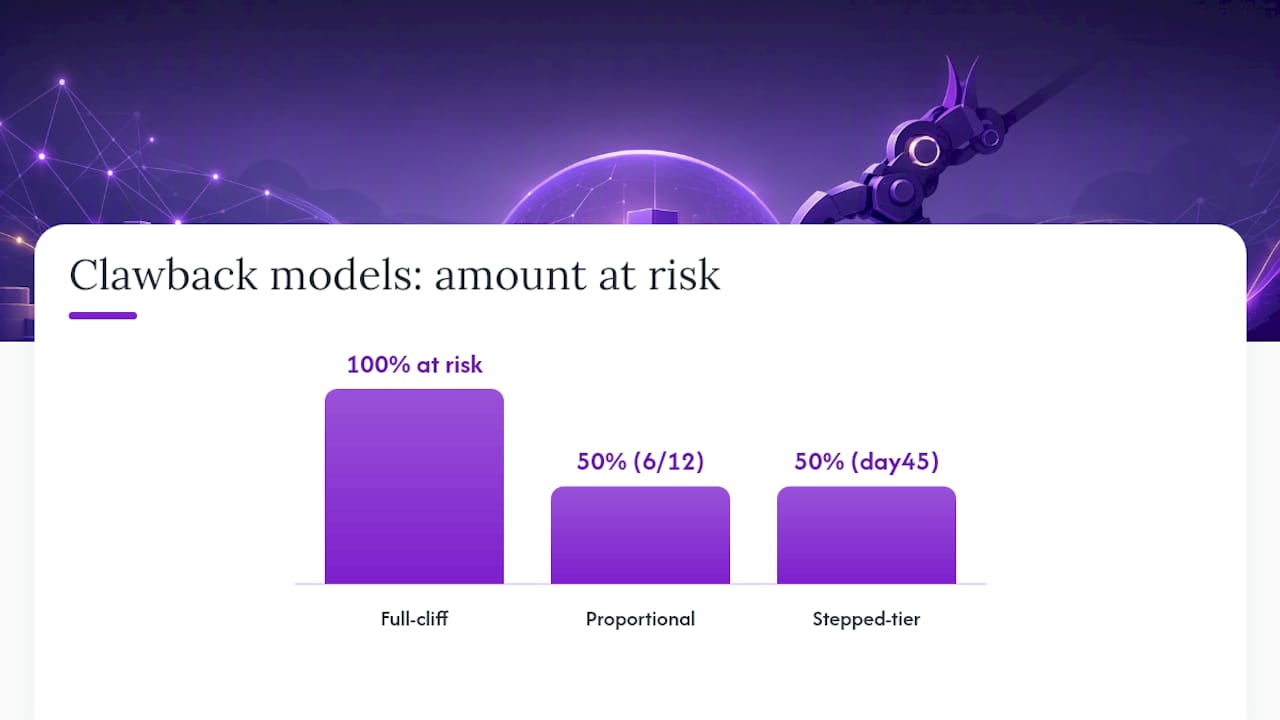
Full-cliff recovery claws back 100% of the commission if the trigger event happens at all, regardless of timing. It’s simple to administer but hits hardest on deals that almost made it, which is exactly what damages morale fastest.
Proportional (pro-rata) recovery ties the clawback to how much of the expected value was actually realized. If a customer paid for 6 of 12 contracted months before canceling, the rep keeps commission on the 6 months paid and forfeits the rest.
Stepped-tier recovery reduces the clawback percentage as time passes. A common structure claws back 100% inside 30 days, 50% between 31 and 90 days, and 0% after 90 days.
A simple stepped example: on a $2,000 commission with a customer canceling on day 45, the 50% tier applies, and the rep forfeits $1,000 while keeping $1,000.
- Full-cliff: highest legal exposure, highest morale cost, easiest math.
- Proportional: fairest to reps, moderate administrative complexity.
- Stepped-tier: balances fairness and simplicity, the most common choice in practice.
Cap any single-period deduction at a reasonable portion of a commission check and carry the remainder forward to future pay periods instead of zeroing out a paycheck. This protects the rep and reduces your wage-and-hour exposure.
Pro Tip: A hybrid model, front-loading a smaller commission at booking and paying the remainder ratably as revenue actually collects, often eliminates the need for a clawback entirely because there’s less to recover in the first place.
Is a Commission Clawback Policy Legally Enforceable?
Enforceability comes down to four non-negotiables: the policy must be in writing, the rep must sign it before the commission in question is earned, the contract must clearly define what “earned” means, and no deduction can push a paycheck below the federal minimum wage. The U.S. Department of Labor’s Wage and Hour Division is explicit that deductions cannot cut pay below minimum wage, and that a prior written agreement materially strengthens the case that a deduction is permissible at all.
State law adds another layer, and it varies more than most sales leaders expect:
- California treats commissions as wages once earned and generally bars employers from deducting already-paid wages, even for a legitimate business loss, unless very narrow conditions are met.
- Massachusetts requires that a commission be “definitely determined and due” before it counts as earned. Vague timing language in the plan document invites a wage-act claim.
- New York and Illinois both scrutinize post-employment forfeiture clauses heavily, particularly when a rep is terminated shortly before a deal would have vested.
A pattern shows up outside sales comp, too: research from Harvard Law School’s governance blog finds many large-cap companies voluntarily adopt clawback provisions exceeding SEC requirements, signaling that well-drafted, precise clawback language has become standard governance practice rather than a fringe legal maneuver.
Require a signed plan document for every rep, refresh that signature annually or whenever the plan changes materially, and have employment counsel review the language in every state where you employ sales staff. A clause that’s rock solid in Texas can be unenforceable in California.
What Should Go in a Commission Clawback Policy?
A durable clawback clause needs seven structural elements, and skipping any one of them is what gets policies challenged.
- Trigger list: the exact, objective events that activate a clawback.
- Window: how long after the commission is paid the clawback right exists, and the start date it counts from.
- Recovery mechanism: payroll deduction, offset against future commissions, or direct repayment.
- Deduction cap and carry-forward rule: the maximum percentage of a single check that can be withheld, and what happens to the rest.
- Departed-employee treatment: how the same trigger applies (or doesn’t) once someone has left the company.
- Dispute path: who reviews a contested clawback and on what timeline.
- Signature and acknowledgment: proof the rep saw and accepted the terms before the commission was earned.
Sample phrasing, meant as a starting point for counsel to adapt, not as legal advice:
Put this language in the comp plan document itself, not buried in a general offer letter, and have reps re-acknowledge it at least annually. SHRM’s clawback policy resources offer a useful structural template for exactly this kind of documentation.
How Do You Automate Commission Clawback Tracking?
A defensible clawback process runs on a repeatable sequence, not a one-off spreadsheet review whenever finance notices a problem.
- Trigger detection: a cancellation, refund, or non-payment event fires from the CRM, billing system, or customer success platform.
- Eligibility check: the system confirms the deal falls inside the clawback window and matches an approved trigger.
- Calculation: the full, proportional, or stepped-tier formula runs against the original commission amount.
- Statement adjustment: the deduction shows up as a clearly labeled line item on the rep’s next pay statement.
- Notification: the rep gets advance notice before the deduction hits, not a surprise on payday.
- Appeal window: the rep has a defined period to contest the calculation before it’s final.
- Audit log: every step, timestamp, and approval gets recorded for later review.
Spreadsheets tend to hold up fine for small teams, but once a brokerage or sales org passes roughly 30 to 40 reps, manual tracking in spreadsheets becomes error-prone and hard to audit, and that’s usually the point where a dedicated system earns its cost.
Before flipping any clawback rule live, run it in shadow mode against a quarter or two of historical data. Shadow-mode testing surfaces disputed edge cases and unexpected dollar amounts before they show up on a real paycheck, which is far cheaper to fix on a spreadsheet than in an angry one-on-one.
Pro Tip: Route the first few live clawbacks through a manager for manual sign-off, even after automation is live. It catches edge cases the rules didn’t anticipate and gives reps a human to talk to before the deduction posts.
How Do Commission Clawbacks Affect Accounting and Reporting?
Clawbacks don’t just touch payroll. They ripple into revenue recognition and deferred commission accounting under ASC 606 and ASC 340-40, and finance teams need clean, traceable entries when auditors come asking.
- A recovery reverses the original commission expense entry and, where the commission was capitalized, reduces the associated deferred commission asset.
- If the refund or cancellation happens within the same reporting period as the original sale, the reversal is a straightforward offset against that period’s commission expense.
- If it happens after the period closed, the reversal needs a linked adjusting entry that references the original transaction ID, not a generic write-off.
- Every clawback entry should carry a reference back to the original commission record, so an auditor can trace the full lifecycle in one pass.
Track two numbers every quarter: clawback dollars as a percentage of total commission paid, and the count of contested cases. A rising contested-case count is usually the first sign your trigger definitions need tightening before the dollar figures get ugly.
Common Mistakes in Commission Clawback Policies
Most clawback disputes trace back to a handful of repeatable, avoidable errors.
- Adding clawback terms mid-year and applying them to commissions already in progress, which almost always fails the “signed before earned” test.
- Uncapped recoveries that can wipe out an entire paycheck in one period.
- Relying on “management discretion” instead of an objective trigger list.
- Hiding deductions inside a lump payroll adjustment instead of itemizing them clearly on the pay statement.
The fix for each is straightforward: written and signed agreements before commissions accrue, reasonable recovery windows, hard caps on any single deduction, clearly listed exceptions, and full transparency on every pay statement.
| Mistake | Why it fails | Better approach |
|---|---|---|
| Mid-year policy change | Fails “signed before earned” test | Apply new terms only to future-earned commissions |
| Uncapped deduction | Risks minimum-wage violation | Cap at 25 to 50% per period, carry forward the rest |
| “Management discretion” trigger | Legally fragile, seen as arbitrary | Objective trigger list, defined in writing |
| Hidden pay-stub deduction | Erodes trust, invites wage claims | Itemized line, advance notice |
If your churn rate is low and the dollars at stake are small relative to the administrative cost of running the program, skip the clawback altogether and use a simpler holdback or extended vesting schedule instead.
How Do You Roll Out a Clawback Policy Without Breaking Trust?
A phased rollout keeps a new clawback policy from landing as a surprise, and surprise is what turns a fair policy into a morale problem; for example, incorporating real estate drone photography can similarly improve transparency and trust in sales processes.
- Weeks 1 to 4: draft the policy with legal counsel, define triggers, caps, and windows.
- Weeks 5 to 8: run shadow-mode tests against the last two to four quarters of historical deal data, including edge cases like partial refunds and mid-cycle downgrades.
- Weeks 9 to 12: collect signed acknowledgments, train managers on the math, and announce the policy in a live session, not a buried email attachment.
- First live cycle: limit scope to new deals only, route early cases through manual manager review, and publish a clear appeals process before the first deduction posts.
Train managers to walk through the actual arithmetic with their reps rather than pointing to a policy PDF. A rep who sees exactly how a $1,000 stepped-tier deduction was calculated is far less likely to escalate than one who just sees a smaller number on their statement.
How Do You Communicate a Clawback Policy to Sales Teams?
The single biggest predictor of whether a clawback policy gets accepted or fought is how it’s introduced, not how it’s written. Reps who hear about a new clawback clause for the first time in a payroll email tend to assume the worst. Reps who hear it explained face to face, with real numbers, tend to accept it as a normal part of the compensation structure.
Present the policy in a live meeting before it takes effect, walk through at least two worked examples using realistic deal sizes, and let reps ask questions in the room. Follow up with a one-page summary they can keep, not the full legal document, covering just the trigger list, the window, and the cap.
Managers need their own training pass before they train their teams. Give them a short script for the “why,” a laminated or digital cheat sheet with the calculation formulas, and explicit instructions to route the first few real cases through a second reviewer rather than handling them solo.
New hires should get the clawback terms during onboarding, alongside their base comp plan, not as an afterthought buried in a benefits packet weeks later. Building the signature requirement into the standard onboarding paperwork means there’s never a question about whether someone saw the terms before their first commission accrued.
Revisit the policy annually with the full sales team, even if nothing changed. A short refresher keeps the terms top of mind and gives reps a scheduled forum to raise concerns before a dispute happens, rather than after.

How Should Disputed Clawbacks Be Handled?
Every commission clawback policy needs a dispute path that’s faster and more human than the general HR grievance process, because commission disputes are time-sensitive and emotionally charged in a way most other pay disputes aren’t.
The most common conflict scenarios follow a predictable pattern. A rep disputes attribution, arguing the cancellation was caused by a delivery failure, not anything they did. A rep disputes timing, arguing the cancellation happened just outside the clawback window and shouldn’t count. A rep disputes the math itself, arguing the proportional or stepped-tier calculation was applied incorrectly.
For each scenario, resolution works best with a short, fixed timeline: the rep files a written objection within 10 business days of the deduction notice, a manager and a sales ops or finance representative review the case together within 5 business days, and the rep gets a written explanation either way, approved or denied. Decisions should never rest with a single manager acting alone. That’s exactly the kind of “discretion” that makes a policy look arbitrary in a later wage claim.
Keep every dispute, and its resolution, in the same audit log used for standard clawback tracking. A pattern of disputes clustered around one trigger type, one manager, or one product line is usually a sign the underlying rule needs revision, not that reps are pushing back without cause.
Do Commission Clawbacks Hurt Morale and Retention?
Poorly designed clawbacks are one of the fastest ways to lose your best reps, and the damage often shows up months after the actual deduction. Harvard Business Review’s analysis warns that badly structured clawback policies can do more harm than good, and recommends measuring behavioral outcomes rather than dollars recovered as the real success metric.
The mechanism is simple: a rep who closes a deal in good faith, gets paid, and then watches that money disappear months later feels punished for something outside their control, even when the trigger is technically fair. That feeling compounds fast on a sales floor, where comp plan trust drives daily effort.
Three mitigations matter most. First, graduated stepped-tier or proportional recovery instead of full-cliff claims back materially less on deals that came close to sticking, which softens the emotional hit considerably. Second, transparent, itemized pay statements with advance notice prevent the single worst experience: an unexplained smaller paycheck. Third, capping the recovery window tightly, 90 to 180 days rather than a full year, limits how often reps feel like old work is still hanging over them.
Author Perspective: Balancing Protection and Rep Morale
Clawbacks earn their place when non-payment or early churn is a real, recurring drag on the business, not a one-off bad deal. Used sparingly and precisely, they protect the comp budget without punishing good-faith selling.
Used broadly, they start acting as a quiet tax on your best performers, the ones closing the most deals and therefore carrying the most exposure to a bad customer. That’s backwards incentive design dressed up as risk management.
I’d rather see teams lean on graduated recovery, hard caps, or a holdback structure than a full-cliff clawback applied liberally. And I’d measure success by whether early churn actually drops and contested cases stay low, not by how many dollars get clawed back in a quarter. A policy that recovers a lot of money while quietly bleeding your top quartile of reps isn’t working, no matter what the ledger says.
— Wes
A Compliant Way to Track and Document Commission Adjustments
Brokerpay gives brokerages the audit trail a clawback policy actually depends on, without the compliance exposure of tracking adjustments through Venmo, Zelle, or a shared spreadsheet.
Every commission split, referral fee, and co-op payment routes through brokerage-controlled accounts with a documented approval workflow, so when a recovery or adjustment happens, there’s a clear record of what changed, when, and why. That matters as much for keeping commission tracking clean for tax purposes as it does for defending a clawback if a rep ever disputes one. Brokerpay runs on flat monthly pricing with no per-transaction fees, and offers a 30-day refund guarantee if it isn’t the right fit.
If your brokerage is still moving commission adjustments through peer-to-peer payment apps or manual spreadsheets, see how Brokerpay’s plans work and get a documented, auditable process running before your next disputed recovery lands on someone’s desk.
Where to Go for Legal and Accounting Guidance
Commission clawback rules touch wage law, revenue accounting, and HR policy at once, so no single source covers the whole picture.
- The U.S. Department of Labor’s Wage and Hour Division is the primary authority on minimum-wage deduction limits and permissible payroll deductions.
- FASB’s ASC 606 / ASC 340-40 guidance governs how commission expense and deferred commission assets should be adjusted when revenue reverses.
- Harvard Law School’s Forum on Corporate Governance provides governance context on how far companies extend clawback provisions beyond regulatory minimums.
- The Pepperdine Journal of Business, Entrepreneurship & the Law offers deeper scholarly analysis of clawback design and consequences.
Sources
- U.S. Department of Labor, Wage and Hour Division
- FASB ASC reference
- Harvard Law School Forum on Corporate Governance — clawback provisions
FAQ
What Is a Commission Clawback?
A commission clawback is a contract provision that lets an employer recover commission already paid to a sales rep when a specific, predefined event happens, such as a customer refund, cancellation, or non-payment. It only applies when the trigger and recovery terms were documented and signed before the commission was earned.
What Are the Requirements for a Clawback Policy?
A defensible commission clawback policy needs a written agreement signed before the commission is earned, objective and specific triggers rather than vague discretion, and a deduction structure that never pushes pay below minimum wage, per Department of Labor wage guidance. It also needs a clear window, a capped recovery amount per pay period, and a documented dispute path.
Are Bonus Clawbacks Enforceable?
Bonus and commission clawbacks are generally enforceable when they’re written, signed in advance, and don’t violate state wage law, but enforceability varies significantly by state. California restricts deductions from wages already paid, while Massachusetts requires that a commission be “definitely determined and due” before it counts as earned, so the same clause can be enforceable in one state and vulnerable in another.
Can You Give an Example of a Commission Clawback?
A common example is a stepped-tier refund clawback: if a customer cancels within 30 days of signing, the company recovers 100% of the commission paid; between 31 and 90 days, it recovers 50%; after 90 days, no recovery applies. A platform like Brokerpay can document each step of that recovery, from the original commission record to the final adjusted pay statement, so the whole trail stays auditable.