Model Your Annual Net: Brokerage Cap Policies for Agents

A brokerage cap is the dollar ceiling your company collects from your commissions during a cap period. Once your split payments to the brokerage reach that number, you stop paying the company split and keep close to 100% of every deal, minus whatever post-cap fees your contract still charges. The catch is timing and fine print: when the cap resets and what fees survive it decide whether “100% after cap” actually means more money in your pocket.
TL;DR:
- Agents with consistent high production, typically over 15 closings annually, benefit most from brokerage caps by reaching the limit early and maximizing commission retention.
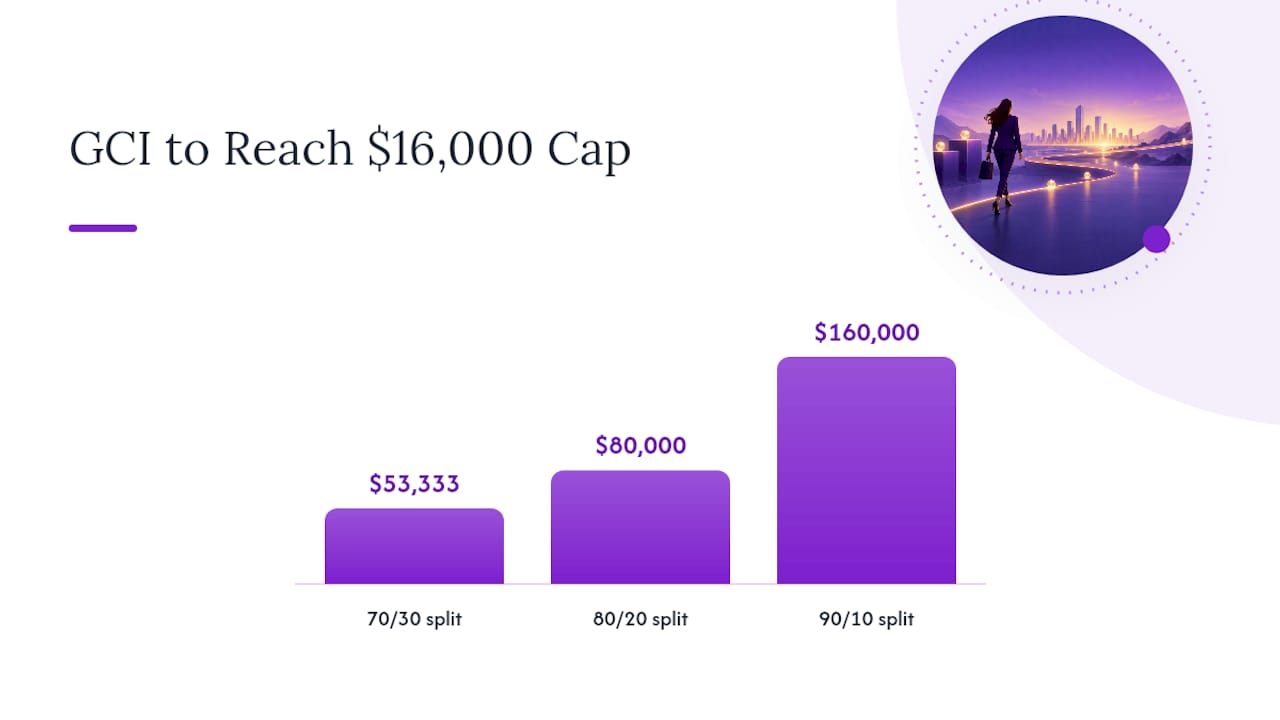
- The required gross commission income to hit a cap varies widely; for example, an 80/20 split with a $16,000 cap demands $80,000 GCI, while a 70/30 split requires about $53,333.
- Post-cap fees such as per-transaction charges, compliance fees, or franchise percentages often remain, reducing the net benefit of a “100% commission” promise.
- Reset rules differ: some brokerages use calendar year resets, others use anniversary or deal-level resets, affecting when and how agents hit their cap.
- Proper cap tracking, ideally automated through systems like Brokerpay, ensures transparency, prevents errors, and supports compliance, especially in multi-office arrangements.
Table of Contents
- How Brokerage Cap Policies Actually Work
- Calendar Resets, Anniversary Resets, and Other Cap Models
- What Caps Actually Do to Your Annual Take-Home
- Fees That Often Survive a Brokerage Cap
- Who Actually Benefits From a Brokerage Cap Policy
- Questions to Ask Before Trusting a Cap Policy
- Why Compliant Cap Tracking Protects Brokerages, Too
- What Agents Should Actually Do With This
- Get Your Commission Payouts Off Venmo for Good
- Sources
- FAQ
How Brokerage Cap Policies Actually Work
Every cap policy runs on two numbers: your split percentage and your cap amount. Before you cap, the brokerage keeps a piece of each commission (often called the company dollar), and you keep the rest (your agent dollar). Those company-dollar payments accumulate until they hit the cap, and then the split stops.
The math behind it is simple:
- Required GCI to cap = cap amount ÷ company’s split percentage
- On an 80/20 split with a $16,000 cap, the brokerage keeps 20% of every deal, so you need $80,000 in gross commission income (GCI) before you cap.
- On a 70/30 split with the same $16,000 cap, the company keeps 30%, so you only need about $53,333 in GCI to hit it.
- A 90/10 split pushes that threshold to $160,000 in GCI for the same $16,000 cap.
Steeper company splits sound worse upfront but often get you to full commission faster in dollar terms, because you’re paying in more per deal. The number that actually matters isn’t the split. It’s how fast you reach the cap given your production and the average commission size on your deals.
Check your independent contractor agreement for whether fees like errors-and-omissions insurance or transaction fees count toward the cap or sit outside it entirely. Some brokerages count only the split dollars; others fold flat fees into the running total, which changes your breakeven math significantly.
Pro Tip: Ask for your year-to-date cap balance in writing every quarter. Brokerages that track this manually make mistakes, and you want a paper trail if a dispute comes up at renewal.
Calendar Resets, Anniversary Resets, and Other Cap Models
Not every cap works the same way, and the reset rule is often the detail agents miss until it costs them money.
- Calendar year resets: your cap clock starts January 1 for everyone, regardless of when you joined. Join in October, and you might cap almost immediately, then start paying the split again just weeks later.
- Anniversary resets: your cap period runs 12 months from your join date or last reset, so a June hire caps and resets on a rolling June-to-June schedule.
- Deal-level caps: instead of an annual ceiling, some brokerages cap the split on each individual transaction, so a huge single sale doesn’t cost you an outsized company-dollar payment.
- Soft caps and tiered caps: your split percentage improves in stages as production climbs, and post-cap fees often kick in as a hybrid, replacing the split with a flat per-transaction charge instead of the full 100%.
Reset rules and cap amounts sometimes get adjusted by the brokerage over time as service costs rise, which is exactly why the reset date needs to be spelled out, in writing, before you sign anything.
What Caps Actually Do to Your Annual Take-Home
The dollar impact of a cap depends entirely on how fast you get there and what survives after you do.
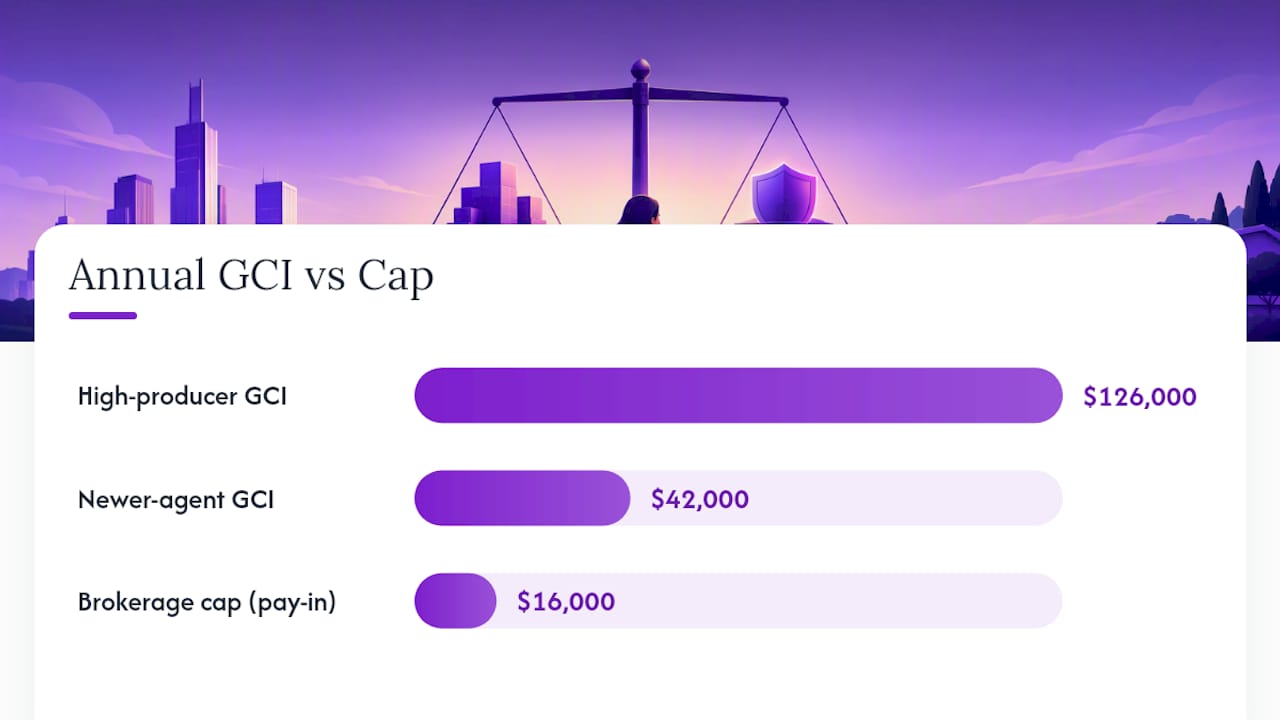
That’s roughly $126,000 in GCI. On an 80/20 split with a $16,000 cap, this agent pays in the full $16,000 and caps partway through the year, then keeps the rest of that year’s commissions nearly whole.
Compare that to a newer agent closing four deals a year on the same terms, around $42,000 in GCI.
- List your last 12 months of closed GCI (or a realistic projection if you’re new).
- Multiply by the brokerage’s split percentage to see how much you’d pay in before capping.
- Compare that number to the published cap. If your annual pay-in never reaches the cap, the cap policy doesn’t help you this year.
- Add back estimated post-cap fees for any deals closed after you’d theoretically cap.
- Compare the result against a flat-fee or no-cap brokerage offering a different split structure.
High producers gain real money from caps. Low-volume agents are often paying for a benefit they never reach.
Fees That Often Survive a Brokerage Cap
The phrase “100% commission after cap” almost never means zero deductions. Practical breakdowns of commission caps consistently flag transaction fees as the thing agents overlook when comparing offers.
- Per-transaction fees: often $200 to $500 per closed deal, charged regardless of cap status.
- Compliance or broker review fees: sometimes called a CBR fee, covering file review and E&O coverage, typically $50 to $150 per transaction.
- Franchise fees: a percentage (often 6% to 8%) taken off the top before any split calculation, common at franchise-affiliated offices.
- Technology or desk fees: flat monthly charges that continue whether you’ve capped or not.
Run the numbers before assuming capped means free. Cap and fee comparisons across brokerages show these post-cap charges are the single biggest gap between advertised and actual net pay.
Who Actually Benefits From a Brokerage Cap Policy
Caps reward volume and punish inconsistency, so knowing your own production pattern matters more than knowing the cap number.
- Best fit: agents with 15 or more closings a year and stable average sale prices, who reliably cross the cap threshold by midyear.
- Poor fit: new agents, part-time agents, and anyone with fewer than 8 to 10 annual transactions who rarely gets near the ceiling.
- Risk for brokerages: caps can encourage sandbagging, where top producers slow-walk closings toward year-end once they’ve already capped, or delay deals into the next period to reset favorably.
- Turnover risk: high performers who feel capped out sometimes leave for a brokerage offering tiered splits or accelerators instead, trading a hard ceiling for continued upside.
Brokerages that pair caps with tiered rate improvements or year-end bonuses tend to keep their best agents longer than those relying on the cap alone as a retention tool.
Questions to Ask Before Trusting a Cap Policy
Get every one of these answered in writing before you sign, not verbally in an interview.
- What’s the exact reset date, and is it calendar year or anniversary based?
- Which fees count toward the cap balance, and which are charged separately?
- What specific fees continue after I cap, and what are the current dollar amounts?
- Can the brokerage change the cap amount or fee schedule unilaterally, and how much notice do I get?
- Is the cap per-agent or does it apply differently across teams and referral splits?
Red flags include vague answers about “typical” fees instead of a written schedule, any clause allowing cap changes without advance written notice, and reluctance to show you last year’s actual fee schedule for a capped agent.
Pro Tip: Ask a currently capped agent at that office what they actually netted last year after fees. That one conversation tells you more than any recruiting pitch.
To compare offers apples to apples, project your expected GCI, calculate pay-in under each split, add expected post-cap fees, and compare the resulting net, not the headline split percentage.
Why Compliant Cap Tracking Protects Brokerages, Too
Agents splitting referral fees or co-op commissions through Venmo or Zelle create real exposure under HUD’s fair housing framework, since informal peer-to-peer payments leave no audit trail proving compliant, non-discriminatory payout practices.
- Manual cap tracking in spreadsheets routinely miscounts GCI and resets, especially across multi-office brokerages.
- Brokerpay documents every split, referral fee, and co-op payment against the cap automatically, creating an audit trail that holds up under review.
- Automated tracking removes the guesswork agents complain about most: knowing their real-time cap balance.
What Agents Should Actually Do With This
Model your own 12-month net before you trust any recruiting pitch about caps. Ask for the written fee schedule, not a verbal summary, and treat any brokerage that resists transparency as a warning sign. A cap genuinely rewards consistent high producers. It does nothing for everyone else, and pretending otherwise wastes your time at the negotiating table.
Get Your Commission Payouts Off Venmo for Good
Brokerpay is the alternative to spreadsheet tracking and peer-to-peer payment apps for brokerages managing caps, splits, and co-op commissions. Instead of trusting a manual ledger to catch when an agent crosses their cap, or hoping nobody sends a referral fee over Zelle, Brokerpay routes every payment through broker-controlled accounts with a full audit trail attached.
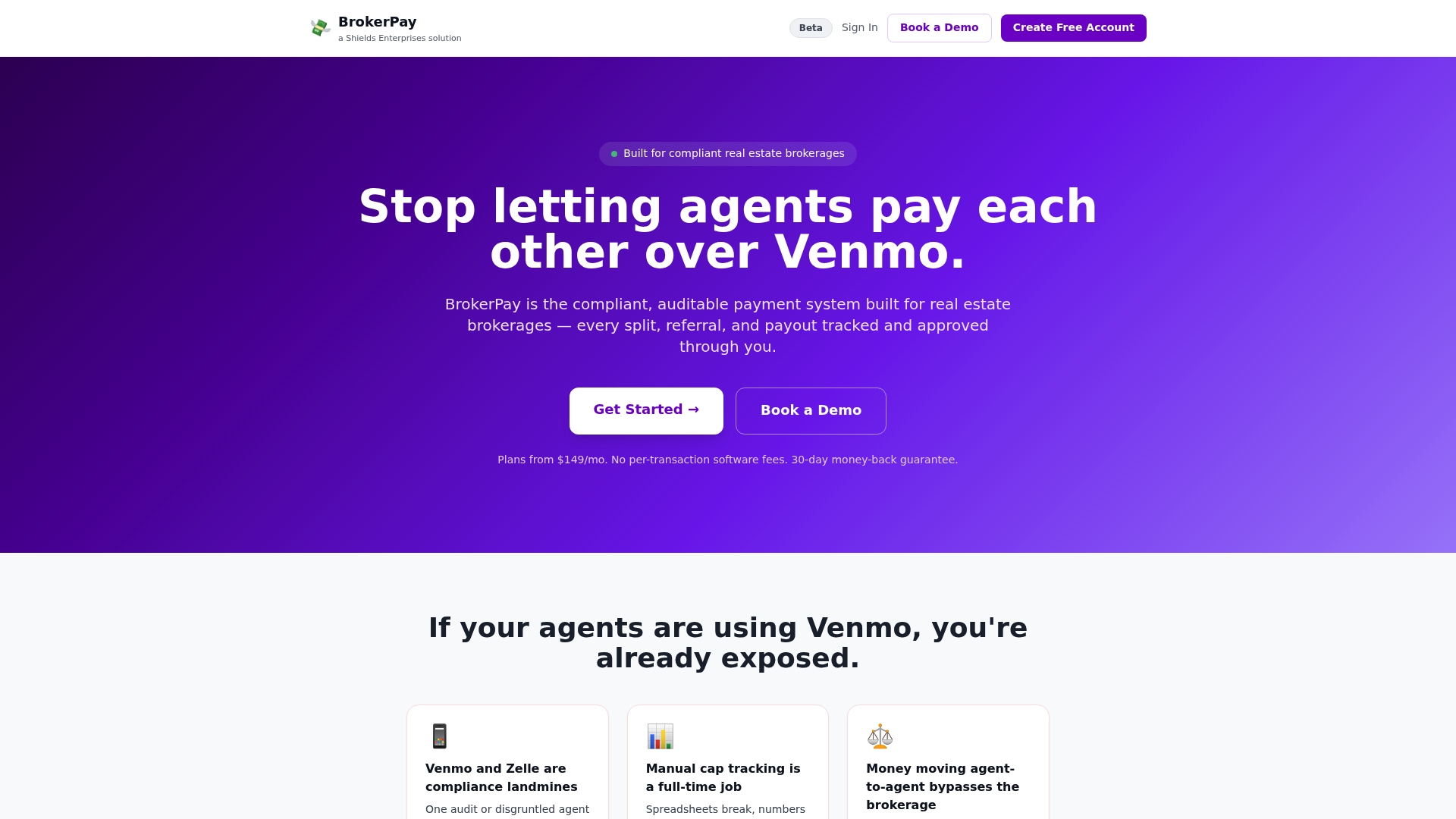
That means accurate real-time cap balances, documented approval workflows for every split, and a defensible record if a compliance question ever comes up. If you’re a brokerage still reconciling caps by hand or worried about how agents are actually paying each other, see how Brokerpay’s plans work and get a system built specifically for commission payments instead of a workaround borrowed from splitting dinner bills.
This article is general information, not a substitute for advice from a qualified financial advisor. Consult a qualified financial professional about your own circumstances before acting on anything here.
Sources
- HUD | Fair Housing
- Salesforce blog — Commission cap analysis
- Real estate commission splits by brokerage: caps, fees & net pay (2026)
FAQ
What Is a Brokerage Cap?
A brokerage cap is the dollar amount a brokerage collects from your commission splits during a set period, usually a year, before you stop paying the company split. After you cap, you generally keep close to 100% of your commissions, though post-cap transaction fees often still apply.
Is There a Limit to How Much You Can Have in a Brokerage Account?
This question usually refers to investment brokerage accounts, not real estate commission caps, and there’s generally no limit on how much money you can hold in a standard investment brokerage account. Real estate commission caps are an unrelated concept tied specifically to agent compensation agreements.
How Much Does a Realtor Make on $200,000?
What the agent actually keeps depends on their split, for example $4,800 on an 80/20 split before reaching their cap, or closer to the full $6,000 if they’ve already capped for the period, minus any post-cap fees.
What Is a 70/30 Commission Split in Real Estate?
Once capped, the agent typically keeps a much larger share, sometimes close to 100%, subject to any remaining transaction or compliance fees.
Does Brokerpay Help Brokerages Manage Cap Tracking?
Yes. Brokerpay automates cap tracking, documents agent splits and referral fees, and creates audit trails that support RESPA compliance. Pricing for its plans is available directly on Brokerpay’s site.