7 Audit Ready Brokerage Payment Controls to Avoid RESPA and 1099 Risk

Brokerage payment controls are the rules, approvals, and documentation that govern how commissions, splits, referral fees, and co-op payments get calculated and paid. The core stack is short: a split engine, a signed commission disbursement authorization (CDA) for every payout, staged approvals, monthly three-way reconciliation, an audit trail, and W-9/1099-NEC readiness. Get these six in place and you eliminate peer-to-peer payment risk while building the paper trail auditors and the IRS actually want to see.
TL;DR:
- Proper controls require a single deal record that tracks all participants, deals, and statuses in one updated source to prevent scattered information.
- Building a compliant system involves sequencing steps such as collecting W-9s, modeling split templates, establishing approval processes, and performing monthly reconciliations with broker signatures.
- Automation should enforce rules like signature capture, staged approvals, and comprehensive audit trails to prevent manual workarounds and reduce errors.
- Payments must route through brokerage-controlled accounts with signed CDAs and detailed reconciliation, avoiding informal methods like Venmo or Zelle for agent payouts.
- Compliance with RESPA and IRS rules depends on proper documentation of services, signed agreements, timely reconciliation, and accurate vendor tagging to avoid legal and tax issues.
Table of Contents
- What Controls Does Every Brokerage Need?
- How Do You Build Compliant Payment Controls?
- What Technology Should You Require From a Payment Platform?
- What Are the RESPA and 1099 Rules Brokerages Must Follow?
- Why Do Brokerages Keep Making the Same Payment Mistakes?
- How Brokerpay Puts These Controls in Place
- Sources
- FAQ
What Controls Does Every Brokerage Need?
Every brokerage running commissions through spreadsheets or group texts has the same blind spot: no single source of truth. A deal record should hold every participant, the gross commission, the split logic, and the current status, updated in one place instead of scattered across a spreadsheet, a text thread, and someone’s memory.
From there, the rest of the stack builds outward. Split templates handle caps, tiers, team arrangements, and referral deductions, stored as reusable rules with effective dates so a policy change in March doesn’t rewrite January’s math. Every payout needs a signed CDA, the document that spells out the deal reference, the calculation, every deduction, and who authorized it, retained in a version history rather than overwritten.
Approval workflows matter just as much as the documents themselves. The person who reconciles the trust account should not be the same person who authorizes checks. That separation of duties is not paperwork for its own sake. It is the single control most likely to catch an error, or a fraud, before money leaves the account.
Monthly three-way reconciliation, matching the bank statement, the trust or general ledger, and the sub-ledgers, is the audit requirement practitioner guides cite most often. It needs a broker-of-record signature every month, not just a spreadsheet that balances.
Here’s the full stack, in the order it usually gets built:
- A deal record as the single source of truth for participants, gross commission, and status
- Split templates covering caps, tiers, team splits, and referral deductions with effective dates
- A signed, versioned CDA for every disbursement
- An approval workflow that separates reconciliation from payment authorization
- Monthly three-way reconciliation with a dated broker signature
- A time-stamped audit trail covering every edit, adjustment, and user action
- W-9 collection and 1099-NEC vendor tagging completed before the first payout
Pro Tip: Build your audit trail to capture who changed a split and when, not just what the final number was. Auditors care about the “who and when” almost as much as the dollar amount.
How Do You Build Compliant Payment Controls?
Building this out doesn’t require a six-month project. It requires sequencing the right steps so nothing gets bypassed under deadline pressure.
- Set policy and assign owners. Decide who at your brokerage owns operations, finance, and broker-of-record sign-off before you write a single rule.
- Collect W-9s before any payout. Tag every agent and referral partner as a 1099-NEC vendor where it applies, so tax season isn’t a scramble.
- Model your split templates. Map caps, team splits, and referral deductions to actual transaction fields, then run test cases against real past deals to catch edge cases.
- Build approval gates. Stage sign-offs so a deal moves from proposal to broker approval to payout, with an exception queue for anything that doesn’t match the template.
- Establish monthly reconciliation. Pick a fixed day, require broker sign-off, and pilot it with one office before rolling it out across every location.
- Train staff and lock the payout rails. No commission ever leaves through Venmo, Zelle, or a personal check. Every payout routes through a controlled brokerage account.
- Run an annual compliance review. Check every marketing services agreement and referral arrangement for RESPA exposure before renewal.
A few things trip up brokerages every time they skip the sequence:
- Rolling out approval gates before W-9s are collected, which forces a policy exception on day one
- Piloting reconciliation across every office at once instead of one location first
- Letting an agent’s “just this once” Venmo request become a standing workaround
The multi-office brokerages that get this right treat step six as non-negotiable, not aspirational. If the rails allow a manual override, someone will use it.
What Technology Should You Require From a Payment Platform?
Software either enforces your policy or it just documents your policy violations after the fact. The difference comes down to six features.
A rule engine should handle split templates, effective dating, cap progress tracking, and conditional calculations, so a change to one agent’s cap doesn’t require a manual recalculation across every open deal. Automated CDA generation with e-signature capture and immutable attachments means the document that authorizes payment is created the same way every time, with no copy-paste errors.
The approval workflow engine needs role-based access control and staged sign-offs, the software equivalent of the separation of duties your policy already requires. Without it, one login can reconcile and pay, which defeats the control entirely.

A full audit trail and version history should log every change to a split, a CDA, or a payout, not just the final state. Practitioner frameworks for commission tracking treat this data model, deal, participant, split rule, allocation, adjustment, payout, as the foundation the rest of the system depends on.
Round out the stack with:
- Accounting export to QuickBooks or your general ledger, formatted for direct posting
- ACH payout rails routed through brokerage-controlled accounts
- A documented exception and dispute workflow with adjusting entries
One documented benefit of automation is what it produces on the way out: audit-ready artifacts like signed CDAs, calculation histories, and exportable journal entries that hold up when an auditor asks for backup.
What Are the RESPA and 1099 Rules Brokerages Must Follow?
RESPA Section 8 is where casual payment habits turn into federal exposure. Marketing services agreements can violate RESPA when they function as disguised referral fees rather than payment for services actually rendered at market value. The CFPB has enforced against MSAs that were structured or implemented specifically to increase referral volume, and its bulletin makes clear that the label on an agreement doesn’t protect you if the substance is a kickback.
The regulatory text draws the line clearly enough to act on. Regulation X permits bona fide compensation for actual services and lawful cooperative brokerage splits, but it prohibits payments tied to referrals with no service behind them. That distinction is why documentation matters as much as the dollar amount: keep contemporaneous evidence of what was actually performed under any MSA, not just the invoice.
On the tax side, the IRS requires reporting nonemployee compensation on Form 1099-NEC once a payment meets the filing threshold. NAR guidance goes further for real estate specifically: listing brokers paying cooperative commissions to a non-employee should collect a W-9 before payment and file accordingly, rather than chasing tax IDs after the check clears.
Your defense in any audit or enforcement inquiry comes down to three documents:
- A signed CDA that ties every payout to a specific deal and calculation
- A monthly reconciliation worksheet with a dated broker signature
- An audit trail showing who approved what, and when
Why Do Brokerages Keep Making the Same Payment Mistakes?
Brokerages default to Venmo and Zelle for one reason: it’s faster than waiting on a policy that doesn’t exist yet. The workaround feels harmless until an auditor asks for the paper trail behind a $4,000 referral payment and there isn’t one.
The fix isn’t more warnings. It’s making compliance the path of least resistance: enforced sign-off before any check goes out, one person executing payouts instead of five, and a reconciliation that happens the same day every month whether or not anyone feels like doing it. Automation helps here specifically because it turns a policy into a workflow. A rule either fires or it doesn’t; there’s no “just this once.”
— Wes
How Brokerpay Puts These Controls in Place
This platform was built around the stack this article describes, not as an add-on but as the product itself. It automates split calculations against caps and tiers, generates and captures signed CDAs, enforces approval workflows with real role separation, and produces the audit trail state examiners and the IRS actually want. Every payout routes through brokerage-controlled accounts, so there’s no Venmo request waiting in a text thread and no personal check clearing outside the books.
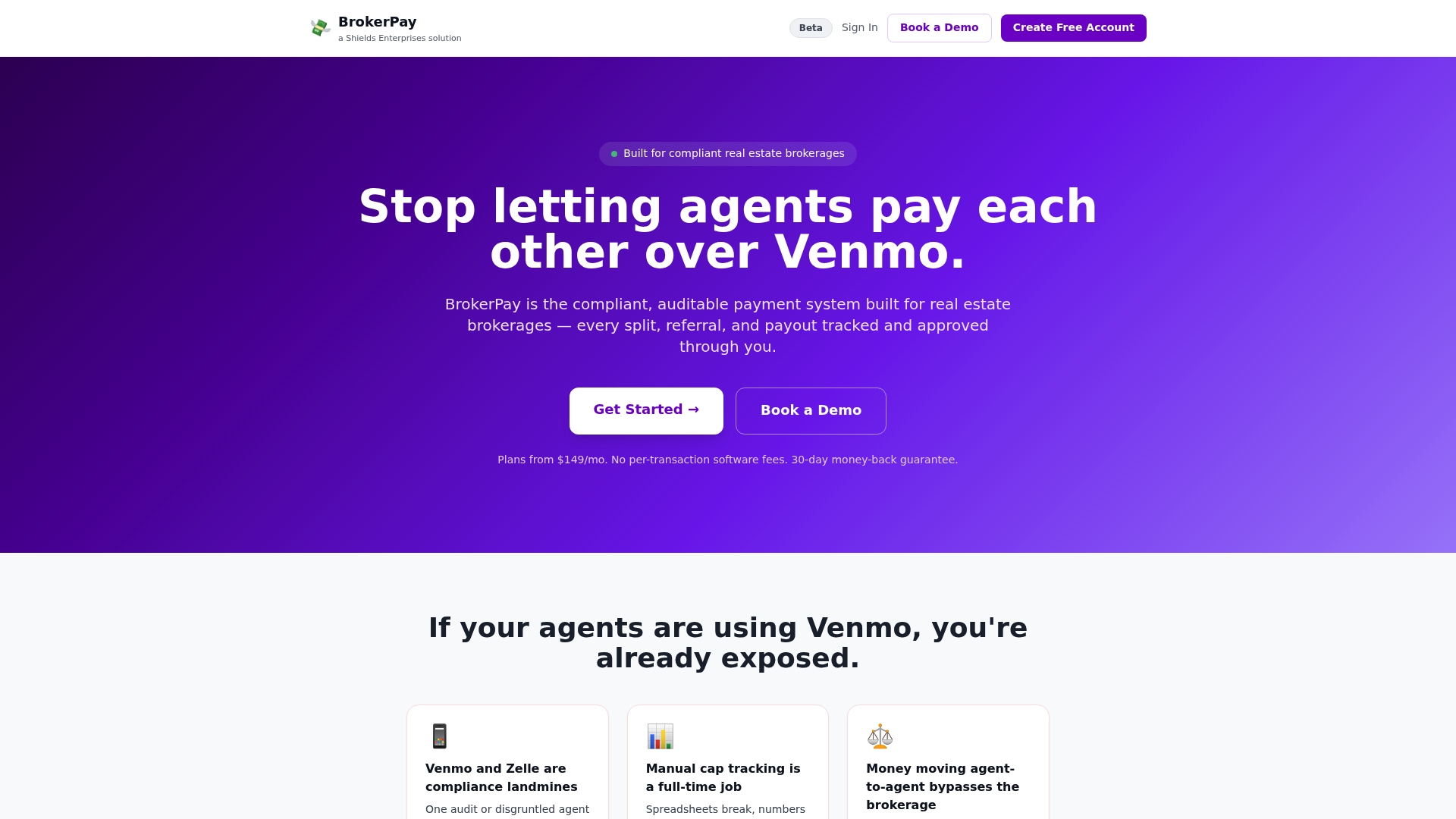
If you’re still managing splits in a spreadsheet and paying agents through whatever app is fastest, that gap is exactly what creates federal liability under RESPA and audit failures at the state level. Brokerpay is the direct alternative: flat monthly pricing based on agent count, no per-transaction fees, and a 30-day refund guarantee if it doesn’t fit your workflow. Explore the Starter, Growth, and Enterprise plans and request a demo to see your own split rules modeled inside the platform before you commit.
Sources
- Reporting payments to independent contractors — IRS
- CFPB compliance bulletin on RESPA and MSAs
- 12 CFR § 1024.14 - RESPA/Regulation X provisions — Cornell LII
- Beancount
- Commission tracking for real estate teams — AltStack
FAQ
What Is a Commission Disbursement Authorization?
A CDA is the signed document that authorizes a specific commission payout, including the deal reference, the calculation, deductions, and the approving signatory. It should be versioned and retained, not overwritten, so every past payout has its own permanent record.
Why Is Three-Way Reconciliation Required Monthly?
Three-way reconciliation matches your bank statement, trust or general ledger, and sub-ledgers, and it’s the audit item state examiners request most often. A dated worksheet with a broker signature shows the account was actually checked, not just that it happened to balance.
Can a Brokerage Pay Agent Commissions Through Venmo or Zelle?
Doing so creates two separate problems: no audit trail tied to a signed CDA, and a payment record that can’t be reconciled against trust or GL accounts. Regulators expect commission payouts through documented, brokerage-controlled accounts, and Brokerpay’s workflow is built specifically to replace that habit.
When Does a Brokerage Need to File a 1099-NEC for Commissions?
The IRS requires reporting nonemployee compensation on Form 1099-NEC once payments to a non-employee meet the filing threshold, and NAR recommends collecting a W-9 before the first payout rather than after. Tagging vendors correctly at intake avoids a year-end scramble.
Are Marketing Services Agreements Legal Under RESPA?
An MSA is lawful only when payment reflects the market value of services actually performed, not referral volume. The CFPB has specifically flagged MSAs structured to increase referrals as high-risk, so brokerages should keep contemporaneous documentation of the services behind every agreement.