Pass an Audit: Versioned Cap Adjustment Tracking for U.S. Brokerages

A compliant cap adjustment tracking system produces one thing above all: a searchable, versioned cap ledger that ties every adjustment to the contract rules in force at the time, the production transactions that triggered it, and a timestamped approval record. Brokerages that can produce this on demand satisfy auditors, IRS reporting needs, and NAR independent-contractor guidance in one motion.
TL;DR:
- A searchable, versioned cap ledger must link each adjustment to the active contract version, transaction dates, approval records, and jurisdiction-specific retention rules.
- Adjustments should reference specific contract clauses, deposit timing, and approval evidence to withstand audits and IRS or state scrutiny.
- Cap calculations require a fixed workflow involving data ingestion, calculation, human approval with documented rationale, and proper linkage to payouts.
- Automation must include explicit approval thresholds, reconciliation routines, and audit trails with timestamped user identification to prevent silent software changes.
- Implementing a disciplined recordkeeping process with jurisdiction-aware retention and version control is crucial to remaining audit-ready and avoiding compliance pitfalls.
Table of Contents
- Core Legal and Recordkeeping Requirements for Cap Tracking
- Recommended Ledger Schema and Metadata Fields
- Workflow for Calculating and Authorizing Cap Adjustments
- Automation Guardrails and Audit Readiness
- A Practical Checklist and Implementation Perspective
- Step-by-Step Procedures for Tracking Cap Adjustments
- Common Compliance Pitfalls and How to Avoid Them
- Integrating Cap Tracking With Payroll and Accounting Systems
- Best Practices for Reconciling Cap Adjustments Against Payouts
- Cap Adjustment Scenarios and Documentation Templates
- What Actually Matters in Cap Adjustment Tracking
- How BrokerPay Supports Cap Adjustment Tracking
- FAQ
- Sources
Core Legal and Recordkeeping Requirements for Cap Tracking
Cap adjustment tracking does not exist in a vacuum. It sits inside a web of contractor classification rules, state recordkeeping statutes, and federal tax reporting obligations, and the tracking system has to satisfy all three at once.
The starting point is classification. NAR guidance advises brokers to use written independent-contractor agreements and pay agents on a commission basis tied to IRC Section 3508, not on hours worked. A cap calculation that drifts toward hourly logic, or that cannot point to the contract clause it is enforcing, weakens that classification. Every adjustment needs to trace back to a specific, dated contract version.
Retention requirements add a second layer, and they are not uniform. Under Florida Statutes Section 475.5015, brokerage records generally must be kept for at least five years, and Illinois imposes a similar five-year standard with a requirement that recent records be available promptly for inspection. New Mexico requires six years for transaction records. A tracking system built for one state’s timeline will fail an audit in another.
The third layer is the gap between tax reporting and operational evidence. IRS Form 1099-MISC instructions govern what gets reported to the government, but they say nothing about how a specific cap adjustment was calculated or who approved it. A 1099 total is a summary, not proof.
- Contract-linked calculations: every cap adjustment cites the agreement version in force at the time
- Jurisdiction-aware retention: each record carries a retention deadline based on where the office operates
- Transaction-level evidence: adjustments reference the closings or payments that triggered them, not just a final number
Florida and Illinois require at least five years of record retention for many brokerage records, which means a cap ledger without searchable, exportable history for that window is not audit-ready.
Recommended Ledger Schema and Metadata Fields
A cap ledger has to stand apart from the general ledger because it answers a different question: not “what did we pay,” but “why did this agent’s cap change, under which contract, and who signed off.” Mixing the two makes both harder to audit.
The ledger should reference a versioned snapshot of the agent’s agreement, so an adjustment made in March always points back to the contract terms active in March, even if the agreement was updated in June. Event timing also needs a documented rule: does a transaction count toward the cap at closing, at receipt of funds, or at payout? Pick one and apply it consistently, and record reversals or chargebacks as linked entries rather than edits that erase the original record.
- Agent ID and contract ID with version number and effective date
- Cap type (team cap, company-dollar cap, graduated split) and the period it applies to
- Linked production transaction IDs feeding the calculation
- Adjustment reason, the calculation logic used, and the resulting amount
- Authorization evidence: user, role, and timestamp
- Jurisdiction, retention deadline, legal-hold flag, and reversal history
| Field category | Example value | Why it matters |
|---|---|---|
| Contract version | v3, effective March 1 | Ties adjustment to rules in force at the time |
| Event timing | Recognized at closing | Prevents disputes over when a cap resets |
| Authorization | Office manager, approved | Proves who signed off, not just that someone did |
| Retention deadline | Six years (New Mexico) | Matches jurisdictional requirement |
Workflow for Calculating and Authorizing Cap Adjustments
A defensible cap adjustment workflow follows a fixed sequence rather than ad hoc edits in a spreadsheet.
- Ingest closed production data from the transaction system
- Run the cap calculation against the agent’s current contract version
- Generate a proposed adjustment record, not a final one
- Route the proposed adjustment to a human for authorization, with the contract clause and production evidence attached
- Queue the approved adjustment for payout and record the disbursement with a timestamp
Adjustments above a set dollar threshold, or any adjustment that changes an agent’s effective split retroactively, should escalate to a second approver rather than clearing automatically. The person authorizing an adjustment should be identifiable by name and role, not just “system,” and that evidence should sit next to the adjustment permanently.
Edge cases deserve explicit policy rather than improvisation. A late closing that lands after a cap period resets, funds received weeks after closing, or a dispute over whether a referral fee should reduce the cap all need a documented default rule. When a retroactive change is unavoidable, record it as a new, linked entry that references the original, never as a silent overwrite.
Pro Tip: Treat every retroactive cap change as a new ledger entry that points back to the one it corrects, so the audit trail shows both numbers and the reasoning between them.
Automation Guardrails and Audit Readiness
Automation speeds up cap tracking, but it also creates a new risk: software quietly changing an agent’s economics without anyone noticing. Guardrails exist to prevent that.
Any adjustment that changes a payout amount or crosses a defined threshold should require explicit human approval before it posts, with the system logging who approved it and why. Routine reconciliation between the cap ledger, the general ledger, and year-end 1099 aggregates catches drift before it compounds into a bigger discrepancy. Exception reports, reviewed on a set schedule, should flag mismatches for remediation rather than letting them sit.
- Require explicit sign-off for adjustments above a dollar or percentage threshold
- Reconcile the cap ledger against the general ledger and 1099 totals on a recurring schedule
- Maintain exception reports with a defined remediation owner and deadline
- Export records with retention metadata and legal-hold flags intact, formatted for regulator review
Systems that log authorization evidence, tied to a named user and timestamp, give brokerages a defensible answer when a 1099 total is questioned during an audit, because the ledger shows the transaction-level reasoning the tax form does not.
A Practical Checklist and Implementation Perspective
Operations teams evaluating or building a cap tracking system can use a short checklist: does the system version contracts, require human authorization evidence, export by jurisdiction, and separate the cap ledger from the general ledger? If any answer is no, the gap is worth fixing before relying on the output in an audit.
Compliant commission platforms built for brokerages, including BrokerPay, are designed around this checklist directly: compliance-first automation, audit trails tied to each adjustment, brokerage-controlled disbursements, and a documented alternative to ad hoc Venmo or Zelle transfers that create federal liability exposure. These are the vendor’s own stated design goals, worth confirming against the checklist above rather than accepted at face value.
Step-by-Step Procedures for Tracking Cap Adjustments
Day-to-day cap tracking works best as a repeatable procedure rather than a monthly scramble.

First, pull closed transactions for the period from the brokerage’s transaction management system. Second, match each transaction to the correct agent and confirm the contract version active on the closing date. Third, run the cap calculation and generate a proposed adjustment, holding it for review rather than posting it automatically. Fourth, route the proposal to the designated approver along with the underlying production records and the contract clause it applies. Fifth, once approved, post the adjustment to the cap ledger with a timestamp and the approver’s identity attached. Sixth, queue the payout change in the payroll or disbursement system, keeping the cap ledger entry and the payout record linked by a shared transaction ID.
Finally, archive the complete record set, including the proposal, the approval evidence, and the final posting, with a retention deadline assigned based on the office’s jurisdiction. This sequence should run on a fixed cadence tied to the brokerage’s pay cycle, not whenever someone remembers to check. A weekly or biweekly rhythm catches errors while the underlying closings are still easy to verify, instead of letting discrepancies pile up until year-end reconciliation.
Common Compliance Pitfalls and How to Avoid Them
The most frequent mistake is treating the 1099 as the system of record for cap calculations. A 1099 reports totals to the IRS; it does not show how an adjustment was derived or who approved it, and IRS instructions make no claim that it does. Brokerages that rely on tax forms alone have no answer when an agent disputes a specific adjustment.
A second pitfall is letting automated cap logic silently change an agent’s split without a visible approval step. NAR’s guidance on independent contractor status warns against anything that blurs the line between contractor and employee treatment, and unsupervised automatic changes to compensation terms can look exactly like that blur to a regulator or in litigation.
A third is applying a single retention policy across every office when state rules differ. A brokerage with locations in Florida and New Mexico cannot use one retention clock for both; Florida’s five-year standard and New Mexico’s six-year requirement for transaction records need separate metadata, not a one-size assumption.
A fourth pitfall is losing the contract version history. If an agreement is updated but the old version is not preserved and linked to past adjustments, there is no way to show which rules applied when a disputed adjustment was made. Versioned storage, not overwriting, solves this.
Integrating Cap Tracking With Payroll and Accounting Systems
Cap adjustments only matter operationally once they reach a paycheck or a disbursement, which means the cap ledger cannot sit isolated from payroll and accounting.
The cleanest approach keeps the cap ledger as the source of truth for the calculation and authorization, then pushes a confirmed adjustment to payroll or the accounting system as a single, timestamped transaction. That transaction should carry a shared reference ID so a bookkeeper or auditor can trace a payout line back to the originating cap ledger entry without manual cross-referencing.
Accounting systems typically recognize revenue and expense on their own schedule, which may not match the cap ledger’s event-timing rule. If the cap ledger recognizes a transaction at closing but accounting recognizes it at receipt of funds, that gap needs documentation so the two systems reconcile instead of appearing to disagree. Payment infrastructure that routes disbursements through brokerage-controlled accounts rather than informal transfers makes this linkage easier to maintain, since every disbursement already carries a transaction record by default.

Avoid duplicate manual entry wherever possible. Every re-entry of an adjustment amount between systems is a chance for a transcription error that then takes a reconciliation cycle to catch.
Best Practices for Reconciling Cap Adjustments Against Payouts
Reconciliation works best as a recurring habit, not a once-a-year fire drill before tax season.
On a monthly or quarterly cadence, compare the cap ledger’s posted adjustments against the actual payout records in payroll or accounting. Any mismatch, whether it is a timing difference or a missed adjustment, goes into an exception report with an assigned owner and a resolution deadline. At year-end, reconcile the cap ledger’s annual totals against the 1099 aggregates being prepared for filing, since a mismatch at that stage is far harder to unwind than one caught mid-year.
Keep the exception report itself as part of the audit trail. A reconciliation process that fixes errors but discards the record of what went wrong loses the evidence that the control actually works. Documented co-op and referral payment workflows offer a useful model here: compliant payment examples that log every step tend to reconcile faster because there is less to reconstruct after the fact.
Build the reconciliation checklist around three questions: does every cap ledger adjustment have a matching payout, does every payout trace back to an authorized adjustment, and does the annual total match the 1099 reporting. A clean yes to all three is the real measure of audit readiness.
Cap Adjustment Scenarios and Documentation Templates
A few recurring scenarios illustrate what the documentation should look like in practice.
Standard cap reached mid-month. An agent crosses their cap threshold on a closing dated the 15th. The ledger entry should record the contract version, the closing ID, the calculation showing the cap was met, the approver, and the effective date the new split rate takes hold.
Late-arriving funds. A transaction closes in one cap period but funds are received in the next. The documentation should state explicitly which event, closing or receipt, the brokerage treats as the trigger, and the entry should note the delay and the rule applied, not just the final number.
Disputed referral fee. An agent contests whether a referral fee should count against their cap. The record should hold the original calculation, the dispute note, any revised calculation, and the approver’s resolution, linked rather than overwritten so both versions remain visible.
Retroactive contract change. A brokerage updates commission terms mid-year. Adjustments made before the change keep their original contract version reference; adjustments after the change reference the new version, and the transition date is logged as its own metadata field.
Each of these templates needs the same core fields: contract version, production reference, calculation logic, authorization evidence, and a retention deadline, regardless of how unusual the scenario is.
What Actually Matters in Cap Adjustment Tracking
Most advice on this topic focuses on picking software with a cap feature, as if the feature itself were the safeguard. It is not. The safeguard is the discipline behind it: documented contract versions, a human who signs off on exceptions, and a retention policy that matches the jurisdiction the office operates in. Software without that discipline just automates the same risk faster.
The conventional advice also tends to treat the 1099 as the finish line for compliance. It is not even the starting line for operational evidence. A brokerage that can produce a clean 1099 total but cannot show who approved a specific cap adjustment, or under which contract version, is exposed the moment an agent disputes a number or a regulator asks a pointed question.
If there is one place to start, it is authorization evidence. Get that right, with named approvers, timestamps, and contract references, before worrying about dashboards or integrations. A consulting perspective on preserving contractor classification makes a similar point: supervision and documentation matter more than the tooling wrapped around them.
— Wes
How BrokerPay Supports Cap Adjustment Tracking
We built BrokerPay around the checklist above because that is what brokerages actually need to pass an audit, not a dashboard with a cap feature bolted on. Every adjustment we process carries an audit trail, a versioned contract reference, and approval evidence tied to a named user, and every disbursement routes through a brokerage-controlled account instead of an informal transfer that creates federal liability exposure.
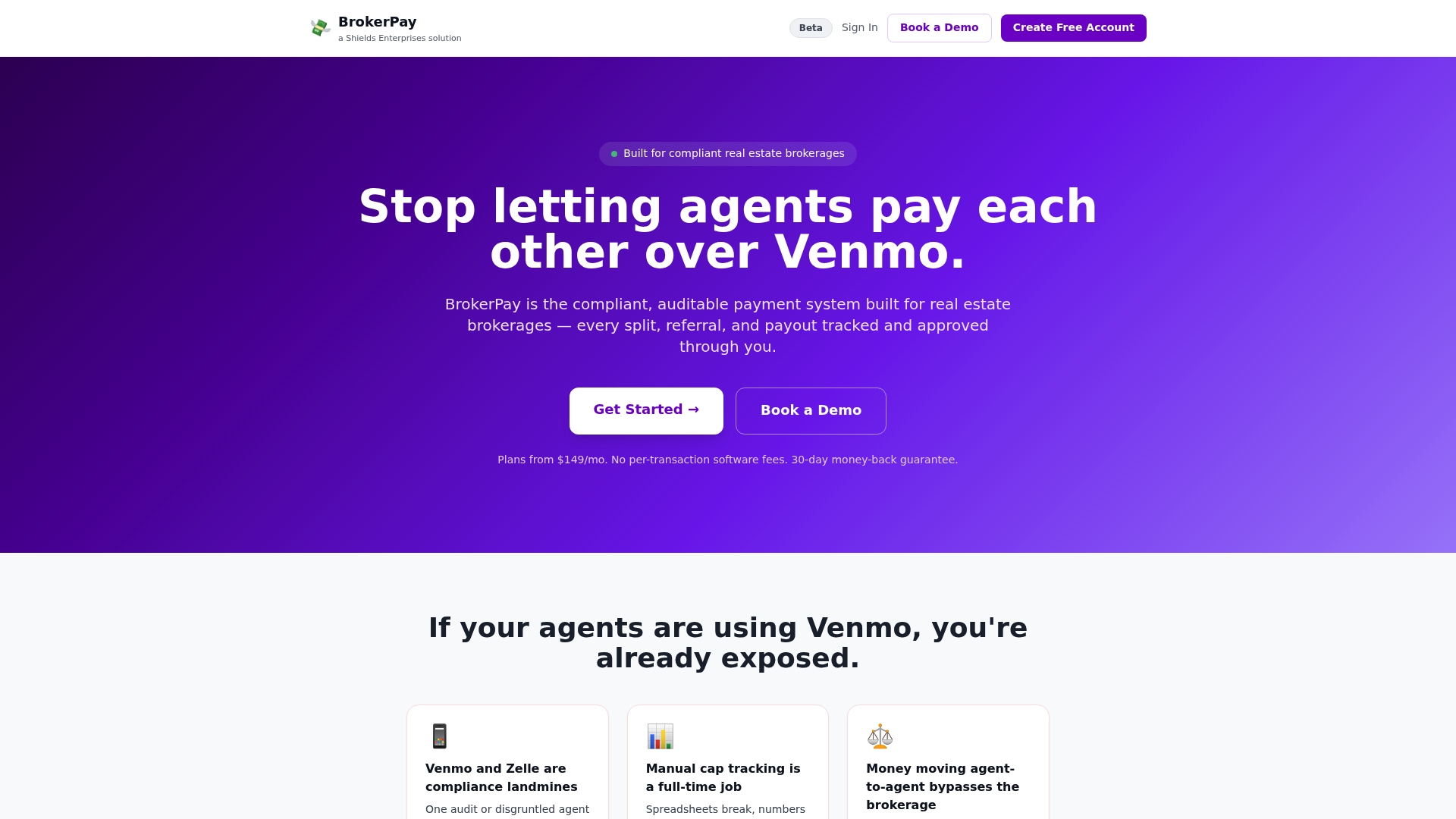
If this feels like a lot to retrofit into a spreadsheet, start small. We recommend a single-office pilot: export a sample audit report from your current process, run cap calculations in parallel with what you already have for a month or two, and validate that the jurisdictional retention exports match what your state actually requires.
- Compliant commission, referral, and co-op payment workflows in one system
- Cap tracking tied to contract versions and approval evidence
- Brokerage-controlled disbursements, with no Venmo or Zelle workarounds
We offer plans that scale by agent count with flat monthly pricing and no per-transaction fees. Check BrokerPay’s plans to see which tier fits your office.
This article is general information, not a substitute for advice from a qualified financial advisor. Consult a qualified financial professional about your own circumstances before acting on anything here.
FAQ
How long should brokerages retain cap adjustment records?
Retention periods are set by state, and they are not identical. Florida and Illinois generally require at least five years for many brokerage records, while New Mexico requires six years for transaction records, so multi-office brokerages need retention metadata mapped by jurisdiction rather than one blanket rule.
Does a 1099 count as proof that a cap adjustment was authorized?
No. IRS 1099 instructions govern tax reporting totals, not the transaction-level evidence of who approved an adjustment or how it was calculated, so brokerages still need a separate cap ledger with authorization records.
What authorization evidence should a cap adjustment include?
At minimum, the record should show who approved the change, their role, a timestamp, and the contract version in force at the time of the adjustment. This evidence should live permanently next to the adjustment, not in a separate approval thread that can get lost.
When should a cap adjustment be recognized: at closing, receipt, or payout?
There is no single legal requirement dictating this choice, so brokerages need to pick one event, closing, receipt of funds, or payout, document it as policy, and apply it consistently. Mixing recognition rules across offices is a common source of reconciliation errors.
How does cap tracking relate to independent contractor classification?
NAR guidance advises that cap calculations be based on documented production and written commission-based agreements rather than hours worked, since pay structures resembling hourly compensation can undermine independent contractor status under IRC Section 3508.
Sources
- How brokers can preserve independent contractor status
- Chapter 475 Section 5015 - 2024 Florida Statutes
- Instructions for Form 1099-MISC (and related reporting guidance)