Audit Ready RESPA Payment Compliance Workflows for U.S. Brokerages

An auditable payment compliance workflow routes every commission, referral fee, and co-op payment through a brokerage-controlled account, requires a documented approval before funds move, and keeps an immutable record of who approved what and why. The Consumer Financial Protection Bureau’s Regulation X, IRS reporting rules, and guidance from the National Association of REALTORS® all point to the same conclusion, and platforms like BrokerPay exist because manual systems and peer-to-peer apps rarely meet that bar.
TL;DR:
- Payments through brokerage-controlled accounts with documented approval and service records ensure compliance and facilitate audits.
- Fluctuations in referral fee amounts and repeated payments without clear service documentation raise red flags under RESPA.
- Using peer-to-peer apps like Venmo or Zelle introduces risks due to their lack of formal tracking and verification, which can trigger regulatory scrutiny.
- Regular reconciliation of payment records with IRS thresholds and retention of W-9 and supporting documentation are essential for tax compliance.
- Transitioning to automated, recorded payout systems significantly reduces legal and audit risks compared to manual or informal payment methods.
Table of Contents
- What RESPA Requires for Commissions, Referrals, and Co-op Payments
- Core Design Elements of an Auditable Payment Workflow
- Tax and Reporting Checklist: W-9s, 1099s, and Retention
- Why Venmo and Zelle Create Risk for Brokerage Payouts
- Step-by-Step Checklist to Implement an Auditable Workflow
- Why This Matters More Than Most Brokerages Assume
- How BrokerPay Puts These Controls Into Practice
- FAQ
- Sources
What RESPA Requires for Commissions, Referrals, and Co-op Payments
RESPA Section 8 prohibits giving or accepting a fee, kickback, or anything of value in exchange for referring business related to a federally related mortgage loan. The rule matters to brokerages because commission splits, referral fees, and co-op payments all involve money moving between licensees, and regulators want to see that the money paid for real work, not just for sending a client down the hall.
The good news for brokerages: cooperative arrangements among licensed agents and brokers are allowed. Regulation X permits these payments when they represent bona fide compensation for services actually performed, not a disguised reward for a referral. The test is whether the payment reflects fair market value for identifiable work, something NAR’s own guidance reinforces when it warns brokerages to document the services behind every referral payment.
Red flags tend to look similar across brokerages. Run these checks against your current arrangements:
- Does the fee scale with referral volume rather than hours worked or deliverables produced?
- Is there a written description of the service performed, or just a verbal understanding?
- Does the payment amount match typical market rates for that service, or does it run noticeably higher?
- Is the same referral source paid repeatedly without any documented service each time?
Any arrangement that fails these checks needs a second look before the next payment goes out.
Core Design Elements of an Auditable Payment Workflow
A workflow earns the label “auditable” only when every dollar can be traced back to an approval and a reason. Three elements make that possible.
- Brokerage-controlled routing. Commission, referral, and co-op payments should move through accounts the brokerage directly controls, clearly separated from personal or informal arrangements. Trust funds and operating funds need distinct, labeled accounts; mixing them creates accounting problems that are hard to untangle later.
- Approval workflows with timestamps. Every payment needs a signoff from someone authorized to approve it, logged with a timestamp, before funds move. The approval record should reference the evidence of service, not just a dollar amount.
- Retained documentation. Each payment needs a paper trail behind it: a signed W-9, an independent contractor agreement, a description of the service performed, the payment authorization itself, and a reconciliation record tying the payment to the brokerage’s books.
A compliant payment workflow design built around these three elements turns a RESPA question from “what did we mean to do” into “here’s the record.”
Pro Tip: Store the service evidence (a marketing report, a referral log, a signed agreement) in the same system as the payment record, not in a separate file folder someone has to go hunting for during an audit.
Tax and Reporting Checklist: W-9s, 1099s, and Retention
Payment compliance does not stop at RESPA. The IRS requires brokers to collect a signed W-9 from every independent contractor before the first payment goes out, and that form should stay on file for as long as the relationship continues plus several years after, since it supports every 1099 filed during that period.
Nonemployee compensation, including agent commissions and referral fees paid to independent contractors, gets reported on Form 1099-NEC once payments meet the IRS reporting threshold. Brokers filing 10 or more information returns in a year must e-file rather than submit paper forms, a rule the IRS’s 1099 instructions spell out directly. Some reporting thresholds for certain payment categories change after December 31, 2025, so confirm the current figures before filing rather than relying on last year’s numbers.
A short checklist keeps this manageable:
- Collect a W-9 before the first payment, not after.
- Flag any contractor who refuses to provide a taxpayer ID. That can trigger backup withholding.
- Reconcile 1099 totals against payment records monthly, not just at year-end.
- File electronically once the 10-return threshold applies.
A commission tracking system that logs every payment as it happens makes year-end reconciliation a non-event instead of a scramble.
Why Venmo and Zelle Create Risk for Brokerage Payouts
Peer-to-peer payment apps feel convenient, which is exactly why so many brokerages default to them for splits and referral fees. The problem is that convenience comes at the cost of the documentation RESPA and the IRS both expect.
Venmo and Zelle were built for informal transfers between individuals, not for commercial recordkeeping. A few specific risks show up repeatedly:
- Transaction notes rarely capture the service rendered, leaving no evidence a payment was for work rather than a referral.
- Recipient account names can be spoofed or mistyped, raising the odds of misdirected funds with limited recourse.
- Return and reversal rates on these consumer apps draw attention from payment networks. FTC staff comments on NACHA’s enforcement proposals make clear that processors and originators are expected to monitor anomalous return patterns, and elevated rates can trigger scrutiny from banks or regulators.
Brokerage-controlled ACH transfers, integrated payout platforms, and dedicated real estate payment gateways solve the documentation gap because they log approvals, timestamps, and service evidence as a normal part of processing the payment, not as an afterthought.
Step-by-Step Checklist to Implement an Auditable Workflow
Moving from manual or P2P-based payouts to a documented system is a project with a clear sequence, not a single switch to flip.
- Pre-launch. Draft a written compensation policy covering splits, referral fees, and co-op arrangements. Collect outstanding W-9s and confirm independent contractor status for every agent. Set up brokerage-controlled accounts with trust and operating funds clearly separated.
- Launch. Configure routing rules so payments default to brokerage accounts, build approval requirements into the workflow, connect the system to your accounting software, and run test payments to confirm reconciliation works before going live with real money.
- Ongoing. Monitor return and reversal rates monthly, reconcile payment records against your books every month rather than quarterly, and hold a quarterly compliance review to catch drift before it becomes a pattern. Archive records according to your retention policy rather than deleting them once a transaction closes.
Brokerages switching from spreadsheets or manual payout processes to automated systems tend to find the hardest part is step one: getting the policy written down clearly enough that the system can enforce it.
Pro Tip: Run your first full month in parallel, old process and new system side by side, before retiring the manual method. Discrepancies are far easier to catch while you still have both records.

Why This Matters More Than Most Brokerages Assume
Most brokerages treat RESPA compliance as a legal formality handled once, when a referral agreement gets signed. That approach misses the point. RESPA risk lives in the ongoing pattern of payments, not the paperwork at signing, and a brokerage that documents the agreement well but pays informally every month afterward has not actually reduced its exposure.
The bigger blind spot is the assumption that P2P apps are a temporary workaround rather than a permanent liability. Every Venmo or Zelle transfer logged as a “commission split” without a service record behind it is a transaction a regulator could question years later, long after anyone remembers the details. The fix is not more paperwork. It is a system that captures the record automatically, at the moment the payment happens, so nobody has to reconstruct it later from memory.
— Wes
How BrokerPay Puts These Controls Into Practice
We built BrokerPay specifically to close the gap between what RESPA and the IRS expect and what most brokerages actually do when a commission check needs to go out fast. Every payment we process routes through brokerage-controlled accounts, carries an approval trail, and gets logged with the documentation a compliance review or an IRS inquiry would ask for.
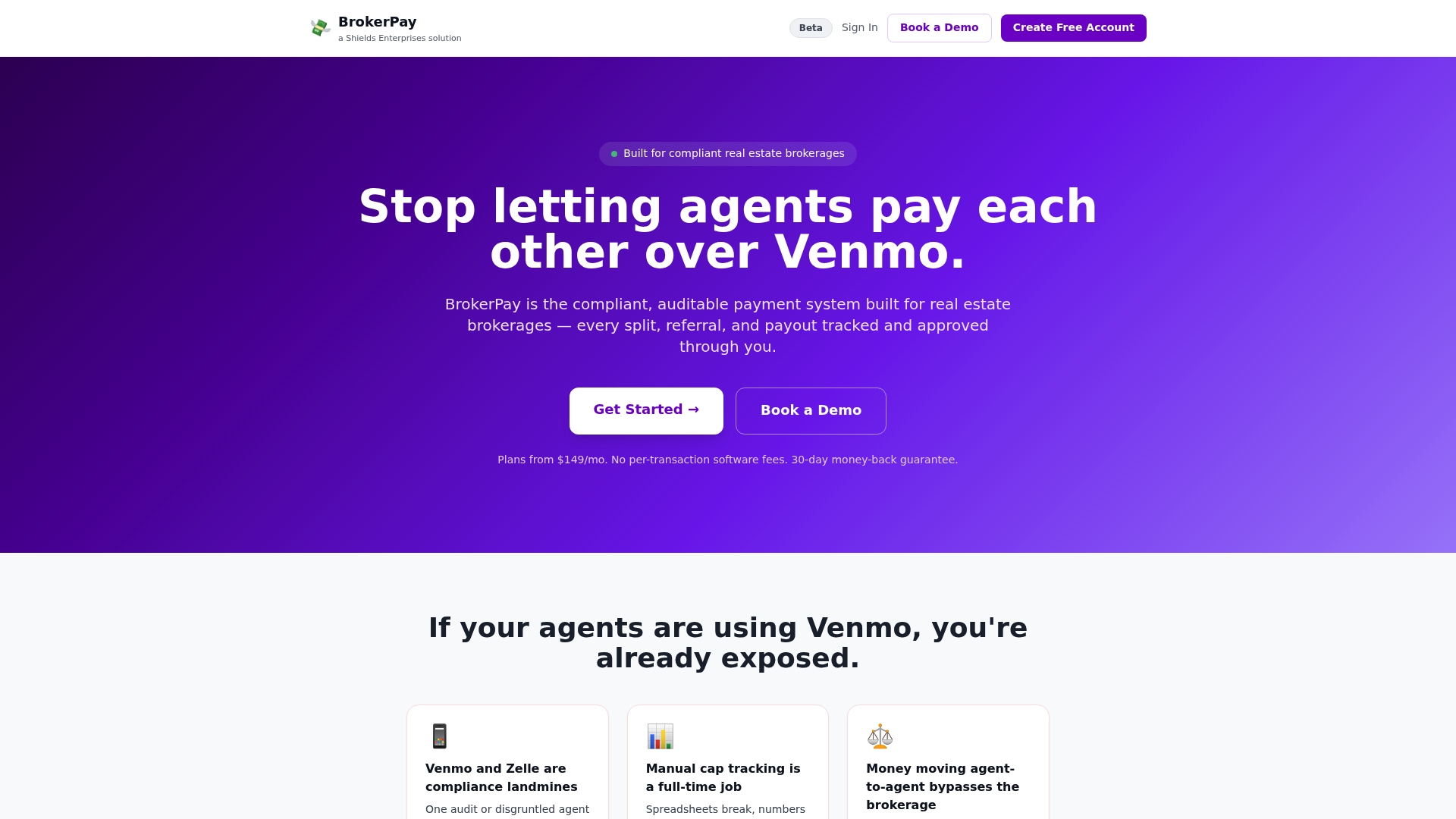
Here is what that looks like in practice:
- We track, document, and process agent splits, referral fees, and co-op commissions without routing payments through personal payment apps.
- We replace Venmo and Zelle workarounds with brokerage-controlled ACH transfers, approval logs, and audit trails built for real estate commission payments.
- We price with flat monthly plans and do not add per-transaction fees.
If your brokerage is still reconciling splits by hand or trusting P2P transfer notes to double as documentation, view our plans or request a demo at BrokerPay to see how the workflow runs for your office size.
This article is general information, not a substitute for advice from a qualified lawyer. Consult a qualified legal professional about your own circumstances before acting on anything here.
FAQ
Is paying a referral fee between real estate agents always illegal under RESPA?
No. RESPA Section 8 prohibits fees paid purely for referrals, but cooperative brokerage payments are permitted when they represent fair compensation for services actually performed. The key is documentation showing real work behind the payment, not the existence of the payment itself.
How long should a brokerage keep W-9s and payment records?
The W-9 and supporting payment records should stay on file for the length of the contractor relationship plus several years afterward, since they support every 1099 filed during that period. Brokerages following NAR’s recordkeeping recommendations typically pair that retention with a standardized compensation schedule and independent contractor agreement on file for each agent.
Why is Venmo risky for paying agent commissions?
Venmo and similar apps rarely capture the service detail regulators expect behind a commission or referral payment, leaving a weak audit trail. They also carry return and reversal patterns that payment networks monitor, and FTC staff commentary on NACHA oversight notes that elevated return rates can draw processor or regulator scrutiny.
Does BrokerPay replace the need for a written compensation policy?
No. We handle the routing, approval trail, and documentation of each payment, but a brokerage still needs its own written compensation policy defining splits, referral terms, and co-op arrangements. We built our platform to enforce that policy consistently once it exists.
What triggers a 1099-NEC filing for a brokerage?
A brokerage must file Form 1099-NEC once nonemployee compensation paid to an independent contractor, such as an agent’s commission or referral fee, meets the IRS reporting threshold for the year. Brokers filing 10 or more information returns must e-file rather than submit paper forms.
Sources
- Consumer Financial Protection Bureau — Regulation X (RESPA) §1024.14
- IRS — Instructions for Forms 1099‑MISC and 1099‑NEC
- National Association of REALTORS® — Tips to give and get referrals in a RESPA‑compliant way
- FTC staff comment — NACHA network enforcement proposal