RESPA Compliant Commission System for U.S. Multi Office Brokerages

For multi-office brokerages, the right choice is a centralized commission engine integrated with your agent transaction system (ATS) and accounting software, because it gives you one source of truth, one audit trail, and consistent rule enforcement across every location. ATS-native commission tools work fine only when your splits, caps, and override rules are simple and identical office to office. Anything more complex, and the compliance risk and reconciliation headaches outweigh the convenience.
TL;DR:
- ATS native tools can handle a single office with roughly 50 agents when splits, caps, and referral rules match; office variation favors centralization.
- Rollouts take weeks for simple setups and months for complex builds; map legacy agreements, then run both payroll systems for at least two cycles.
- RESPA prohibits payments for referrals and permits settlement fee splits only for services actually performed; require written agreements, fair market value documentation, and brokerage controlled accounts.
- Model caps, layered overrides, draws, and co op payments with version controlled rules and test cases; reconcile before each payout, not after disputes emerge.
Table of Contents
- ATS-native, centralized engine, or spreadsheets: which fits your brokerage?
- How long implementation takes and where the budget goes
- RESPA compliance risks every multi-office brokerage should control
- The commission structures your system actually has to model
- Metrics and reports that prove the system is working
- Migration checklist: from pilot to full rollout
- BrokerPay: built for compliant multi-office payouts
- When to centralize, and when to wait
- BrokerPay plans and your next step
- FAQ
- Sources
ATS-native, centralized engine, or spreadsheets: which fits your brokerage?
Most multi-office brokerages run one of three architectures, and the right pick depends on how much variation exists between your offices.
ATS-native commission modules live inside your existing transaction management platform. They work well when every office uses the same split structure, the same cap thresholds, and the same referral rules. The moment one office negotiates different splits or runs a separate co-op structure, the native module starts producing exceptions that someone has to fix by hand.
A centralized commission engine sits between your ATS, your accounting system, and your bank, pulling transaction data in, applying rules by office or agent tier, and pushing approved payouts out. This is the only option built to handle variable splits, multiple override layers, and audit requirements across several offices at once.
Spreadsheets or custom-built tools are what most brokerages start with and what almost all eventually outgrow. They are cheap at first and brutal at scale: no audit trail, no version control, and every office manager builds their own logic.
Decision factors worth weighing:
- Agent count: under roughly 50 agents in a single office, ATS-native tools can hold up; multi-office growth past that point usually strains them.
- Office variability: if splits, caps, or co-op terms differ by office, a centralized engine is close to mandatory.
- Compensation complexity: tiered splits, draws, and manager overrides multiply the number of edge cases a spreadsheet has to catch manually.
- Compliance exposure: anywhere referral fees or co-op payments cross state lines or involve outside parties, documentation requirements favor a system built for audit trails over ad hoc tracking.
How long implementation takes and where the budget goes
A centralized commission rollout for a multi-office brokerage typically runs through six phases:
- Discovery: inventory every comp plan, split variant, and exception across all offices.
- Rule mapping: translate each plan into system logic, including caps, overrides, and co-op terms.
- Integration build: connect the engine to your ATS and accounting platform.
- Testing and pilot: run one office through the system before expanding.
- Parallel runs: process payroll both old and new ways for at least two cycles.
- Go-live: retire the legacy process office by office.
The biggest cost drivers are integration depth (how many systems need to talk to each other), the number of unique comp rule variants you’re modeling, and how many payees (agents, teams, referral partners) the system has to track. Simple, single-office ATS setups can move in a matter of weeks; multi-office builds with custom rules and several integrations routinely take months, not weeks.
The most common delay isn’t the software. It’s incomplete rule mapping: an office manager forgets a legacy agent agreement, and it surfaces three pay cycles later as a reconciliation error.

Pro Tip: Build your rule inventory before you shop for software, not after you sign a contract.
RESPA compliance risks every multi-office brokerage should control
Section 8 of the Real Estate Settlement Procedures Act prohibits giving or accepting anything of value for referring settlement service business, and it bars splitting settlement-service fees except for services actually performed, as laid out in the regulation itself. That provision is the reason Marketing Services Agreements between brokerages and vendors draw regulatory scrutiny: the CFPB has warned that MSAs are frequently used to disguise referral fees, and that any payment for a settlement service must correspond to a real, necessary, distinct service priced at fair market value. Enforcement turns on facts and execution, not just contract language: a well-drafted agreement can still be unlawful depending on how it’s carried out.
A brokerage cannot document a referral payment with a Venmo memo line and call it an audit trail. Peer-to-peer apps route money outside brokerage-controlled accounts, skip approval workflows entirely, and leave no immutable record tying a payment to the service it was supposedly compensating.
Controls that hold up under audit:
- Route every commission, referral, and co-op payment through a brokerage-controlled account, never a personal payment app.
- Document the specific service behind every payment, with fair-market valuation attached.
- Require a written agreement before any referral or co-op arrangement pays out.
- Keep a full, timestamped audit trail for every transaction, from approval to disbursement.
- Review MSAs and referral arrangements periodically against current NAR guidance on RESPA-compliant referrals.
The commission structures your system actually has to model
Multi-office operations rarely run one clean split. The patterns that show up most often:
- Flat and tiered splits: a straight percentage, or one that changes as an agent crosses production thresholds.
- Caps: once an agent hits an annual cap, their split (or the brokerage’s cut) changes for the rest of the period.
- Office, desk, and manager overrides: a percentage skimmed off a transaction for a broker, team lead, or office manager.
- Referral splits: a cut paid to the referring agent or outside brokerage, subject to RESPA documentation requirements.
- Co-op payments: shared commissions between cooperating brokerages on the same transaction.
- Draw and recoup logic: advances against future commissions that have to be tracked and clawed back correctly.
Each of these complicates reconciliation differently. Caps require running-total tracking across an entire year. Overrides require layering multiple payees onto a single transaction without double-counting. Draws require the system to remember a balance across pay periods.
The fix is version-controlled rule sets (so a rule change doesn’t silently alter last month’s math), documented test cases for each pattern, and a reconciliation routine that runs before every payout, not after agents start calling.
Metrics and reports that prove the system is working
Once a commission engine is live, a handful of numbers indicate whether it’s actually working:
- Payout accuracy: the share of commission payments that required no manual correction.
- Time-to-payout: days from closing to funds landing in an agent’s account.
- Reconciliation variance: dollar difference between expected and actual payouts each cycle.
- Unapplied credits: referral or co-op amounts sitting unresolved.
- Dispute rate: commission disputes raised per hundred transactions.
- Cap attainment: how many agents have crossed their cap, and when.
Replacing fragmented, branch-specific spreadsheets with one centralized system is what gives multi-office brokerages a single, reliable view of commission liabilities across every office, instead of a patchwork that only reconciles after the fact.
Finance needs liability rollups and audit exports. Office managers need agent-level statements and dispute queues. Operations needs co-op ledgers and reconciliation variance by office. A single dashboard trying to serve all three usually serves none of them well.
Migration checklist: from pilot to full rollout
Moving offices onto a new system works best as a sequence, not a flip of a switch:
- Map every comp rule and known exception across all offices before touching the new system.
- Pilot one office first, and use that office as your template for the rest.
- Run parallel payroll cycles, old system and new, for at least two full pay periods and reconcile every discrepancy.
- Train payroll and front-office support staff before agents start asking questions.
- Prepare agent-facing statements and a dispute workflow before go-live, not after the first complaint.
Pro Tip: Pick your most straightforward office for the pilot, not your most complicated one. You want to validate the process, not debug it under pressure.
BrokerPay: built for compliant multi-office payouts
We built BrokerPay around the exact problem described above: routing every commission, referral, and co-op payment through brokerage-controlled accounts instead of personal payment apps. Every payout carries an audit trail, a documented approval step, and support for splits, caps, overrides, and referral fees across as many offices as a brokerage runs.
We support the workflows that trip up spreadsheets and P2P apps alike, including compliant co-op payment structures and secure payment routing that keeps funds inside brokerage-controlled accounts from approval to disbursement.
When to centralize, and when to wait
Centralize once you have more than a couple of offices and comp plans that already differ. Rushing a centralized system onto offices with messy, undocumented rules just automates the mess faster.
— Wes
BrokerPay plans and your next step
We offer multiple ways to bring multi-office commission management under one compliant system, sized to agent count rather than transaction volume, so adding offices never adds per-payout fees.
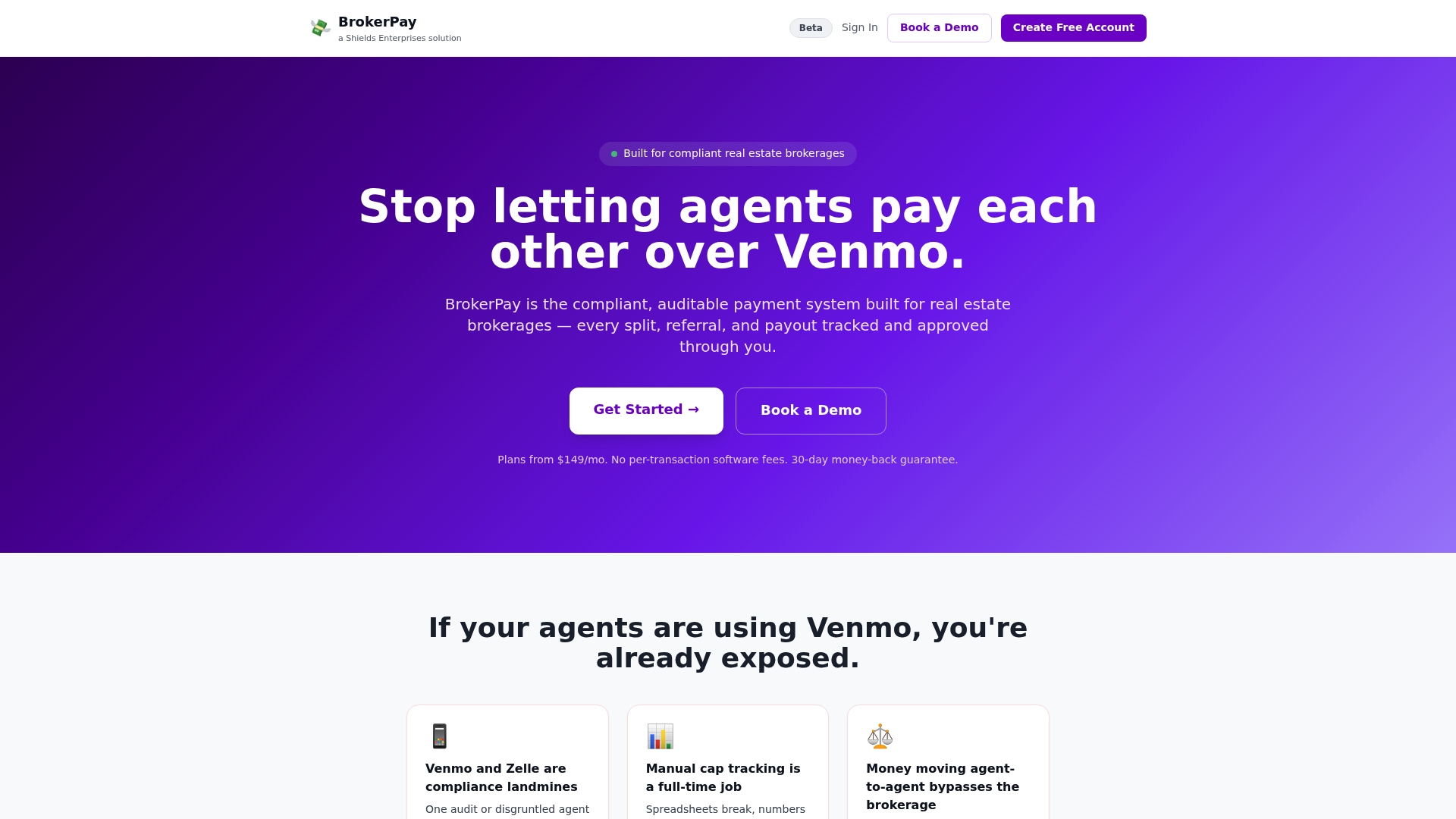
- Request a demo to see how splits, caps, and co-op payments map onto your current offices.
- Run our compliance checklist against your existing referral and MSA arrangements.
- Pilot one office before committing to a full rollout.
| Plan | Fit |
|---|---|
| Starter | Single office or early multi-office brokerages |
| Growth | Multiple offices with variable comp rules |
| Enterprise | Large, multi-office operations with complex compliance needs |
Pricing for each plan is available on request through our plans and signup page. If you’re ready to stop routing commissions through personal payment apps, that’s the place to start.
This article is general information, not a substitute for advice from a qualified lawyer. Consult a qualified legal professional about your own circumstances before acting on anything here.
FAQ
Is a $100 commission job worth it?
Whether a flat commission payment is worth taking depends on the time required and whether it’s a one-time referral fee or part of an ongoing arrangement. For brokerages, the more important question is whether that payment is properly documented as compensation for an actual service, since RESPA treats undocumented referral payments as prohibited regardless of the dollar amount.
What are the four types of commissions?
Real estate commission structures generally break down into flat splits, tiered or graduated splits, capped splits, and override or referral splits layered on top of a base commission. Multi-office brokerages often run several of these simultaneously across different offices or agent tiers.
What is the best commission tracking software?
The right software depends on how uniform your commission rules are across offices: ATS-native modules work for simple, consistent splits, while brokerages with variable rules, caps, and co-op arrangements generally need a centralized engine. BrokerPay is built specifically for brokerage-controlled, RESPA-compliant payout tracking across multiple offices.
What is the average commission for a sales manager?
Sales manager overrides vary by brokerage and are typically structured as a percentage skimmed from agent transactions rather than a fixed figure, so there’s no single industry-wide rate. Brokerages should document their own override structure clearly in agent agreements to keep it auditable.