Secure Broker Payments for Brokerages: Move Off P2P Before an Audit

Secure broker payments mean a RESPA compliant, auditable commission payment platform that automates agent splits, referral and co-op commissions, cap tracking, and ACH transfers, with BrokerPay as one example of this kind of system. For independent and multi-office brokerages still running payouts through spreadsheets or peer-to-peer apps, the fix is to evaluate an auditable payments platform now, before an audit forces the question.
TL;DR:
- For cooperative commissions above $600 to nonemployees, collect a W-9 before payment and report the amount on Form 1099-MISC at year end.
- Marketing service fees are lawful only when they pay for distinct work actually performed at fair market value, rather than disguising a referral payment.
- Route payments through accounts controlled by the brokerage, retain records for at least five years, and keep payment initiation separate from approval.
- A pilot can begin within a few weeks, but full rollout may take one to two quarters depending on office count and integrations.
- Start with one office, preferably the busiest, then train staff and reconcile sample payouts before expanding the process across the brokerage.
Table of Contents
- Why compliance matters: RESPA, marketing agreements, and tax reporting
- Practical compliance checklist for brokerages
- Step-by-step implementation: from assessment to full rollout
- Compliant co-op payment workflows you can adapt
- Timeline and cost considerations for switching systems
- A practical perspective on control versus convenience
- How BrokerPay fits into a compliant payment process
- FAQ
- Sources
Why compliance matters: RESPA, marketing agreements, and tax reporting
RESPA Section 8 prohibits kickbacks and unearned fees tied to settlement services, but it carves out a specific exception for cooperative brokerage arrangements between licensees who are actually performing brokerage work. The CFPB’s Regulation X defines “thing of value” broadly, covering money, discounts, and commissions, which means almost any informal payment arrangement falls under its reach.

Marketing service agreements sit in a gray zone. Regulatory guidance makes clear that a payment labeled as marketing support is lawful only when it reflects services actually performed and priced at fair market value, not structured to disguise a referral fee.
On the tax side, brokerages that pay cooperative commissions above $600 to non-employees must collect a W-9 before paying and report the amount on Form 1099-MISC.
- RESPA Section 8 bars kickbacks but allows cooperative splits between licensees performing brokerage services.
- Marketing fees must be tied to real, distinct services, not disguised referral payments.
- Cooperative commissions over $600 to non-employees require a W-9 and a 1099-MISC filing.
Venmo, Zelle, and unversioned spreadsheets create exposure because they leave no reliable record of what was paid, when, or why, which is exactly what an auditor or the IRS will ask for first.
Practical compliance checklist for brokerages
Before changing systems, run your current payout process against this list. It mirrors what regulators and auditors actually check.
- Every payment ties to a documented business purpose and, where relevant, a signed contract describing the service performed.
- A completed W-9 is on file before any external payee receives a cooperative commission or referral fee, with 1099 workflows ready at year end.
- Role-based access separates who can initiate a payment from who approves it, with no single person controlling both ends.
- Audit logs are immutable, split records are versioned, and records are retained for at least five years.
- Settlement-related disbursements move through brokerage-controlled accounts rather than personal P2P apps.
- Affiliated arrangements and broker-to-broker agreements carry written disclosures when the relationship requires one.
Regulation X specifically expects payments for additional settlement services to be for work that is actual, necessary, and distinct, and it documents the five-year retention expectation that most brokerages underestimate until an inquiry lands on their desk.
Pro Tip: Run this checklist quarterly, not just during onboarding. Agent rosters and referral partners change faster than most compliance reviews.
Step-by-step implementation: from assessment to full rollout
Moving off manual payouts works best as a sequence rather than a single cutover.
Start by mapping every current payment flow: who initiates a split, who approves it, where the money actually comes from, and where records live. This step usually surfaces the gaps, missing W-9s, undocumented referral arrangements, split calculations that exist only in someone’s head.
- Set written policy first: an approved payee list, a W-9/1099 collection rule, a retention period, and a defined approval chain.
- Choose platform features that match the policy: role-based access, multi-stage approvals, an audit trail, direct bank routing, and cap tracking.
- Prioritize integrations with your accounting system, escrow workflow, and MLS-adjacent tools before expanding to anything else.
- Pilot with one office or one transaction type before rolling out brokerage-wide.
- Train your team, document the new process, and run sample reconciliations after rollout to confirm the numbers match.
A practical migration playbook for brokerages moving off spreadsheets and P2P apps can shorten this process considerably, since most of the pain points are common across offices of similar size.
Pro Tip: Pilot with your highest-volume office first. If the new process holds up under real transaction volume, the rest of the rollout goes faster.
Compliant co-op payment workflows you can adapt
These templates reflect the kinds of transactions that create the most compliance friction when handled manually.
- Buyer-broker co-op split: requires the cooperating agreement, a documented commission percentage, and a secondary approval before funds release; record retention runs five years.
- Referral to an out-of-office broker: requires a signed referral agreement, a W-9 collected before payment, and a flag for 1099 reporting at year end; timing matters because late W-9 collection delays payout.
- Cap-tracking adjustment: requires a reconciliation record showing the agent’s year-to-date production against their cap threshold, with an approval step before the draw amount changes.
- Each template should specify the required records, who approves the payment, the timing window, and the tax step that follows.
For more detailed, real-world scenarios, our compliant co-op payment workflow examples walk through eight variations brokerages commonly encounter. Brokerages working through a merger or acquisition face an added layer of RESPA risk during deal structuring, and RESPA guidance for brokerage M&A is worth reviewing before combining payout systems across offices.
Timeline and cost considerations for switching systems
Most brokerages can pilot an automated payments platform within a few weeks and complete a full rollout within one to two quarters, depending on office count and how many integrations are involved. Smaller independent brokerages typically move faster than multi-office operations juggling several accounting systems.
- Subscription cost scales with agent count rather than transaction volume on most platforms.
- Implementation and integration work (accounting, escrow, MLS-adjacent tools) is usually the larger time cost, not the software itself.
- Training and agent communication take real effort: agents need to understand why Venmo and Zelle are going away.
- The payoff shows up operationally: fewer reconciliation errors, cleaner audit trails, and faster responses when a regulator or lender asks for records.
A practical perspective on control versus convenience
The brokerages that get burned are rarely the ones trying to cut corners. They’re the ones that let convenience quietly replace documentation, one Venmo payment at a time, until nobody can reconstruct why a split was 60/40 instead of 70/30 eight months ago.
My advice: prioritize role-based access, approval chains, and audit trails over whatever feels fastest this week. Run the compliance checklist above against your current process, start a pilot with one office, collect outstanding W-9s now rather than at tax time, and schedule a demo of an auditable platform before your next audit forces the issue.
— Wes
How BrokerPay fits into a compliant payment process
We built BrokerPay around the exact controls this guide describes: an audit trail that timestamps every split calculation, multi-stage approval workflows, role-based access, ACH routing through brokerage-controlled accounts, and cap tracking that ties directly to each agent’s production. None of it depends on anyone remembering to screenshot a Venmo confirmation.
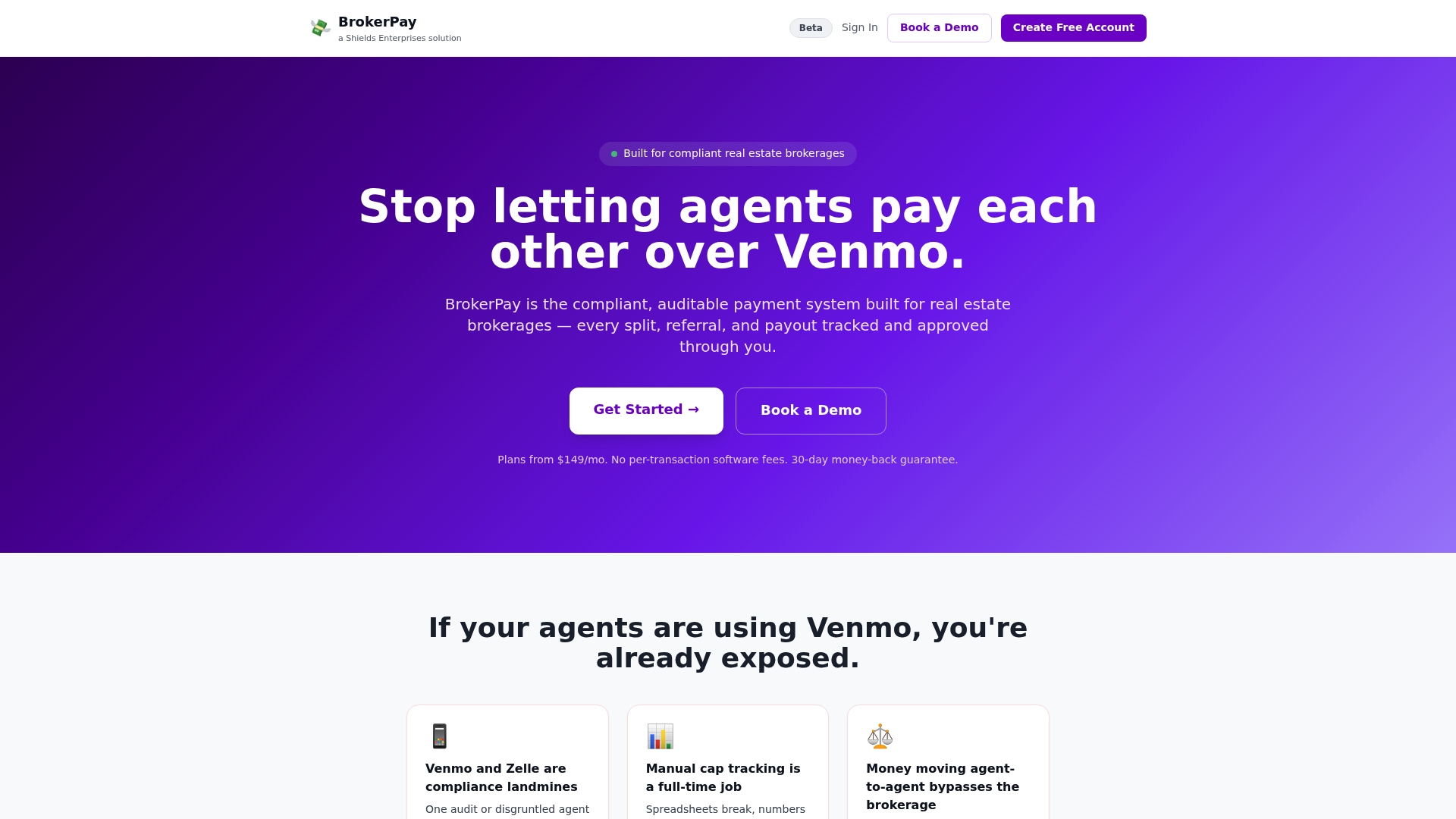
- We route every commission, referral fee, and co-op split through accounts your brokerage controls, not personal payment apps.
- Our audit logs are immutable and versioned, built to hold up under the same scrutiny Regulation X describes.
- We offer plans sized to your agent count, with flat monthly pricing and no per-transaction fees.
If your current process relies on spreadsheets, group texts, or P2P transfers to move commission money, it’s worth seeing what an auditable alternative looks like in practice. Explore BrokerPay’s plans and request a demo to see how the controls above apply to your offices.
This article is general information, not a substitute for advice from a qualified lawyer. Consult a qualified legal professional about your own circumstances before acting on anything here.
FAQ
What makes a broker payment “secure” under RESPA?
A secure broker payment is documented, tied to services actually performed, and routed through brokerage-controlled accounts rather than personal apps. RESPA Section 8 permits cooperative brokerage splits specifically when licensees are performing brokerage services and the payment reflects that work.
Do brokerages need a W-9 before paying a referral fee?
Yes. Brokerages paying cooperative commissions over $600 to non-employees should collect a completed W-9 before payment and report the amount on Form 1099-MISC at year end.
How long should commission records be retained?
Regulatory guidance under 12 CFR §1024.14 points to a five-year retention expectation for records supporting settlement-related payments, including cooperative brokerage splits.
Why are Venmo and Zelle risky for commission payments?
Peer-to-peer apps leave no reliable record of what was paid, to whom, or for what service, which creates problems if a regulator or auditor asks for documentation. They also make W-9 collection and 1099 reporting harder to enforce consistently.
What does BrokerPay cost?
BrokerPay offers Starter, Growth, and Enterprise plans, with pricing details available by visiting the BrokerPay plans page directly, since pricing depends on agent count and office structure.
Sources
- § 1024.14 Prohibition against kickbacks and unearned fees. | Consumer Financial Protection Bureau
- 12 CFR §1024.14 — Prohibition against kickbacks and unearned fees (govinfo)
- IRS requires reporting of cooperative commissions | NAR