Commission Disbursement Authorization: 6 Fields for U.S. Compliance

A commission disbursement authorization, or CDA, is the signed instruction a broker sends to escrow or the closing agent telling them exactly how to split and pay out commission at closing. Once your splits are final, the one thing to do is sign the CDA and get it to escrow right away. NAR guidance and standard escrow procedures both treat this document as the trigger for payment.
TL;DR:
- The broker of record or an authorized office manager typically signs the CDA because the brokerage holds the agreement and carries compliance responsibility.
- Include property and escrow identifiers, each payee’s legal and tax details, exact amounts or percentages, payment instructions, signatures, and release language.
- Finalize every split and referral fee before generating the CDA, then confirm escrow has accepted it before the scheduled disbursement.
- If escrow finds an omission or mismatch, submit a corrected, signed CDA; phone calls, email promises, and informal payment apps cannot replace it.
Table of Contents
- What a commission disbursement authorization is and when you need one
- What fields a CDA needs to include
- How to complete and submit a CDA so closing pays out correctly
- How escrow and title companies process a CDA, and where things go wrong
- Building an audit-ready commission disbursement workflow
- A practitioner’s take on common commission disbursement mistakes
- BrokerPay: a compliant way to document and automate commission disbursement
- FAQ
- Sources
- Primary sources and references
What a commission disbursement authorization is and when you need one
A CDA tells the closing agent who gets paid, how much, and where to send it. Brokers use this form constantly for co-op payments between listing and buyer-side firms, referral fees owed to outside agents, and internal splits between the brokerage and its own agents.
The broker of record or an authorized office manager typically signs the CDA, not the individual agent, since the brokerage holds the listing or buyer agreement and bears the compliance responsibility. When a listing broker is paying a buyer’s broker out of seller proceeds, written seller authorization for that payment should already exist in the listing agreement.
This matters more since 2024. Written buyer agreements are now required before touring a home, and compensation terms must be stated as an objectively ascertainable amount or percentage rather than a range, according to NAR’s guidance on written buyer agreements. Offers of compensation can no longer run through the MLS, which pushes more of the actual payment terms into documents like the CDA and broker-to-broker agreements.
- Co-op commission splits between listing and buyer-side brokerages
- Referral fees owed to an outside agent or brokerage
- Internal agent splits and team-based commission divisions
What fields a CDA needs to include
Escrow and title companies will not process a CDA with gaps. Before you submit one, check that it contains every field they expect to see.
- Property and escrow identifiers: the property address, escrow or file number, and closing date.
- Payee identification: full legal name of each brokerage or individual being paid, license number where applicable, and mailing address.
- Tax and 1099 instructions: the payee’s taxpayer ID or EIN and how the payment should be classified for 1099 reporting.
- Exact payment amounts or percentages: stated as a specific dollar figure or an objectively ascertainable percentage, consistent with how compensation must now be documented under current NAR guidance, never a range.
- Payment method and account details: whether funds go by check or ACH, and the exact payee name the check or deposit should match.
- Signatures, dates, and release language: the broker’s signature, the date, and language authorizing escrow to release funds per the stated instructions.
Accurate tax classification up front also protects agents and brokerages at filing time, a point covered in more detail in our guide to commission tracking and tax issues.
Pro Tip: Double-check that the payee name on the CDA matches the name on file with escrow exactly; a mismatch (LLC versus individual agent, for example) is one of the most common causes of a bounced disbursement.

How to complete and submit a CDA so closing pays out correctly
Timing drives most CDA problems. Produce the document only after every split, referral fee, and co-op arrangement is finalized. A CDA generated too early forces a corrected version later, which slows down closing and creates confusing duplicate paperwork in the file.
Once splits are locked, the transaction coordinator or office admin typically fills in property and payee details, while the broker of record reviews the figures and signs. From there:
- Deliver the signed CDA to escrow or title through your transaction management system, secure upload, or email with read confirmation.
- Confirm the closing agent has received and accepted the document before the scheduled disbursement date.
- Build in a follow-up step to verify the check or ACH transfer actually went out, and capture proof of payment for the file.
- Store the signed CDA and payment confirmation together, since this pairing is what an audit or compliance review will ask for first.
Some brokerages also set internal deadlines around receipt of commission checks, such as requiring deposit within two business days of receipt, to keep trust accounting clean and avoid stale, undeposited funds sitting in the office. Building that kind of deadline into your process, alongside the CDA itself, keeps the full disbursement cycle auditable from signature to deposit.
How escrow and title companies process a CDA, and where things go wrong
Closing agents run a fairly consistent verification process before they release any commission funds. They confirm the CDA matches the signed listing agreement or buyer agreement, check that payee names and tax information are complete, and verify the stated amounts tie out to the closing statement.
Most delays trace back to a handful of avoidable issues:
- Compensation stated as a range instead of a fixed dollar amount or percentage
- A missing broker signature or an unsigned amendment to a prior CDA
- Incomplete payee tax information, which holds up 1099 classification
- A request to route funds through a personal payment app instead of a brokerage or escrow-controlled account
When escrow flags a problem, the fix is a corrected and re-signed CDA, not a phone call or an email promising to follow up later. Escrow companies generally will not disburse against anything less than a clean, signed document, which is why getting the numbers objectively ascertainable and the signatures complete on the first pass matters so much.
Building an audit-ready commission disbursement workflow
In practice, BrokerPay’s co-op payment workflow examples walk through the process, with real scenarios showing how brokerages document splits and referral payments without improvising.
The weak point in most offices is what happens when a CDA process breaks down and someone suggests Venmo or Zelle as a shortcut. Peer-to-peer apps leave no real audit trail, do not enforce approval steps, and create exactly the kind of informal commission handling that regulators and RESPA compliance reviews flag first, as explored further in our piece on commission payment alternatives.
- Generate the CDA only after final splits are confirmed
- Route it through an internal approval step before it reaches escrow
- Store the signed document and payment confirmation together for audit purposes
Pro Tip: Treat every commission payment, no matter how small, as something that needs a documented trail; a $150 referral fee handled off the books is still a compliance exposure.
A practitioner’s take on common commission disbursement mistakes
After watching brokerages work through hundreds of closings, three mistakes show up over and over. First, offices generate the CDA too early, before a referral fee or split is finalized, and end up re-issuing it at the last minute. Second, vague compensation language, like “a range” instead of a fixed figure, stalls escrow every time. Third, brokerages that let agents settle commission disputes through Venmo or Zelle are quietly building a compliance problem they will not notice until someone asks for records.
— Wes
BrokerPay: a compliant way to document and automate commission disbursement
Manual CDAs work, but they depend on someone remembering to generate the form at the right time, chase signatures, and file the payment proof correctly every single time. We built BrokerPay to take that burden off brokerage staff by automating the entire disbursement cycle instead of relying on a spreadsheet and a PDF.
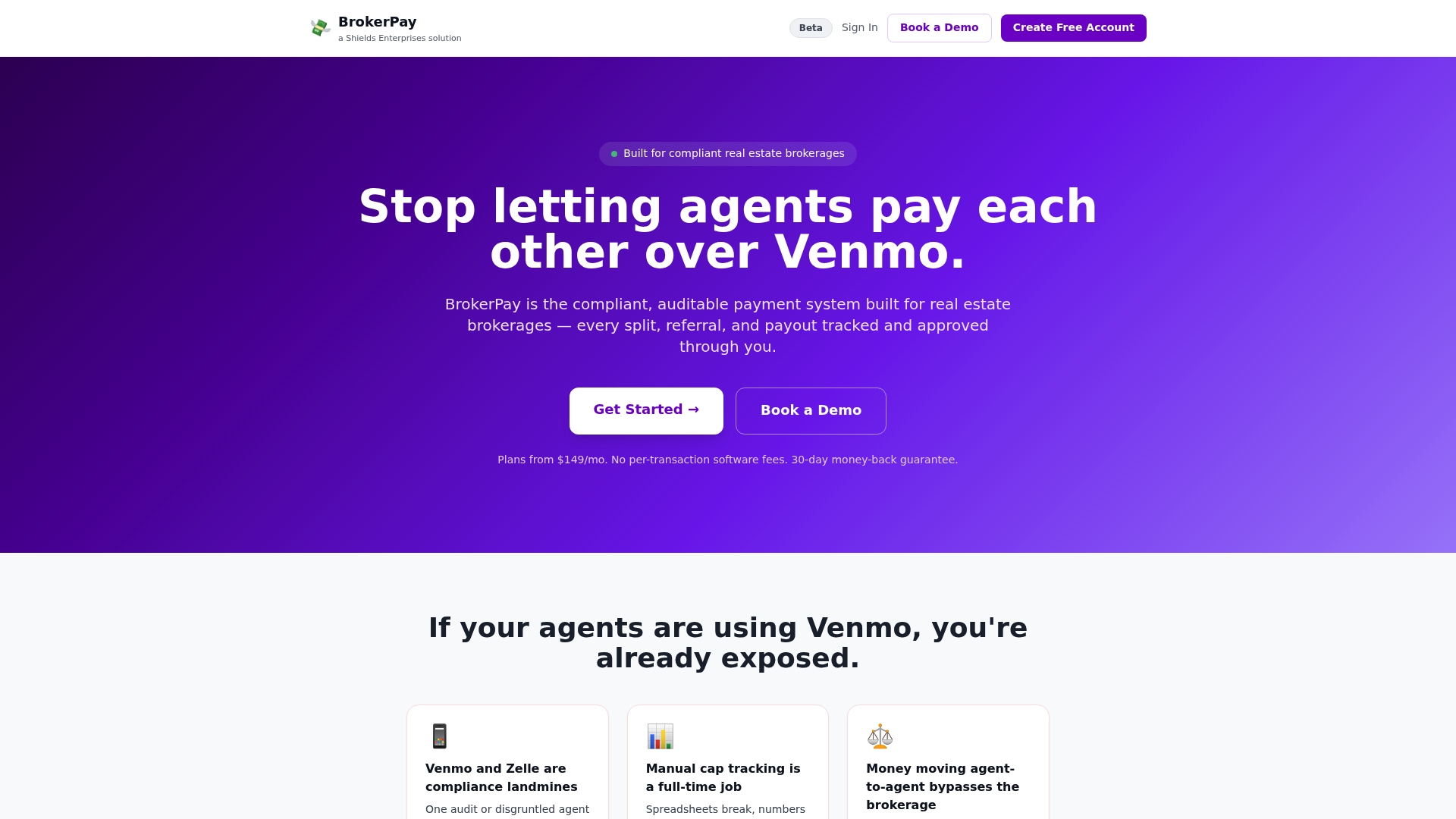
Our platform routes commission splits, referral fees, and co-op payments through accounts controlled by the brokerage, with approval workflows and audit trails attached to transactions. Brokerages with higher transaction volume, multiple offices, or recurring audit exposure benefit from automating tracking because manual methods do not scale past a certain point.
- Approval workflows that replace ad hoc sign-offs with a documented chain
- Audit trails that pair every payment with its authorization automatically
- Cap tracking and co-op payment handling built for brokerage-level accounting
If informal payment apps or manual CDA chasing are creating risk in your office, our Starter, Growth, and Enterprise plans are built to replace that process with one that holds up under review.
FAQ
What is a commission disbursement form?
A commission disbursement form, also called a CDA, is the signed instruction a broker gives to escrow or a title company specifying who gets paid, how much, and by what method at closing. It typically includes payee details, exact amounts or percentages, and authorization language that permits escrow to release funds accordingly.
Under which circumstances would a broker be entitled to a commission?
A broker is generally entitled to a commission when a written agreement, such as a listing agreement or a buyer representation agreement, specifies the compensation terms and the transaction closes under those terms. Since 2024, buyer-side compensation must be documented in a written agreement signed before touring a home, with the amount stated as a fixed figure or percentage rather than a range, per NAR’s guidance.
Can a broker terminate a listing agreement?
Listing agreements typically include termination terms negotiated between the broker and seller, and either party may be able to end the agreement under those specific conditions. The exact process depends on the language in the signed agreement, so brokers and sellers should review the termination clause in their own contract rather than assume a universal rule.
How much would a real estate agent make on a $300,000 house?
Commission amounts are negotiable and vary by brokerage, market, and the specific agreement in place, so there is no fixed percentage that applies universally. As an illustrative example only, commission on a sale would be calculated as a percentage of the sale price before any splits between brokerages or agents, though actual terms depend entirely on what the listing agreement and any buyer agreement specify.
Sources
- Written buyer agreements 101 — NAR
- NAR settlement Frequently Asked Questions (FAQ)
- Broker-to-broker agreements 101 — NAR